Thursday, April 26, 2007

Catastrophes in the Solar System


Earth sits between two worlds that have been devastated by climate catastrophes. In the effort to combat global warming, our neighbours can provide valuable insights into the way climate catastrophes affect planets.

Modelling Earth’s climate to predict its future has assumed tremendous importance in the light of mankind’s influence on the atmosphere. The climate of our two neighbours is in stark contrast to that of our home planet, making data from ESA’s Venus Express and Mars Express invaluable to climate scientists.
Venus is a cloudy inferno whilst Mars is a frigid desert. As current concerns about global warming have now achieved widespread acceptance, pressure has increased on scientists to propose solutions.

The atmosphere of Venus is much thicker than Earth’s. Nevertheless, current climate models can reproduce its present temperature structure well. Now planetary scientists want to turn the clock back to understand why and how Venus changed from its former Earth-like conditions into the inferno of today.

They believe that the planet experienced a runaway greenhouse effect as the Sun gradually heated up. Astronomers believe that the young Sun was dimmer than the present-day Sun by 30 percent. Over the last 4 thousand million years, it has gradually brightened. During this increase, Venus’s surface water evaporated and entered the atmosphere.

“Water vapour is a powerful greenhouse gas and it caused the planet to heat-up even more. This is turn caused more water to evaporate and led to a powerful positive feedback response known as the runaway greenhouse effect.”

As Earth warms in response to manmade pollution, it risks the same fate. Reconstructing the climate of the past on Venus can give scientists a better understanding of how close our planet is to such a catastrophe. However, determining when Venus passed the point of no return is not easy. That’s where ESA’s Venus Express comes in.

The spacecraft is in orbit around Venus collecting data that will help unlock the planet’s past. Venus is losing gas from its atmosphere, so Venus Express is measuring the rate of this loss and the composition of the gas being lost. It also watches the movement of clouds in the planet’s atmosphere. This reveals the way Venus responds to the absorption of sunlight, because the energy from the Sun provides the power that allows the atmosphere to move.

In addition, Venus Express is charting the amount and location of sulphur dioxide in the planet’s atmosphere. Sulphur dioxide is a greenhouse gas and is released by volcanoes on Venus.

What happened on these two worlds is very different but either would be equally disastrous for Earth. We are banking on our ability to accurately predict Earth’s future climate.

Climate catastrophes in the Solar System ESA press release 26 April 2007
_______________________________________________________
_______________________________________________________
Gliese and Earth-like Worlds from Centauri Dreams
NASA's AIM Mission Soars To The Edge Of Space
Satellites Play Vital Role In Understanding The Carbon Cycle
_______________________________________________________
_______________________________________________________

Labels: , ,

Tuesday, November 07, 2006

ESA on Climate Change


_______________________________________________________


The United Nations annual summit on climate change
this week in Nairobi, Kenya, seeks to negotiate a successor to the Kyoto Protocol strategy, which becomes obsolete in 2012, to restrict emissions of heat-trapping gases that drive climate change. ESA joins the activities to share results of its satellite-based Kyoto-supporting services.

Around 25 billion tonnes of extra carbon dioxide is released into the atmosphere annually by human activities, mainly through wildfires, land clearance and the burning of fossil fuels. The total amount of carbon dioxide in the atmosphere has increased by a quarter since the start of the Industrial Revolution 150 years ago.

Carbon-storing forests need mapping for the Kyoto Protocol to work In addition to reducing greenhouse emissions to clear the air of excess carbon dioxide, plant growth absorbs carbon from the atmosphere, so the Protocol includes a mechanism for signatories to offset emissions against increases in the stock of carbon stored in vegetation, especially forests.

What the Protocol requires for such offsetting to take place is annual reporting of land use changes – especially afforestation, reforestation and deforestation (ARD) - associated with shifts in the terrestrial carbon stock, to be carried out at the national level.

ESA has a long-standing commitment to extend the use of satellite data beyond science into operational applications, and in particular to strengthen the effectiveness of international conventions. To this end, a project called GSE Forest Monitoring (GSE-FM), which began in February 2003, integrates the most relevant and recent scientific research and monitoring practices with the latest analytical tools and information technologies aimed at detecting changes in forest area and density in order to establish baselines and projections and estimate averted emissions.

Satellite data enable forecasts for offshore industry
Renewable energy has limitless resources, but harnessing its full potential requires careful management of the fluctuations in the energy source. Earth Observation (EO) from space can assist with timely information on available resources such as met-ocean conditions, solar radiation and snow water content as well as environmental factors affecting the yield such as weather conditions, land cover and surface roughness.

The ability of satellites to deliver synoptic information (providing spatial variability) and long-term time series from the archive (providing temporal variability) make them particularly useful to optimise energy production and complement traditional in-situ measurements, which are costly and provide only local information.

more from ESA at UN Summit on Climate Change 6th Nov 2006
_______________________________________________________
Aeronautics Engineers Design Silent, Eco-friendly Plane
_______________________________________________________

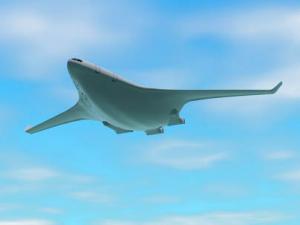
MIT and Cambridge University researchers unveiled the conceptual design for a silent, environmentally friendly passenger plane at a press conference Monday, Nov. 6, at the Royal Aeronautical Society in London.

Public concern about noise is a major constraint on expansion of aircraft operations. The 'silent aircraft' can help address this concern and thus aid in meeting the increasing passenger demand for air transport.

The project aims to develop aircraft by 2030.
The conceptual design addresses both the engines and the structure, or airframe, of a plane. Half of the noise from a landing plane comes from the airframe.

Other key features of the design include:
[] An overall shape that integrates body and wings into a "single" flying wing. As a result, both the body and wings provide lift, allowing a slower approach and takeoff, which would reduce noise. The shape also improves fuel efficiency.
[] The elimination of the flaps, or hinged rear sections on each wing. These are a major source of airframe noise when a plane is taking off and landing.
[] Engines embedded in the aircraft with air intakes on top of the plane rather than underneath each wing. This screens much of the noise from the ground.
[] A variable-size jet nozzle that allows slower jet propulsion during takeoff and landing but efficient cruising at higher speeds.

more from Science Daily releases 7th november 2006
_______________________________________________________
_______________________________________________________
Famous Quotes
Winners never quit and quitters never win.
Vince Lombardi
_______________________________________________________

Labels: ,