Friday, July 27, 2007

Sun shakes Earth's Magnetic Field


Killer electrons from Vimeo. Click on arrows for full screen view

ESA's Cluster Mission helps reveal how the Sun shakes the Earth's magnetic field.

Space is a hostile region for astronauts & satellites. One constituent of this hazardous environment around the Earth are very energetic electrons, able to perturb or permanently damage satellites.

Ultra Low Frequency (ULF) waves, which travel along the Earth's magnetic field lines, are a prime candidate for generating these killer electrons, but the source of these waves remains unclear.
[+/-] Click here to expand

A recent study using ground based instrumentation and a dozen satellites at a range of altitudes, provides a means to trace the energy source of these waves from the solar wind into the Earth's magnetosphere down to the ground.

Part of this satellite constellation, the four spacecraft of the ESA Cluster mission, was located at the border of the magnetosphere and played a major role in discriminating between the various theoretical ULF wave generation scenarios.

Quasi-sinusoidal oscillations of the magnetic field lines with periods of a few minutes were recorded continuously for several hours,
as if a celestial musician had plucked the magnetic field lines or strings of the Earth's magnetic guitar

Several ways of exciting these waves have been proposed. Most of them involve the solar wind as the external driver. The solar wind is a continuous stream of solar particles impacting and shaping the Earth's magnetic environment. However, understanding the global nature of these geomagnetic pulsations and the tracing of the energy transfer from the solar wind to the ground is a difficult task.

It requires a fortuitous alignment of several satellites, together with ground–based instruments to observe the oscillations simultaneously.

More from ESA releases
A space armada and ground based instruments to track ULF waves
Image & Simulation Credit: Andy Kale, University of Alberta
________________________________________________________
________________________________________________________
'Killer' electrons in orbit explained by Heather Catchpole @ Cosmos Magazine
Killer Electrons In Space Are Now Less Mysterious from Science Daily releases

________________________________________________________
________________________________________________________

Labels: , , ,

Monday, January 29, 2007

Earth's Magnetosphere


_______________________________________________________

The magnetosphere of Earth is a region in space whose shape is primarily determined by the distortion of Earth's internal magnetic field and by the solar wind plasma and the interplanetary magnetic field (IMF). In the magnetosphere, a mix of free ions and electrons is held mainly by magnetic and electric forces that are much stronger than gravity and collisions.

On the side facing the Sun, the distance to its boundary (which can vary) is about 70,000 km or between 10 - 12 Earth radii (or RE, where 1 RE=6371 km). The boundary of the magnetosphere "magnetopause" is roughly bullet shaped, about 15 RE abreast of Earth and on the night side (in the "magnetotail" or "geotail") approaching a cylinder with a radius 20-25 RE. The tail region stretches well past 200 RE, and the way it ends is not known.

The neutral gas envelope of Earth ("geocorona") continues to about 4-5 RE, with diminishing density and minimal interaction with the plasmas of the magnetosphere. So does the upwards extension of the ionosphere, known as the plasmasphere.

The internal field of the Earth (its "main field") appears to be generated in the Earth's core by a dynamo process, associated with the circulation of liquid metal in the core, driven by internal heat sources. Its major part resembles the field of a bar magnet ("dipole field") inclined by about 10° to the rotation axis of Earth, but more complex parts ("higher harmonics") also exist, as first shown by Gauss. The dipole field has an intensity of about 30,000-60,000 nanotesla (nT) at the Earth's surface, and its intensity diminishes like the inverse of the cube of the distance.

The solar wind is a fast outflow of hot plasma from the sun in all directions. Above the sun's equator it typically attains 400 km/s; above the sun's poles, up to twice as much. The flow is powered by the million-degree temperature of the sun's corona, for which no generally accepted explanation exists as yet. Its composition resembles that of the Sun - about 95% of the ions are protons, about 4% helium nuclei, with 1% of heavier matter - and enough electrons to keep charge neutrality.

A magnetic tail is formed by solar winds blowing electrified gases, plasma, trapped in a planet's magnetosphere away from the sun. The magnetic tail can extend great distances away from its originating planet. Earth's magnetic tail extends beyond the orbit of the Moon, while Jupiter's magnetic tail is believed to extend beyond the orbit of Saturn. The plasma in the tail is revolving, reaching the end of the tail and then folding back in on itself and returning to the planet it originated from.

There are also gaps in the magnetic tail, called troughs, where no stream of material exists. These troughs change in size and location, and can reconnect at later points in the tail. The night-side magnetic tail can sometimes whip violently back, throwing large amounts of superheated plasma and highly charged particles at the originating planet.

Magnetic fields from currents that circulate in the magnetospheric plasma extend the Earth's magnetism much further in space than would be predicted from the Earth's internal field alone. Such currents also determine the field's structure far from Earth, creating the regions described in the introduction above.

Similarly, in everyday applications, electric currents always require a "voltage" to drive them, a sort of electric pressure difference (a pressure known as "electric potential"), similar to the pressure difference that drives water along a pipe. Ohm's law is observed to hold fairly well in metallic conductors used by electric technology (e.g. wires) and it predicts a current proportional to voltage. Double the voltage and the current doubles, remove it and no current can flow.

Not so in the magnetosphere (and in many plasmas) where currents (with one important exception) need no voltage to drive them. Any electric current is the transport of electric charge, but in many cases, such transport is already implied by the structure of the field and the plasma. For instance, electrons and positive ions trapped in the dipole-like field near the Earth tend to circulate around the magnetic axis of the dipole (the line connecting the magnetic poles), without gaining or losing energy (see "Guiding center motion").

Viewed from above the northern magnetic pole, ions circulate clockwise, electrons counterclockwise, producing a net circulating clockwise current, known (from its shape) as the ring current. No voltage is needed--the current arises naturally from the motion of the ions and electrons in the magnetic field.

Any such current will modify the magnetic field. The ring current, for instance, strengthens the field on its outside, helping expand the size of the magnetosphere. At the same time, it weakens the magnetic field in its interior. In a magnetic storm, plasma is added to the ring current, making it temporarily stronger, and the field at Earth is observed to weaken by up to 1-2%.

The deformation of the magnetic field, and the flow of electric currents in it, are intimately linked, making it often hard to label one as cause and the other as effect. Frequently (as in the magnetopause and the magnetotail) it is intuitively more useful to regard the distribution and flow of plasma as the primary effect, producing the observed magnetic structure, with the associated electric currents just one feature of those structures, more of a consistency requirement of the magnetic structure.

As noted, one exception (at least) exists, a case where voltages do drive currents. That happens with Birkeland currents, which flow from distant space into the near-polar ionosphere, continue at least some distance in the ionosphere, and then return to space. (Part of the current then detours and leaves Earth again along field lines on the morning side, flows across midnight as part of the ring current, then comes back to the ionosphere along field lines on the evening side and rejoins the pattern.) The full circuit of those currents, under various conditions, is still under debate.

Because the ionosphere is an ohmic conductor of sorts, such flow will heat it up. It will also give rise to secondary Hall currents, and accelerate magnetospheric particles - electrons in the arcs of the polar aurora, and singly-ionized oxygen ions (O+) which contribute to the ring current.
_______________________________________________________
_______________________________________________________

Labels: , ,

Wednesday, January 10, 2007

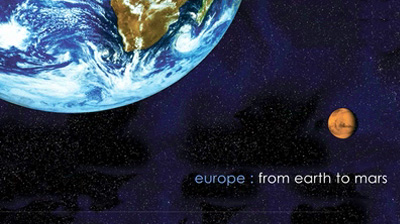
ESA - Earth to Mars


_______________________________________________________


Consultations were hosted by the European Space Agency (ESA) and the British National Space Centre (BNSC) in Edinburgh 8/9th January 2007.

Representatives from the UK and other European political, industrial and scientific sectors, together with members of the general public, the various stakeholder groups in Europe with colleagues from across the world, debated the future long-term exploration of the solar system and beyond.

The UK has a vibrant space science and industrial community that already makes a significant contribution to our knowledge economy. Its experience in developing innovative space technology will continue to ensure the UK plays a leading role in both European and global space exploration in the future.

MoonLITE Credit: SSTL
MoonLITE equipped with missile-shaped penetrators carrying seismometers to investigate the lunar interior and a telecommunications capability to demonstrate high data rate telecoms at the Moon.


Moonraker Credit: SSTL
MoonRaker, a small propulsive Lander to provide in-situ geological dating.
These mission options exemplify the UK's expertise in small satellites, robotics and miniaturised instruments and MoonLITE's telecoms capability could provide a vital contribution to NASA's ambition of establishing a Moon base by 2020.

The UK is already the second largest European contributor to ESA's Aurora programme of planetary exploration and is currently involved in developing an ambitious Mars Rover project that will fly onboard Europe's ExoMars mission to the Red Planet slated for launch in 2013.


_______________________________________________________
ESA's Aurora Mission

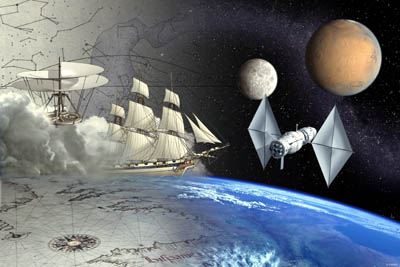
From the dawn of humankind the need to explore has driven expansion across our planet. Today this expansion continues towards other planets in the solar system by means of robotic spacecraft - virtual explorers. But will human expansion continue? In the public consciousness this is only a matter of time. By 2025 an international human mission to Mars may be a reality. It may use the Moon as a way station and to prepare for the great leap. The feasibility of such a mission is being assessed, however, the necessary technology and capability still need to be developed.

Over the next 20 years robotic missions will prepare for human missions, by collecting as much scientific and engineering data as possible, without human scientists in situ. These robotic missions will contribute and demonstrate the technologies needed to put humans on Mars and return them safely to our planet.

Some of the key technologies for a human mission are also very important to the search for life in situ on the red planet and on other solar systems, planets and moons. Soft and precision landing, drilling and sample return, will not just be demonstrated for the sake of technology. These missions will carry sophisticated exobiology payloads and provide answers to some key questions on the origin of life in the solar system and possible causes for its extinction.

A challenging and complex return mission to collect a sample on Mars might also involve our first attempt at interplanetary exploitation. Instead of lugging propellant for the return trip all the way from Earth, the lander systems could include technology that would generate rocket fuel from Martian resources.

Ultimately, though, Mars exploration plans should result in an even greater adventure - a human mission. Astronauts are vastly more capable than even the smartest robot, but they are also vastly more difficult and expensive to transport. Unlike robots, they eat and breath; and if their environment is too uncomfortable, they can become tetchy and depressed. For a human Mars expedition to be possible, new technologies will have to be developed and tested: not only soft-landing methods and in-situ fuel processing, but life-support engineering for a long haul far from home and perhaps entirely new rocket systems, possibly based on new types of propulsion, which will reduce the time spent coasting through space.

By 2025 A human Mars mission, perhaps with the Moon as a first target or even as a way station to the Red Planet, would represent the culmination of the programme's efforts. And just incidentally, it would also guarantee that there was life on Mars: human life.

Read more European workshop on space exploration from ESA
Europe forges long-term strategy for Space Exploration by PPARC
_______________________________________________________
_______________________________________________________

Labels: , , ,

Tuesday, December 12, 2006

Planet Earth


The outermost layer of the atmosphere will lose 3 percent of its density over the coming decade. (Credit: NCAR)
_______________________________________________________

Recent observations by scientists tracking satellite orbits have shown that the thermosphere, which begins about 60 miles above Earth and extends up to 400 miles, is beginning to become less dense, said Robert Kerr, program director in the National Science Foundation's (NSF) Division of Atmospheric Sciences.

At heights of more than 60 miles, one of the main elements of the atmosphere is atomic oxygen, a single atom of oxygen. As carbon dioxide increases near Earth's surface, it gradually diffuses upward and absorbs heat through collisions with atomic oxygen. It then radiates the heat away to space through infrared radiation, and the result is a net cooling of the upper atmosphere. As the molecules cool and settle, the thermosphere loses density.

Also affecting the thermosphere is the 11-year cycle of solar activity. During the active phase of the cycle, ultraviolet light and energetic particles from the sun increase, producing a warming and expansion of the upper atmosphere. When solar activity wanes, the thermosphere settles and cools.

Read more Science Daily releases 12 December 2006
Original Source: National Science Foundation Press Release


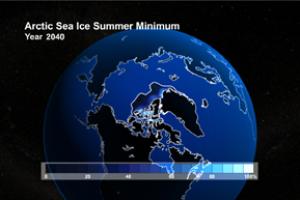
By about 2040, the Arctic may be nearly devoid of sea ice during the late summer unless greenhouse gas emissions are significantly curtailed. (Illustration copyright UCAR)
_______________________________________________________

Arctic sea ice has retreated in recent years, especially in the late summer, when ice thickness and area are at a minimum. To analyze how global warming will affect the ice in coming decades, the team studied a series of seven simulations run on the NCAR-based Community Climate System Model, one of the world's leading tools for studying climate change. The scientists first tested the model by simulating fluctuations in ice cover since 1870, including a significant shrinkage of late-summer ice from 1979 to 2005. The simulations closely matched observations, a sign that the model was accurately capturing the present-day climate variability in the Arctic.

The research team points to several reasons for the abrupt loss of ice in a gradually warming world. Open water absorbs more sunlight than does ice, meaning that the growing regions of ice-free water will accelerate the warming trend. In addition, global climate change is expected to influence ocean circulations and drive warmer ocean currents into the Arctic.

"As the ice retreats, the ocean transports more heat to the Arctic and the open water absorbs more sunlight, further accelerating the rate of warming and leading to the loss of more ice," Holland explains. "This is a positive feedback loop with dramatic implications for the entire Arctic region."

Read more Science Daily releases 12 December 2006
Original Source: The National centre for Atmospheric Research


_______________________________________________________

Climate experts search for answers in the oceans
By absorbing half of the carbon dioxide emitted into the atmosphere, the oceans have a profound influence on climate. However, their ability to take up this carbon dioxide might be impaired as a result of climate change. To determine their response to global warming, ESA has backed two projects that provide systematic data on key oceanic variables – colour and temperature.

Read more ESA News 11th December 2006
_______________________________________________________
_______________________________________________________

Labels: ,