Saturday, February 03, 2007

The Moon & TIME


______________________________________________________
La Luna - copyright - 2005 Jerry Lodriguss

The Moon makes a complete orbit about the Earth with respect to the fixed stars (its sidereal period) approximately once every 27.3 days. However, since the Earth is moving in its orbit about the Sun at the same time, it takes slightly longer for the Moon to show its same phase to Earth, which is about 29.5 days (its synodic period). Unlike most satellites of other planets, the Moon orbits near the ecliptic and not the Earth's equatorial plane.

Most of the tidal effects seen on the Earth are caused by the Moon's gravitational pull, with the Sun making only a small contribution. Tidal effects result in an increase of the mean Earth-Moon distance of about 4 meters per century, or 4 centimetres per year. As a result of the conservation of angular momentum, the increasing semimajor axis of the Moon is accompanied by a gradual slowing of the Earth's rotation by about 0.002 seconds per day per century

How Does Your Brain Tell Time? Study Challenges Theory Of Inner Clock

For decades, scientists have believed that the brain possesses an internal clock that allows it to keep track of time.

The changing colours reflect how a brain cell network evolves over time in response to stimuli. (Credit: Buonomano Lab)

Now a UCLA study in the Feb. 1 edition of Neuron proposes a new model in which a series of physical changes to the brain's cells helps the organ to monitor the passage of time.

The most popular theory assumes that a clock-like mechanism -- which generates and counts regular fixed movements -- underlies timing in the brain. In contrast, Buonomano suggests a physical model that operates without using a clock. He offers an analogy to explain how it works.

"If you toss a pebble into a lake," he explained, "the ripples of water produced by the pebble's impact act like a signature of the pebble's entry time. The farther the ripples travel the more time has passed.

"We propose that a similar process takes place in the brain that allows it to track time," he added. "Every time the brain processes a sensory event, such as a sound or flash of light, it triggers a cascade of reactions between brain cells and their connections. Each reaction leaves a signature that enables the brain-cell network to encode time."

The UCLA team used a computer model to test this theory. By simulating a network of interconnected brain cells in which each connection changed over time in response to stimuli, they were able to show that the network could tell time.

Their simulations indicated that a specific event is encoded within the context of events that precede it. In other words, if one could measure the response of many neurons in the brain to a tone or a flash of light, the response would not only reveal the nature of the event, but the other events that preceded it and when they occurred.

Note: This story has been adapted from a news release
issued by
University of California - Los Angeles.
_____________________________________________________
_____________________________________________________

Labels: , , ,

Wednesday, August 09, 2006

HyperPhysics Time

Before a time classified as a Planck time, 10 to the -43 seconds, all of the four fundamental forces are presumed to have been unified into one force. All matter, energy, space and time are presumed to have exploded outward from the original singularity. Nothing is known of this period.

Quark Confinement
When the expansion of the "primordial fireball" had cooled it to 1013 Kelvin, a time modeled to be about 10 to the -6 seconds, the collision energies had dropped to about 1 GeV and quarks could finally hang onto each other to form individual protons and neutrons (and presumably other baryons.) At this time, all the kinds of particles which are a part of the present universe were in existence, even though the temperature was still much too high for the formation of nuclei. At this point we can join the standard "big bang" model as outlined by Steven Weinberg in The First Three Minutes.

http://hyperphysics.phy-astr.gsu.edu/hbase/astro/planck.html#c2

Of course these are models, and the maths & physics are constructed retrospectively to fit the model. Are we at risk of creating an illusory universe of maths & data to fit the model, rather than discover the maths and data to explain the reality.


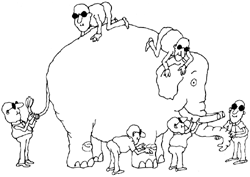
the-intuitive-self has often been used to explain the problem posed when people are tackling a larger problem, like scientists trying to describe the Universe. All these blind men are using earth time (the shades), as the common measure, that is time as we know it on earth as if earth were the centre of the universe of time. I propose these blind men represent what it would be like to measure time from different parts of said universe. Time would look different to each blind man. And their cosmological event horizon would also look different to each blind man.
The one looking at the tail is Sean Carrol from cosmicvariance
Watch out Sean the elephant is about to take a dump.
_______________________________________________
How do we measure time.
We modern earthlings measure time by the revolutions of earth on its axis around the annual orbit around the Sun.
So let us wind back time <<< >>>
the planets disappear, the Sun disappears
Then, what do we use to measure time, what is the measure of time prior to the Solar year.

International Atomic Time
TAI, from the French name Temps Atomique International, is a high-precision atomic time standard that tracks proper time on Earth's geoid. It is the principal realisation of Terrestrial Time, and the basis for Coordinated Universal Time which is used for civil timekeeping all over the Earth's surface.
Time coordinates on the TAI scales are conventionally specified using traditional means of specifying days, carried over from non-uniform time standards based on the rotation of the Earth. Specifically, both Julian Dates and the Gregorian calendar are used. TAI in this form was synchronised with Universal Time at the beginning of 1958, and the two have drifted apart ever since. As of 2006 TAI is about 33 s ahead of Universal Time.

One thing is to discover 'reveal' or even 'create' (?) new chemicals & compounds
One thing is to discover 'reveal' or even 'create' (?) new or rather old particles

Another thing altogether is that somehow these revelations actually tell us the true age of the Universe. When did the Solar year become the Solar year as we know it. When did our Solar system slow to the speed we are measuring time at.

Is Time on Earth measured the same as Time on the other side of the universe, and how can we know since we cannot see the other side of the universe, we cannot see or measure beyond our very own earth related cosmic event horizon.
Even Time on other planets in our Solar system is different to time on Earth. We enforce our perspective of time on those planets. But if we made our calculations of time from Venus, Mars or Jupiter according to local time, the measure of time would not be that which we know it by. We would define it by the measure of revolutions of those planets in one solar year or annual orbit. And the ensuing maths would in no way necessarily match our earthly perception of the universe, it could be something totally other.

Look at the Grand Canyon and you look at the inmensity of time, but is/was time the same measure as that which we measure it by today. Of course geologists and geophysicists can accurately measure data with instruments 'created' retrospectively to reveal data and to validate data. But there is no proof that that data is verifiably so, other than the instruments and maths 'created' to verify it as so. Now I am not saying the data is wrong, I am saying the information in the data, and the translation of that data could be wrong or widely inaccurate.
Look at the Blue Mountains and you have exactly the same incidence. You can reveal places to be 90 million years or 340 million years old, not a small or insignificant margin of difference. Should this margin exist, if our scientific knowledge, data & instrumentation is that 'accurate'
______________________________________________________
______________________________________________________

Labels: , ,