Saturday, September 08, 2007

Akari Galaxy Image M101


M101 is a spiral galaxy twice the size of our own Galaxy, 170 000 light-years in diameter, near the tail of the Great Bear constellation. AKARI’s new observations reveal differing populations of stars spread across its spiral arms.

Using the AKARI space infrared telescope, astronomers have been able to find the warm dust heated by the birth of stars like our Sun in M101, and cooler dust heated by stars more like the present-day Sun.

The image shows the visible light (green), the far-ultraviolet light (cyan) from young stars, the warm dust (red) and the cooler dust (blue). This warm dust is mainly along the spiral arms, with hot spots along the galaxy's outer edge. These hot spots are giant star-forming regions, and it is unusual to find these on the edges of a galaxy.

Commenting on this image Dr Stephen Serjeant from The Open University said, "The evidence points to M101 having experienced a close encounter or near collision with a neighbour or companion galaxy, and it could be that it yanked material out of its neighbour which is now raining down on one side of galaxy and triggering this star formation."

Galaxies near and far from Akari - In Depth Article - from ESA
_________________________________________________________
_________________________________________________________

Labels: , ,

Thursday, July 12, 2007

The Galactic Plane in infrared


Click on Image to Enlarge

The emission of the cold dust and gas is invisible to us when observed in normal light, however, this material instead emits at longer wavelength infrared light. Thus, observations of the sky in infrared light can tell us where and how this invisible gas and dust are distributed across the Galaxy. In the regions where stars are actively being formed, the dust is warmed up by the stellar light and also emits in infrared light. Therefore, by tracing this infrared emission we can search for and study the site of current active star formation in our Galaxy.

The stars that we see in the visible images of our Galaxy represent only a fraction of the total material of our Milky Way. In addition there are copious amounts of cold gas and dust existing at temperatures below -200 C. The distribution of this cold gas and dust is not uniform. High density regions gravitationally attract more and more matter from the surrounding regions, until eventually stars are formed.

More stunning images of the Orion Region, Cignus-X Region, and the Large Magellanic Cloud from Akari Results July 2007
________________________________________________________
________________________________________________________
Planetary Debris and its effects from Centauri Dreams
Star Surface Polluted by Planetary Debris ESO Science Release
Astronomers Get Better View Of Density Waves In Galaxies @ Science Daily
________________________________________________________
________________________________________________________

Labels: , ,

Monday, March 26, 2007

Akari Results


Wealth of new results from AKARI infrared sky-surveyor
This artist’s concept illustrates the possible structure of the central core of the galaxy UGC05101 situated in the constellation Ursa Major , approximately 550 million light years away from the Earth. Termed an ‘ultraluminous infrared galaxy,’ the total energy it emits in the infrared alone is about one trillion times more than the that of the Sun. However, the central region is covered by a thick interstellar medium and can only be observed in the Infrared. Observations with AKARI have revealed evidence for active phenomena in the central part of this galaxy.

It has been postulated that at the centre of UGC05101 is a giant black hole, of mass more than a million times that of our Sun. In this case, the material around it would be expected to radiate enormous amounts of energy as it slowly tumbles into the black hole.

Credits: JAXA
_______________________________________________________
_______________________________________________________
Scientists Compute Death Throes Of White Dwarf Star In 3D
The Purple Rose of Virgo VLT Image of Bright Supernova - from ESO
_______________________________________________________
_______________________________________________________

Labels: , , ,

Wednesday, November 01, 2006

Star formation at work


ENLARGE Image
AKARI's Infrared Camera (IRC), provides a close-up view of part of the Large Magellanic Cloud.

This false-colour composite image was taken by the AKARI satellite in near- and mid-infrared wavelengths (3, 7 and 11 microns), and shows a portion of the Large Magellanic Cloud.

This galaxy, a place of intense star formation, was observed by AKARI during its whole-sky survey and, for this image, during detailed observations.

This image shows many old stars (visible as white dots) in addition to the interstellar clouds. It enables astronomers to study the way stars recycle their constituent gases and return them to the interstellar medium at the end of their lives.

These and new data obtained by AKARI will unlock the secrets of how both the Large Magellanic Cloud and our own Galaxy have formed and evolved to their current state.
_______________________________________________________

AKARI's Far-infrared view of
the Large Magellanic Cloud
ENLARGE Image
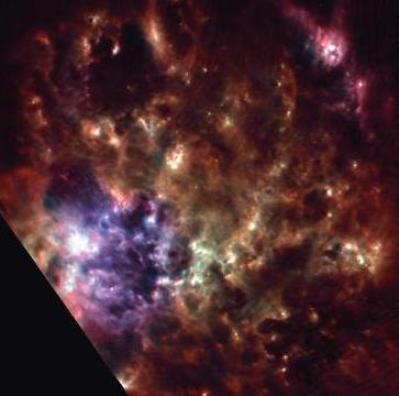
The Large Magellanic Cloud is a neighbouring galaxy to the Milky Way, the galaxy to which our Solar System belongs. It is located extremely close by astronomical standards, at a distance of 160 000 light years and it contains about 10 thousand million stars, about one tenth of our Galaxy's stellar population.

The image is a far-infrared (60, 90 and 140 microns) view obtained by the Far-Infrared Surveyor (FIS) instrument on board AKARI. It reveals the distribution of interstellar matter – dust and gas – over the entire galaxy. Dust grains in these interstellar clouds are heated by the light from newly born stars, and subsequently re-radiate this energy in the form of infrared light. So, the infrared emission indicates that many stars are currently being formed. Such copious star formation activity across a whole galaxy is called a 'star burst'.

The nature of the Large Magellanic Cloud is further revealed by the contrasting distribution of the interstellar matter and the stars. The interstellar matter forms a disk-like structure whilst the stars are located in the 'spindle' shape in the lower half of the image. This shows that the two components are clearly displaced from one another.

Astronomers believe that the observed star formation and the displacement of these two components in the Large Magellanic Cloud were both triggered by the gravitational force generated by our own Galaxy, the Milky Way.

The bright region in the bottom-left of the image is known as the 'Tarantula Nebula'. It is a very productive factory of stars.


The Large Magellanic
Cloud in visible light
Click to ENLARGE

ESA International
1st November 2006
Press Release
more from PPARC
_______________________________________________________
Micrometre: a measurement for wavelengths of infrared radiation.
Some people in astronomy and the semiconductor business use the old name micron
Distances shorter than 1 µm 1 micrometre (micron)
Items with lengths between 1-10 µm (microns)
1.55 µm — wavelength of
light used in optical fibre
6 µm —
anthrax spore
6-8 µm — diameter of a human
red blood cell
7 µm — diameter of the
nucleus of typical eukaryotic cell
7 µm — width of strand of
spider web
1-10 µm — diameter of typical
bacterium
about 10 µm — size of a
fog, mist or cloud water droplet
Distances longer than 10 µm
_______________________________________________________
Science Daily: Large & small stars in Harmonious coexistence
_______________________________________________________
_______________________________________________________
Famous Quotes Even though your kids will consistently
do the exact opposite of what you're telling them to do,
you have to keep loving them just as much. Bill Cosby
_______________________________________________________

Labels: , ,