Friday, August 10, 2007

Supernova factory


The largest known swarm of red supergiant stars has been found near the central bulge of our galaxy. It offers a rare glimpse of massive stars on the verge of exploding.

Red supergiants are among the largest stars in the universe – and in fact are second in size only to rare 'hypergiant' stars such Eta Carinae. Spanning several hundred times the diameter of the Sun, each could fit millions of Sun-like stars inside it.

These stellar titans are extremely rare. Only very massive stars, more than 10 times as heavy as the Sun, turn into red supergiants. And the red supergiant phase lasts just 100,000 years before ending in a supernova, a fleeting moment compared to the overall lifespan of the star
[+/-] Click here to expand

Only about 200 red supergiants have been identified in our galaxy.
In 2006, a team led by Don Figer of the Rochester Institute of Technology (RIT) in New York, NY, US, reported finding a massive cluster of thousands of stars that included 14 red supergiants – the biggest collection of these rare stars then known.
Now, Ben Davies, also of RIT, and a team that includes Figer have identified an even larger group of 26 red supergiants.

'Supernova factory'
The stars were revealed to have the characteristic light spectrum of red supergiants by the Keck II telescope atop Mauna Kea in Hawaii. The cluster has been named RSGC2, and contains about 50,000 stars, making it one of the largest clusters of young stars in the galaxy. The team believes the cluster is less than 20 million years old.

The masses of the supergiants in the cluster are uncertain, but the brightest among them is 300,000 times as luminous as the Sun. RSGC2 was found just a few hundred light years from the one found in 2006, called RSGC1, and the two are very similar in age.

The close proximity of the two massive clusters is probably not a coincidence. There are other signs of copious star formation in their vicinity, a region where one of the galaxy's spiral arms, called Scutum-Crux, meets the central bulge of the galaxy.

"There might be something to do with the physical conditions there where they meet that makes it ripe for forming stars and forming massive clusters," Davies said.

The two red supergiant clusters provide a rare opportunity to study the properties of stars that are very close to exploding.

Ben Davies, Don F.Figer, R. Kudritzki et al., 2007: 'A massive cluster of Red Supergiants at the base of the Scutum-Crux arm' -- accepted to ApJ

______________________________________________________
______________________________________________________

Labels: , ,

Thursday, July 12, 2007

The Galactic Plane in infrared


Click on Image to Enlarge

The emission of the cold dust and gas is invisible to us when observed in normal light, however, this material instead emits at longer wavelength infrared light. Thus, observations of the sky in infrared light can tell us where and how this invisible gas and dust are distributed across the Galaxy. In the regions where stars are actively being formed, the dust is warmed up by the stellar light and also emits in infrared light. Therefore, by tracing this infrared emission we can search for and study the site of current active star formation in our Galaxy.

The stars that we see in the visible images of our Galaxy represent only a fraction of the total material of our Milky Way. In addition there are copious amounts of cold gas and dust existing at temperatures below -200 C. The distribution of this cold gas and dust is not uniform. High density regions gravitationally attract more and more matter from the surrounding regions, until eventually stars are formed.

More stunning images of the Orion Region, Cignus-X Region, and the Large Magellanic Cloud from Akari Results July 2007
________________________________________________________
________________________________________________________
Planetary Debris and its effects from Centauri Dreams
Star Surface Polluted by Planetary Debris ESO Science Release
Astronomers Get Better View Of Density Waves In Galaxies @ Science Daily
________________________________________________________
________________________________________________________

Labels: , ,

Monday, May 21, 2007

Solar System goes for a Ride


When Galaxies Collide, our Solar System Will Go for a Ride

====

Illustration: NASA/CXC/M.Weiss

For decades, astronomers have known that the Milky Way galaxy is on a collision course with the neighboring Andromeda spiral galaxy. What was unknown until now: the fate of the Sun and our solar system in that melee. New calculations by theorists T.J. Cox and Avi Loeb (Harvard-Smithsonian Center for Astrophysics) show that the Sun and its planets will be exiled to the outer reaches of the merged galaxy. Moreover, the collision will take place within the Sun's lifetime, before it becomes a burned-out white dwarf star.

"You could say that we're being sent to a retirement home in the country," said Cox. "We're living in the suburbs of the Milky Way right now, but we're likely to move much farther out after the coming cosmic smash-up."

Computer simulations by Cox and Loeb show that big changes are coming in only 2 billion years, when the Milky Way and Andromeda experience their first close pass. A viewer on Earth would see the night sky evolve from a strip of stars (the Milky Way seen edge-on) to a muddled mess as Andromeda's powerful pull flings stars from their stately orbits.

At that time, the Sun will still be a hydrogen-burning main-sequence star, although it will have brightened and heated enough to boil the oceans from the Earth.

The two galaxies will swing around each other a couple of times, intermingling their stars as gravitational forces stir them together. CfA animation movie

About 5 billion years from now, Andromeda and the Milky Way will have completely combined to form a single, football-shaped elliptical galaxy. The Sun will be an aging star nearing the red giant phase and the end of its lifetime. It and the solar system likely will reside 100,000 light-years from the center of the new galaxy - 4 times further than the current 25,000 light-year distance.

Any descendants of humans observing the future sky will experience a very different view. The strip of Milky Way will be gone, replaced by a huge bulge of billions of stars. Future scientists may look back on today's research as the first prediction of things to come.

"This is the first paper in my publication record that has a chance of being cited five billion years from now," joked Loeb.

The paper describing this research has been submitted for publication to the Monthly Notices of the Royal Astronomical Society.
________________________________________________________
________________________________________________________
A Galactic Collision, and the Sun’s Future from Centauri Dreams
________________________________________________________
________________________________________________________

Labels: , , ,

Saturday, February 24, 2007

Mystery over Australia


_________________________________________
Mystery Over Australia. Credit & Copyright: Ray Palmer

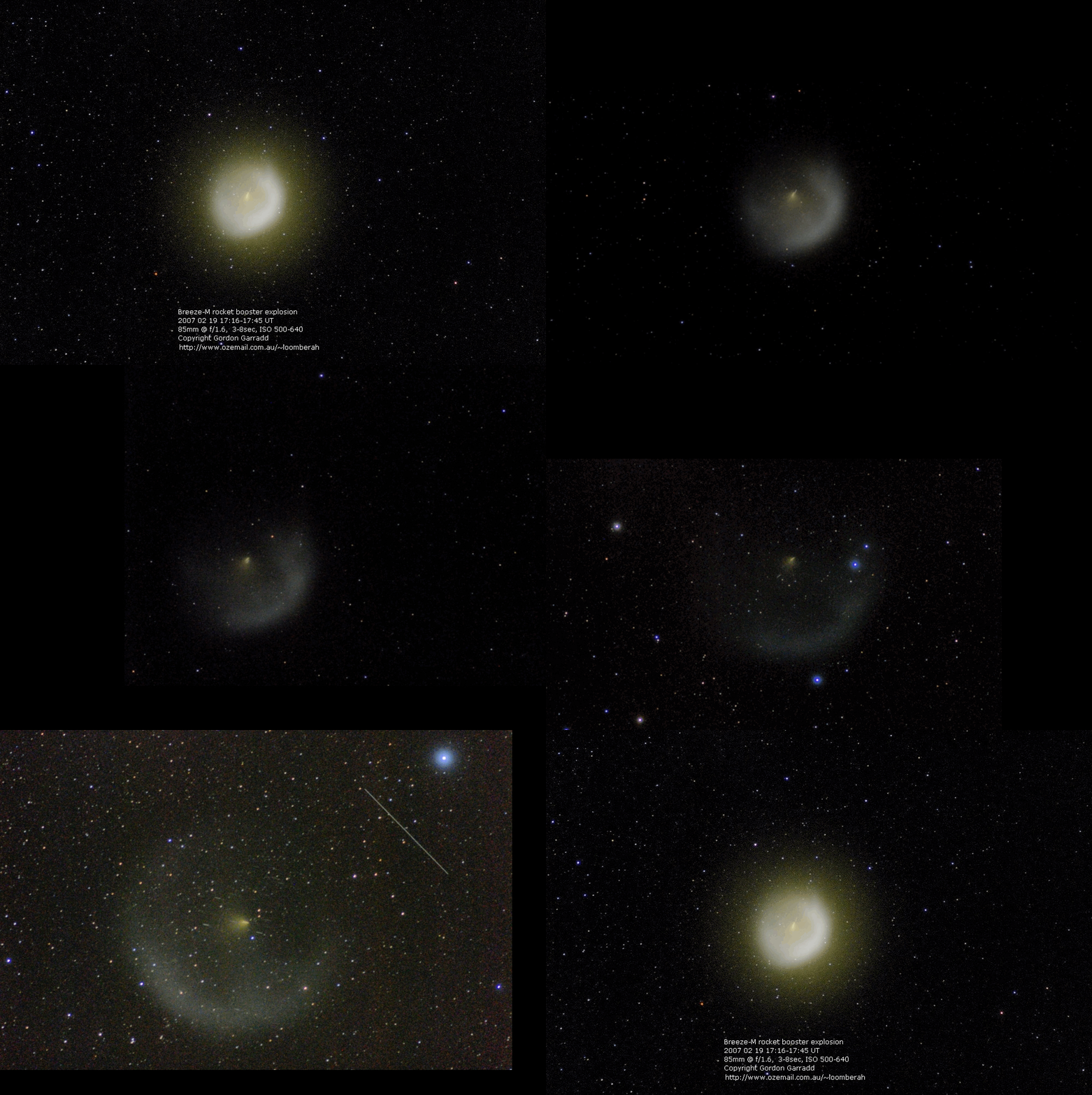
Click on Image to enlarge this stunning view through dark skies over western Australia and the highlights of the southern Milky Way -- including the famous Southern Cross, the dark Coal Sack Nebula, and bright reddish emission regions surrounding massive star Eta Carinae.

The thirty minute long colour film exposure also captured a bright but mysterious object that moved slowly across the sky for over an hour. Widely seen, the object began as a small point and expanded as it tracked toward the North (left), resulting in a comet-like appearance in this picture. What was it?

Reports are now identifying the mystery glow with a plume from the explosion of a malfunctioned Russian rocket stage partially filled with fuel. The rocket stage was marooned in Earth orbit after a failed communication satellite launch almost a year ago on February 28, 2006. A substantial amount of debris from the breakup can be tracked.

Discover the Cosmos with Astronomy Picture of the Day
20MB Video with spectacular explosion from Gordon Garradd
_______________________________________________________
Currently there are approximately 2465 artificial satellites orbiting the Earth and 6216 pieces of space debris as tracked by the Goddard Space Flight Center. Over 16,291 previously launched objects have decayed into the Earth's atmosphere.

Potentially Hazardous Asteroids (PHAs) are space rocks larger than approximately 100m that can come closer to Earth than 0.05 AU. None of the known PHAs is on a collision course with our planet, although astronomers are finding new ones all the time. On 24 Feb 2007 there were 846 known PHAs

Wishing You All A Magical weekend!
_______________________________________________________
_______________________________________________________

Labels: , , ,

Saturday, February 10, 2007

Galactic Centre


______________________________________________________
Stars of the Galactic Center - Credit: Susan Stolovy (SSC/Caltech) et al., JPL-Caltech, NASA

The center of our Milky Way is hidden from the prying eyes of optical telescopes by clouds of obscuring dust and gas.

But in this stunning vista, the Spitzer Space Telescope's infrared cameras, penetrate much of the dust revealing the stars of the crowded galactic center region. A mosaic of many smaller snapshots, the detailed, false-color image shows older, cool stars in bluish hues. Reddish glowing dust clouds are associated with young, hot stars in stellar nurseries. The galactic center lies some 26,000 light-years away, toward the constellation Sagittarius.

At that distance, this picture spans about 900 light-years.

______________________________________________________
Discover the Cosmos with Astronomy Picture of The Day
A Cold, Bright Universe from Centauri Dreams
Magnetic Explosions In The Distant Universe from Science Daily
Hubble illuminates large Cluster of Diverse Galaxies Hubblesite.
______________________________________________________
______________________________________________________

Labels: , , ,

Tuesday, January 16, 2007

Milky Way family grows


Like a Goddess, the Milky Way is truly something to be awed by. We live in a disk of stars so vast, that if our Sun was the size of the dot of an "i" on this page, the Milky Way would stretch from Los Angeles to New York City. Hundreds of billions of stars, our Sun among them, orbit around the dense center of our galaxy, passing in and out of giant dust clouds, the debris of the lives of the stars.

Residing in the outskirts of the Milky Way, our Sun takes 226 million years to make one orbit around the dense center of the galaxy. Even so, our motion is far from leisurely. The Sun, along with all our planets, is moving at well over 400,000 miles per hour around a bulging central swarm of millions of stars concealing a supermassive black hole in their midst. And we are part of all this. Some of the stars we see in the sky, although we don't know which ones, formed out of the same birth cloud the Sun did. Other stars, long dead, seeded our solar system with the rich chemicals needed to form life.

Not only does the Sun belong to a vast extended family, but the Milky Way does as well. Take a fairly basic question: what is the closest galaxy to our own? A lot of people might say the Andromeda Galaxy, which is, in fact, the closest large spiral to us, about two million light-years away. Andromeda is so close, in fact, that it is gravitationally bound to the Milky Way, and is one of the only galaxies in the sky that is moving toward us. Other, somewhat more astronomically savvy people might name the Magellanic Clouds as the closest galaxies. The Large and Small Magellanic Clouds are two small, blobby galaxies that actually orbit the Milky Way, and are about 180,000 and 210,000 light-years away, respectively.

And up until the last few years, everyone seemed pretty pleased with this answer; after all, these were the closest galaxies we could see in the sky. But we were wrong to trust our eyes. As it turns out, there are at least two other galaxies that are much, much closer. Part of the reason we missed them, in fact, is that they are so close; they are actually colliding with the disk of the Milky Way. In a very real way, they snuck up from behind us, hiding behind the stars, dust, and gas that fill the volume of the Milky Way's disk.

So how could we have missed two entire galaxies that are colliding with us? The answer has a lot to do with how we know we live in a spiral galaxy in the first place. I mean, you can't look up into the sky and see the spiral structure of our galaxy, so how do we know it's there? Most people are familiar with the dim, blurry band of light that crosses the sky, which ancient people from several cultures likened to a path of milk. This "Milky Way" is actually the combined light of billions of stars in the plane of our galaxy, and people from at least the eighteenth century have realized that our galaxy has a flattened shape.

The Milky Way: a Growing Galactic Family
by Michelle Thaller @ Spitzer Science Centre


_______________________________________________________
Credit: Vasily Belokurov, SDSS-II Collaboration and reproduced by permission,
copyright 2007, Astronomy magazine, Kalmbach Publishing Co.


Seven or Eight Dwarf Galaxies Discovered Orbiting the Milky Way
The discovery was announced 9 January 2007, during a press conference at the American Astronomical Society's meeting in Seattle, Washington. The galaxies were discovered as part of the Sloan Digital Sky Survey (SDSS-II), the most ambitious survey of the sky ever undertaken.

These dwarf galaxies have been captured by the gravity of the Milky Way and most eventually will merge with our own galaxy.

Dwarf galaxies contain, at most, a few million stars. The new dwarfs have some unusual properties. Several of the newly discovered systems appear to be on the verge of disruption, probably by the tidal gravity of the Milky Way - and the 'Ursa Major II' dwarf already seems to be in several pieces. "They look as though they're being ground up"

Current theories of galaxy assembly suggest that many - perhaps all - of the stars in the halo and thick disk of the Milky Way originated in smaller dwarf galaxies, which were dissolved when they merged into the Milky Way itself.

The new dwarfs are really just the crumbs from the galactic feast. "Most of the merging happened early on - billions of years ago - and what we're seeing here are the leftovers."
_______________________________________________________
_______________________________________________________
Famous Quotes: Justice is truth in action. Benjamin Disraeli
_______________________________________________________
_______________________________________________________

Labels: , ,

Friday, November 03, 2006

Cosmic Bubble


_______________________________________________________
Image courtesy of NRAO/AUI and Jayanne English (U. Manitoba)
& Jeroen Stil, supported by Russ Taylor (U. Calgary); NRAO/AUI & MSX

A Majestic Gas Shell Revealed by the VLA.
ENLARGE Image
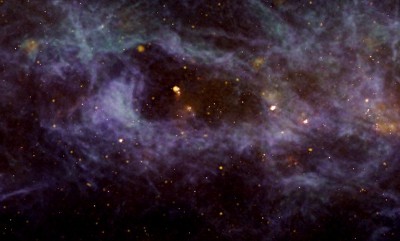
What appears to be the hole of an elongated smoke ring in this National Radio Astronomy Observatory image really is an enormous, nearly empty, bubble blown into the dusty, gas disk of our Milky Way Galaxy.

Such interstellar bubbles are sculpted by the force of the wind and radiation from typically a few dozen hot, massive stars along with the explosive impact of dying stars which are called supernovae. The force sweeps up the disk's gas that is in its path, creating a gas shell surrounding a bubble.

The neighbourhood of our own solar system resides in such a cavity. However the shell in this image, catalogued (using its coordinates) as galactic shell GS 62.1+0.2-18, is located at a distance of 30,000 light years from Earth, and measures 1,100 by 520 light years. Despite its distance, this "smoke ring" appears so large on the sky that the apparent width of the full moon would fit eight times inside it.

The bright yellowish-orange dots scattered across this image are clusters of young, massive stars surrounded by hot gas and are called nebulae. Astronomers from the International/VLA Galactic Plane Survey have determined that none of these clusters harbor the stars that blew the giant shell since none of the clusters are at the same distance as the shell.

Indeed they all are located closer to the Earth than the shell is.

Probably, the stars that blew GS 62.1+0.2-18's hole perished as supernova explosions. This image shows only a small part of a survey which uses both the Very Large Array and the Green Bank Telescopes to trace, in detail, the cool gas in our Galaxy. This gas has been coloured purple, blue and green in this image.

In order to show the locations of star clusters, the image of gas was overlaid with 2 additional images. The one of radio emission associated with regions of hot gas was coloured orange, while heated dust, imaged in infrared by the Midcourse Space Experiment satellite, was coloured red.

Cosmic Bubble Image Wins NRAO Contest
This study is published by VGPS investigators in the Astronomical Journal,
Volume 132, number 3, page 1158.
Investigator(s): J. M. Stil, A. R. Taylor, J. M. Dickey, D. W. Kavars, P. G. Martin, T. A. Rothwell, A. I. Boothroyd, Felix J. Lockman, and N. M. McClure-Griffiths

_______________________________________________________

VLA Discovers
Giant Rings
Around
Galaxy Cluster

Astronomers using the National Science Foundation's Very Large Array (VLA) radio telescope have discovered giant, ring-like structures around a cluster of galaxies. The discovery provides tantalizing new information about how such galaxy clusters are assembled, about magnetic fields in the vast spaces between galaxy clusters, and possibly about the origin of cosmic rays.

These giant, radio-emitting rings probably are the result of shock waves caused by violent collisions of smaller groups of galaxies within the cluster

The newly-discovered ring segments, some 6 million light-years across, surround a galaxy cluster called Abell 3376, more than 600 million light-years from Earth. They were revealed because fast-moving electrons emitted radio waves as they spiraled around magnetic field lines in intergalactic space.

Read more NRAO Ring Cluster release 03 Nov 2006
_______________________________________________________
Understanding the Tonal by Plato
Bursting bubbles of new universes by Plato
Super-supermassive Black-hole from Universe Today
_______________________________________________________
_______________________________________________________
Almost famous Quote: “It’s certainly true that we don’t yet know whether the universe is eternal or whether it had a beginning, and we certainly don’t understand the details of its origin.” “The truth is, we just don’t know. I’m guessing eternal, but we just don’t know.”
Sean Carroll @ Cosmic Variance
_______________________________________________________
Famous Quotes
Always remember that you are absolutely unique.
Just like everyone else. Margaret Mead
_______________________________________________________

Labels: ,

Monday, October 30, 2006

Galactic Snake


_______________________________________________________
Where Galactic snakes live High Resolution Image

Snake on a Galactic Plane!
Animated Galactic Snake
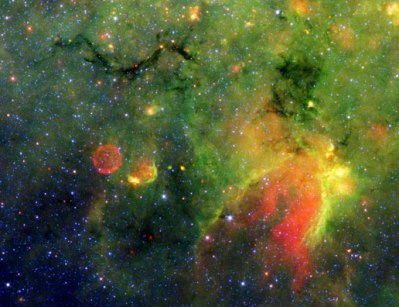
Something scary appears to be slithering across the plane of our Milky Way galaxy in this new Halloween image from NASA's Spitzer Space Telescope. The snake-like object is actually the core of a thick, sooty cloud large enough to swallow dozens of solar systems. In fact, astronomers say its "belly" may be harboring beastly stars in the process of forming.

This infrared image from NASA's Spitzer Space Telescope shows what astronomers are referring to as a "snake" (upper left) and its surrounding stormy environment.

The galactic creepy crawler to the right of the snake is another thick cloud core, in which additional burgeoning massive stars might be lurking. The colorful regions below the two cloud cores are less dense cloud material, in which dust has been heated by starlight and glows with infrared light. Yellow and orange dots throughout the image are monstrous developing stars; the red star on the "belly" of the snake is 20 to 50 times as massive as our sun. The blue dots are foreground stars.

The red ball at the bottom left is a "supernova remnant," the remains of massive star that died in a fiery blast. Astronomers speculate that radiation and winds from the star before it died, in addition to a shock wave created when it exploded, might have played a role in creating the snake.

Spitzer was able to spot the two black cloud cores using its heat-seeking infrared vision. The objects are hiding in the dusty plane of our Milky Way galaxy, invisible to optical telescopes. Because their heat, or infrared light, can sneak through the dust, they first showed up in infrared images from past missions. The cloud cores are so thick with dust that if you were to somehow transport yourself into the middle of them, you would see nothing but black, not even a star in the sky. Now, that's spooky!

Spitzer's new view of the region provides the best look yet at the massive embryonic stars hiding inside the snake. Astronomers say these observations will ultimately help them better understand how massive stars form. By studying the clustering and range of masses of the stellar embryos, they hope to determine if the stars were born in the same way that our low-mass sun was formed -- out of a collapsing cloud of gas and dust -- or by another mechanism in which the environment plays a larger role.

The snake is located about 11,000 light-years away in the constellation Sagittarius. This false-color image is a composite of infrared data taken by Spitzer's infrared array camera and multiband imaging photometer. Blue represents 3.6-micron light; green shows light of 8 microns; and red is 24-micron light.
NASA news 27th October 2006
_______________________________________________________
Light Echo from Star V838 Monocerotis
_______________________________________________________

Echos.of.Light
ENLARGE.Image
These are the most recent NASA Hubble Space Telescope views of an unusual phenomenon in space called a light echo. Light from a star that erupted nearly five years ago continues propagating outward through a cloud of dust surrounding the star. The light reflects or "echoes" off the dust and then travels to Earth.

Because of the extra distance the scattered light travels, it reaches the Earth long after the light from the stellar outburst itself. Therefore, a light echo is an analog of a sound echo produced, for example, when sound from an Alpine yodeler echoes off of the surrounding mountainsides.

The echo comes from the unusual variable star V838 Monocerotis (V838 Mon), located 20,000 light-years away on the periphery of our Galaxy. In early 2002, V838 Mon increased in brightness temporarily to become 600,000 times brighter than our Sun. The reason for the eruption is still unclear.

Hubble has been observing the V838 Mon light echo since 2002. Each new observation of the light echo reveals a new and unique "thin-section" through the interstellar dust around the star. The new images of the light echo were taken with Hubble's Advanced Camera for Surveys in November 2005 (left) and September 2006 (right). Particularly noticeable in the images are numerous whorls and eddies in the interstellar dust, which are possibly produced by effects of magnetic fields.
hubblesite 26th Oct 2006 News Release Number: STScI-2006-50
_______________________________________________________
The Soul Nebula by Frank Barnes @ Universe Today
Lighting Up a Dead Star's Layers @ NASA news release 26 Oct 2006
Gamma Rays from edge of supermassive black-hole from Max Planck Society
The Higgs boson and memory by Plato
Bursting bubbles of new Universes by Plato
Probing the perfect liquid by Plato
_______________________________________________________
_______________________________________________________

Labels: , ,