_______________________________________________________
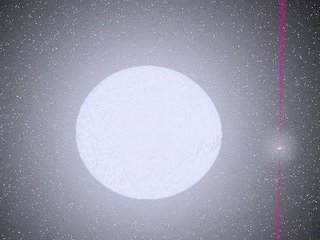
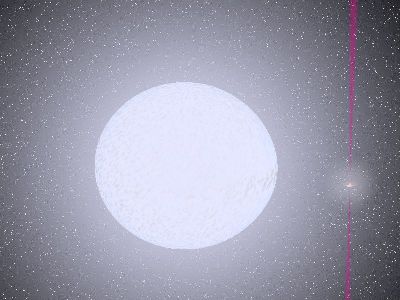
PPARC simulation of the Microquasar LS5039
ENLARGE ImageThis image was created using software developed by Dr. Rob Hynes of LSU.
Gamma-rays are produced in extreme cosmic particle accelerators such as supernova explosions and provide a unique view of the high energy processes at work in the Milky Way.
VHE (very high energy) gamma-ray astronomy is still a young field and the High Energy Stereoscopic System (H.E.S.S.) is conducting the first sensitive survey at this energy range, finding previously unknown sources.
The object that is producing the high energy radiation is thought to be a
'microquasar'. These objects consist of two stars in orbit around each other. One star is an ordinary star, but the other has used up all its nuclear fuel, leaving behind a compact corpse. Depending on the mass of the star that produced it, this compact object is either a neutron star or a black hole, but either way its strong gravitational pull draws in matter from its companion star. This matter spirals down towards the neutron star or the black hole, in a similar way to water spiraling down a plughole.
However, sometimes the compact object receives more matter than it can cope with. The material is then squirted away from the system in a jet of matter moving at speeds close to that of light, resulting in a microquasar. Only a few such objects are known to exist in our galaxy and one of them, an object called LS5039, has now been detected by the H.E.S.S. team.
[+/-] click to expandMore from PPARC PressRelease:
Mystery compact object producing high energy radiation_______________________________________________________
Integral Catches a new erupting blackhole_______________________________________________________

ESA's gamma-ray observatory, Integral, has spotted a rare kind of gamma-ray outburst.
The vast explosion of energy allowed astronomers to pinpoint a possible black hole in our Galaxy.
The outburst was discovered on 17 September 2006 by staff at the Integral Science Data Centre (ISDC), Versoix, Switzerland.
"The galactic centre is one of the most exciting regions for gamma ray astronomy because there are so many potential gamma-ray sources," says Roland Walter, an astronomer at the ISDC, and lead author of these results.
In this case, the outburst continued to rise in brightness for a few days before beginning a gradual decline that lasted for weeks. The way the brightness of an outburst rises and falls is known to astronomers as a light curve. "It was only after a week that we could see the shape of the light curve and realised what a rare event we had observed," says Walter.
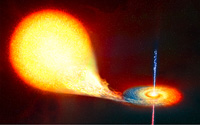
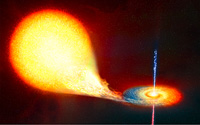
Comparing the shape of the light curve to others on file revealed that this was an eruption thought to come from a binary star system in which one component is a star like our Sun whereas the other is a black hole.
In these systems, the gravity of the black hole is ripping the Sun-like star to pieces. As the doomed star orbits the black hole, it lays down its gas in a disc, know as an accretion disc, surrounding the black hole.
Occasionally, this accretion disc becomes unstable and collapses onto the black hole, causing the kind of outburst that Integral witnessed. Astronomers are still not sure why the accretion disc should collapse like this but one thing is certain: when it does collapse, it releases thousands of times the energy than at other times.
Because such active star–black hole binaries are thought to be rare in the Galaxy, astronomers expect Integral to see such an outbursts only once every few years. That makes each and every one a precious resource for astronomers to study.
INTEGRAL catches a new erupting black hole Additional Material to ESA's Press Release of 27 Nov. 2006
_______________________________________________________
_______________________________________________________
Labels: ESA, GRBs, INTEGRAL, PPARC





Roland Diehl of the Max-Planck-Institut für extraterrestrische Physik, headed the work and believes it is a major step forward. “These gamma-ray lines have been detected before with some dispute. Integral, the only instrument capable of doing this, shows that iron-60 does exist in interstellar space in our Galaxy,” he says.
More than a curiosity, its presence opens a door into the very heart of the most massive stars in the cosmos. The majority of chemical elements are built inside stars from raw ingredients present during star formation from an interstellar gas cloud. In addition to hydrogen and helium produced during the Big Bang, the gas contained enrichments, known to astronomers as ‘metals’, from previous generations of stars and their nuclear reactions.
Until this detection, astronomers had only one radioactive isotope to probe into the current build-up of chemical elements in stars and their distribution with respect to future star formation. That was the radioactive isotope aluminium-26, first discovered in 1978. “The study of aluminium-26 has developed into its own branch of astronomy,” says Diehl.
Iron-60 gives astronomers valuable new insight - although produced in the same stars as aluminium-26, its production differs markedly. Iron-60 is synthesised both later in a star’s life and deeper inside.
As massive stars age, they develop a layered structure in which different chemical elements are fused together. While aluminium-26 is one rung on the ladder of nuclear reactions, iron-60 is produced from pre-existing stable iron isotopes by a process called ‘neutron capture’ in the respective layers where helium and carbon atoms are undergoing fusion.
“Iron-60 provides the entry into studying neutron capture in stars through contemporaneous radioactivity,” says Diehl. It has also prompted a number of particle accelerators to begin more detailed studies of how easily iron captures neutrons.
Unlike aluminium-26, iron-60 is only expelled into space when the star explodes at the end of its life. It then decays with a half-life of 1.5 million years, producing the gamma rays that Integral detected.
The new data pins down the ratio of iron-60 to aluminium-26, which has a half-life of 740 000 years. Previous predictions have fallen anywhere between 10 and 100 percent. Integral shows it to be 15 percent, which agrees well with current theoretical estimates. But theoreticians and nuclear physicists have been stimulated by Integral’s results to strive for more precise predictions.
Radioactive iron, a window to the stars from ESA and Max Planck Institut