Wednesday, July 02, 2008

Supernova Remnant


A new star, likely the brightest supernova in recorded human history, lit up planet Earth's sky in the year 1006 AD. The expanding debris cloud from the stellar explosion, found in the southerly constellation of Lupus, still puts on a cosmic light show across the electromagnetic spectrum. In fact, this composite view includes X-ray data in blue from the Chandra Observatory, optical data in yellowish hues, and radio image data in red.

Now known as the SN 1006 supernova remnant, the debris cloud appears to be about 60 light-years across and is understood to represent the remains of a white dwarf star. Part of a binary star system, the compact white dwarf gradually captured material from its companion star. The buildup in mass finally triggered a thermonuclear explosion that destroyed the dwarf star.

Because the distance to the supernova remnant is about 7,000 light-years, that explosion actually happened 7,000 years before the light reached Earth in 1006. Shockwaves in the remnant accelerate particles to extreme energies and are thought to be a source of the mysterious cosmic rays.


For Zoomable Image of SN1006 from Hubble Click here

This image, taken by NASA's Hubble Space Telescope, is a very thin section of a supernova remnant caused by a stellar explosion that occurred more than 1,000 years ago.
[+/-] Click here to expand

On or around May 1, 1006 A.D., observers from Africa to Europe to the Far East witnessed and recorded the arrival of light from what is now called SN 1006, a tremendous supernova explosion caused by the final death throes of a white dwarf star nearly 7,000 light-years away. The supernova was probably the brightest star ever seen by humans, and surpassed Venus as the brightest object in the night time sky, only to be surpassed by the moon. It was visible even during the day for weeks, and remained visible to the naked eye for at least two and a half years before fading away.

It wasn't until the mid-1960s that radio astronomers first detected a nearly circular ring of material at the recorded position of the supernova. The ring was almost 30 arcminutes across, the same angular diameter as the full moon. The size of the remnant implied that the blast wave from the supernova had expanded at nearly 20 million miles per hour over the nearly 1,000 years since the explosion occurred.

In 1976, the first detection of exceedingly faint optical emission of the supernova remnant was reported, but only for a filament located on the northwest edge of the radio ring. A tiny portion of this filament is revealed in detail by the Hubble observation. The twisting ribbon of light seen by Hubble corresponds to locations where the expanding blast wave from the supernova is now sweeping into very tenuous surrounding gas.

The hydrogen gas heated by this fast shock wave emits radiation in visible light. Hence, the optical emission provides astronomers with a detailed "snapshot" of the actual position and geometry of the shock front at any given time. Bright edges within the ribbon correspond to places where the shock wave is seen exactly edge on to our line of sight.

Today we know that SN 1006 has a diameter of nearly 60 light-years, and it is still expanding at roughly 6 million miles per hour. Even at this tremendous speed, however, it takes observations typically separated by years to see significant outward motion of the shock wave against the grid of background stars. In the Hubble image as displayed, the supernova would have occurred far off the lower right corner of the image, and the motion would be toward the upper left.

SN 1006 resides within our Milky Way Galaxy. Located more than 14 degrees off the plane of the galaxy's disk, there is relatively little confusion with other foreground and background objects in the field when trying to study this object. In the Hubble image, many background galaxies (orange extended objects) far off in the distant universe can be seen dotting the image. Most of the white dots are foreground or background stars in our Milky Way galaxy.

This image is a composite of hydrogen-light observations taken with Hubble's Advanced Camera for Surveys in February 2006 and Wide Field Planetary Camera 2 observations in blue, yellow-green, and near-infrared light taken in April 2008. The supernova remnant, visible only in the hydrogen-light filter was assigned a red hue in the Heritage colour image.

__________________________________________________________
__________________________________________________________

Labels: ,

Sunday, June 29, 2008

Hawking & Colleagues


WHY was the big bang so very big? It has been a struggle to explain why the infant universe expanded so rapidly.

The idea that the universe expanded at a blistering rate in the first 10-34 seconds after the big bang was proposed to explain why regions of the universe separated by vast distances have such a similar background temperature: before inflation occurred, these regions would have been close together with similar properties.

But just why the universe inflated in the first place remains a mystery. WHY was the big bang so very big? It has been a struggle to explain why the infant universe expanded so rapidly.

Now Stephen Hawking at the University of Cambridge, and colleagues, think they are close to perfecting an answer - by treating the early cosmos as a quantum object with a multitude of alternative universes that gradually blend into ours.

Quantum mechanics is awash with strange ideas and can shed new light on inflation, which came in the wake of when the universe itself was around the size of an atom.

By quantum lore, when a particle of light travels from A to B, it does not take one path but explores every one simultaneously, with the more direct routes being used more heavily.

This is called a sum over histories and Prof Hawking and Prof Hertog propose the same thing for the cosmos.

In this theory, the early universe can be described by a mathematical object called a wave function and, in a similar way to the light particle, the team proposed two years ago that this means that there was no unique origin to the cosmos: instead the wave function of the universe embraced a multitude of means to develop.

This is very counter intuitive: they argued the universe began in just about every way imaginable (and perhaps even some that are not). Out of this profusion of beginnings, like a blend of a God’s eye view of every conceivable kind of creation, the vast majority of the baby universes withered away to leave the mature cosmos that we can see today.

[+/-] Click here to expand

But, like any new idea, there were problems. The professors found that they could not explain the rapid expansion - inflation - of the universe, evidence of which is left behind all around us in what is called the cosmic microwave background, in effect the echo of the big bang, a relic of creation that can be measured with experiments on balloons and on space probes.

Now, in a paper in Physical Review Letters with Prof James Hartle of the University of California, Santa Barbara, they realised that their earlier estimates of inflation were wrong because they had not fully thought through the connection between, on the one hand, their theoretical predictions and, on the other, our observations of the echo.

At first, they found that the most probable history of the cosmos had only undergone "a little bit of inflation at the beginning, contradicting the observations," said Prof Hertog. Now, after a correction to take account of how the data we have on inflation is based on only a view of a limited volume of the universe, they find that the wave function does indeed predict a long period of inflation.

"This proposal, with volume weighting, can explain why the universe inflated," Prof Hawking tells New Scientist. By taking into account that we have a parochial view of the cosmos, the team has come up with a radical new take on cosmology.

Most models of the universe are bottom-up, that is, you start from well-defined initial conditions of the Big Bang and work forward. However, Prof Hertog and Prof Hawking say that we do not and cannot know the initial conditions present at the beginning of the universe. Instead, we only know the final state - the one we are in now.

Their idea is therefore to start with the conditions we observe today - like the fact that at large scales one does not need to adopt quantum lore to explain how the universe (it behaves classically, as scientists say) - and work backwards in time to determine what the initial conditions might have looked like.

In this way, they argue the universe did not have just one unique beginning and history but a multitude of different ones and that it has experienced them all.

The new theory is also attractive because it fits in with string theory - the most popular candidate for a "theory of everything."

String theory allows the existence of an" unimaginable multitude of different types of universes in addition to our own," but it does not provide a selection criterion among these and hence no explanation for why our universe is, the way it is", says Prof Hertog.

"For this, one needs a theory of the wave function of the universe."

And now the world of cosmology has one. The next step is to find specific predictions that can be put to the test, to validate this new view of how the cosmos came into being.
=====================
Proof that a mysterious force called “dark energy” is pushing the universe to expand endlessly at a faster and faster rate was selected as the “Breakthrough of the Year” by the editors of Science magazine.

The bizarre idea that some unknown force exists in the universe that is opposing gravity and flinging galaxies away from each other at an accelerating clip was first proposed in 1998. New studies in 2003 proved that the force does exist, and this discovery captured the top prize by the editors of Science as the year’s most important scientific development.

“It is one of the ultimate discoveries in basic science,” said Don Kennedy, editor-in-chief of the journal. “It stirs our imagination even though it challenges our ability to understand.”

“No longer are scientists trying to confirm the existence of dark energy,” the journal reported in its Friday issue. “Now they are trying to find out what dark energy is made of, and what it tells us about the birth and evolution of the universe.”

The editors also selected nine other research advances, ranging from gamma ray research to the evidence of global warming's effects to the effects of RNA on genes. All the selections, the journal said in a statement, were chosen “for their profound implications for society and the advancement of science.”

Expanding universe
Proof for the existence of the “dark force” came from two studies that probed the very early universe — back to less than 400,000 years after the Big Bang — and confirmed that the universe was expanding at a faster rate.

The Wilkinson Microwave Anisotropy Probe telescope analyzed the cosmic microwave radiation background, an echo from the Big Bang, and determined the age and composition of the universe. It confirmed that only 4 percent is ordinary matter, the stuff seen every day, and 23 percent is a cold, dark matter composed of unknown particles. The rest, some 73 percent, of the universe is dark energy.

The study also narrowed the proven age of the universe to 13.7 billion years, plus or minus a few hundred thousand years. Prior estimates had been between 12 billion and 15 billion years.
Another study, the Sloan Digital Sky Survey, mapped the distribution of a quarter-million galaxies and confirmed again the domination of dark energy.

Of the dark energy finding, the journal said: “It is, perhaps, a sign that scientists will finally begin to understand the beginning.”

___________________________________________________________
___________________________________________________________

Labels: ,

Tuesday, March 04, 2008

Planetary Nebula NGC2371


Planetary Nebula NGC2371. Credit: Hubble Heritage

Probing a glowing bubble of gas and dust encircling a dying star, NASA's Hubble Space Telescope reveals a wealth of previously unseen structures.

The object, called NGC 2371, is a planetary nebula, the glowing remains of a Sun-like star. The remnant star visible at the center of NGC 2371 is the super-hot core of the former red giant, now stripped of its outer layers. Its surface temperature is a scorching 240,000 degrees Fahrenheit. NGC 2371 lies about 4,300 light-years away in the constellation Gemini.

The Hubble image reveals several remarkable features, most notably the prominent pink clouds lying on opposite sides of the central star. This colour indicates that they are relatively cool and dense, compared to the rest of the gas in the nebula.

A planetary nebula is an expanding cloud of gas ejected from a star that is nearing the end of its life. The nebula glows because of ultraviolet radiation from the hot remnant star at its center. In only a few thousand years the nebula will dissipate into space. The central star will then gradually cool down, eventually becoming a white dwarf, the final stage of evolution for nearly all stars.

The Hubble picture of NGC 2371 is a false-colour image, prepared from exposures taken through filters that detect light from sulfur and nitrogen (red), hydrogen (green), and oxygen (blue). These images were taken with Hubble's Wide Field Planetary Camera 2 in November 2007, as part of the Hubble Heritage program.
_____________________________________________________
_____________________________________________________

Labels: , ,

Saturday, March 01, 2008

Interstellar Gas Clouds


Simulation of the collapse of an interstellar gas cloud into a massive star. The left side shows the whole cloud, and the right side shows a zoom-in around the massive star in the center. Credit: Mark Krumholz

Two scientists think they have decoded the gassy recipe to create stars as much as 100 times bigger than the sun, perhaps solving the mystery of their formation.

Mark Krumholz Princeton University in New Jersey and his colleague Christopher McKee of the University of California Berkeley used mathematical models to show how small stars can prime superstar formation, and detail their findings in the Feb. 28 issue of the journal Nature.

Gravity tends to break interstellar gas clouds into small pieces, preventing massive star formation, but little stars heating up a gas cloud can smooth it out, forcing gravity to create a huge star.

Star power
Although massive stars are about a million times rarer than the most common stars — those about 80 percent smaller than the sun — they are the movers and shakers of the universe.

"They're very rare, but massive stars are the dominant players in galaxies," Krumholz said. "They're the things that can push around and heat up interstellar gas - essentially where all stars come from."

He also explained that big stars seed the cosmos with elements that are required for life.

"They enrich the universe with metals from their supernovae," he said, noting that only enormous stars are powerful enough to fuse together small atoms and create the heavy materials.

Hot influence
To form a galactic superpower, Krumholz said an interstellar gas cloud needs to be thousands of times more dense than average. Problem is, gravity tends to break dense gas clouds into pieces and thwart massive star formation.

"The challenge isn't getting enough gas, it's getting the cloud into a small enough region and preventing its breakup," he said.

If a few small stars form within the cloud, Krumholz explained, they can heat up the cloud and increase its "column density," or pressure. The heating process prevents gravity from taking control of the cloud, breaking it up and forming only small stars.

"Heating up the gas helps pressure win over gravity's influence, ultimately forcing the gas cloud to collapse in a massive star," Krumholz said.

The new view of star formation highlights the rarity of massive stars — the only kind astronomers on Earth can see in distant galaxies — but leads to the possibility that more stars form in galaxies than previously thought.

"There may be significant parts of galaxies where massive stars can't form, but lower-mass stars like the sun can," Krumholz said.

We estimate the number of stars in a galaxy on the amount of light we see, and if massive stars are missing, then it's possible that we've dramatically underestimated the rate of star formation in distant regions of the universe.
__________________________________________________________
__________________________________________________________
Massive Stars Need Their Smaller Siblings To Grow @ Universe Today
The Dragon - Beijing's New Monster Airport from The Daily Galaxy
X marks the spot in dark matter web from Space New Scientist
__________________________________________________________
__________________________________________________________

Labels: , ,

Saturday, February 23, 2008

Light echoes in RS Pup


Nebula around Cepheid Star RS Pup. Credit: ESO

Astronomers calibrate the distance scale of the Universe
Taking advantage of the presence of light echoes, a team of astronomers have used an ESO telescope to measure, at the 1% precision level, the distance of a Cepheid - a class of variable stars that constitutes one of the first steps in the cosmic distance ladder.

Cepheids are pulsating stars that have been used as distance indicators since almost a hundred years. The new accurate measurement is important as, contrary to many others, it is purely geometrical and does not rely on hypotheses about the physics at play in the stars themselves.

The team of astronomers studied RS Pup, a bright Cepheid star located towards the constellation of Puppis ('the Stern') and easily visible with binoculars. RS Pup varies in brightness by almost a factor of five every 41.4 days. It is 10 times more massive than the Sun, 200 times larger, and on average 15 000 times more luminous.

RS Pup is the only Cepheid to be embedded in a large nebula, made of very fine dust that reflects some of the light emitted by the star.

Because the luminosity of the star changes in a very distinctive pattern, the presence of the nebula allows the astronomers to see light echoes and use them to measure the distance of the star.

"The light that travelled from the star to a dust grain and then to the telescope arrives a bit later than the light that comes directly from the star to the telescope," explains Kervella, lead-author of the paper reporting the result. "As a consequence, if we measure the brightness of a particular, isolated dust blob in the nebula, we will obtain a brightness curve that has the same shape as the variation of the Cepheid, but shifted in time."

This delay is called a 'light echo', by analogy with the more traditional echo, the reflection of sound by, for example, the bottom of a well.

The Principle of the Light Echo By monitoring the evolution of the brightness of the blobs in the nebula, the astronomers can derive their distance from the star: it is simply the measured delay in time, multiplied by the velocity of light (300 000 km/s). Knowing this distance and the apparent separation on the sky between the star and the blob, one can compute the distance of RS Pup.

From the observations of the echoes on several nebular features, the distance of RS Pup was found to be 6500 light years, plus or minus 90 light years.

"Knowing the distance to a Cepheid star with such an accuracy proves crucial to the calibration of the period-luminosity relation of this class of stars," says Kervella. "This relation is indeed at the basis of the distance determination of galaxies using Cepheids."

RS Pup is thus distant by about a quarter of the distance between the Sun and the Centre of the Milky Way. RS Pup is located within the Galactic plane, in a very populated region of our Galaxy.

The long-period Galactic Cepheid RS Puppis.I. A geometric distance from its light echoes. Author(s): P. Kervella, A. Mérand, L. Szabados, P. Fouqué, D. Bersier, E. Pompei, and G. Perrin
___________________________________________________________
___________________________________________________________

Labels: , ,

Monday, February 18, 2008

The Formax Galaxy


The center of the Fornax galaxy cluster is shown in this Chandra image. The galaxy NGC 1404 is shown below and to the left of the center. Hot gas is clearly visible in the center of the cluster and around NGC 1404. (Credit: NASA/CXC/Columbia U./C.Scharf et al.)


Using data from NASA's Chandra X-ray Observatory, scientists have reported the possible detection of a binary star system that was later destroyed in a supernova explosion. The new method they used provides great future promise for finding the detailed origin of these important cosmic events.

In an article on the February 14th issue of the journal Nature, Rasmus Voss of the Max Planck Institute for Extraterrestrial Physics in Germany and Gijs Nelemans of Radboud University in the Netherlands searched Chandra images for evidence of a much sought after, but as yet unobserved binary system - one that was about to go supernova. Near the position of a recently detected supernova, they discovered an object in Chandra images taken more than four years before the explosion.
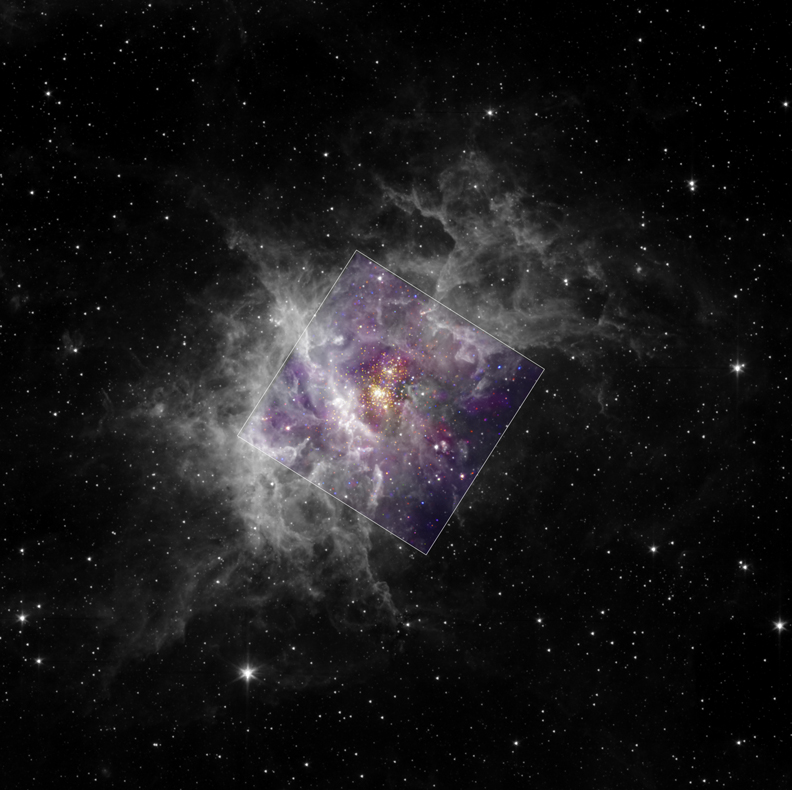
The supernova, known as SN 2007on, was identified as a Type Ia supernova. Astronomers generally agree that Type Ia supernovas are produced by the explosion of a white dwarf star in a binary star system. However, the exact configuration and trigger for the explosion is unclear. Is the explosion caused by a collision between two white dwarfs, or because a white dwarf became unstable by pulling too much material off a companion star?
[+/-] Click here to expand

Answering such questions is a high priority because Type Ia supernovas are major sources of iron in the Universe. Also, because of their nearly uniform intrinsic brightness, Type Ia supernova are used as important tools by scientists to study the nature of dark energy and other cosmological issues.

"Right now these supernovas are used as black boxes to measure distances and derive the rate of expansion of the universe," said Nelemans. "What we're trying to do is look inside the box."

If the supernova explosion is caused by material being pulled off a companion star onto the white dwarf, fusion of this material on the surface of the star should heat the star and produce a strong source of X-radiation prior to the explosion. Once the supernova explosion occurs, the white dwarf is expected to be completely destroyed and then would be undetectable in X-rays. In the merger scenario, the intensity of X-ray emission prior to the explosion is expected to be much weaker.

Based on the detection of a fairly strong X-ray source at approximately the position of SN 2007on 4 years before the explosion, Voss and Nelemans conclude that the data support the scenario where matter is pulled off a companion star. The small number of X-ray sources in the field implies that there is only a small chance of an unrelated source being so close by coincidence. Also, the X-ray source has similar properties to those expected for fusion on a white dwarf, unlike most X-ray sources in the sky.

However, in follow-up studies, Voss, Nelemans and colleagues Gijs Roelofs (Harvard-Smithsonian Center for Astrophysics, Cambridge, Mass.) and Cees Bassa (McGill University, Canada) used higher-quality optical images to better determine the supernova's position. This work, which is not yet published, shows a small, but significant difference in the measured positions of the supernova and the X-ray source, suggesting the source may not be the progenitor.

Follow-up Chandra observations hint that the X-ray object has disappeared, but further observations are needed to finally decide whether the source was the progenitor or not.

The team is also applying this new method to other supernovas and has high hopes that they will eventually succeed in identifying the elusive cause of at least some of these explosions.

"We're very excited about opening up a new way of studying supernovas, even though we're not sure that we've seen this particular stellar bomb before it exploded," said Gijs Roelofs. "We're very confident that we'll learn a lot more about these important supernovas in the future."

Voss agrees that, even if the X-ray source is not found to be the progenitor of SN 2007on, the hunt is worth the effort.

"Finding the progenitor to one of these Type Ia supernovas is a great chase in astronomy right now," he said. "These supernovas are great tools for studying dark energy, but if we knew more about how they form they might become even better tools."

___________________________________________________________
___________________________________________________________

Labels: , , ,

Wednesday, February 13, 2008

Newborn Stars


Click on Image to Enlarge.

Newborn stars peek out from the Rho Ophiuchi star-forming region in this dynamic image from NASA's Spitzer Space Telescope.

This representative-colour image of Rho Oph's main cloud, Lynds 1688, was created with data from Spitzer's infrared array camera, which has the highest spatial resolution of Spitzer's three imaging instruments, and its multiband imaging photometer, best for detecting cooler materials.

Blue represents light with a wavelength of 3.6 microns; green shows light of 8 microns; and red is 24-micron light.

The colours in this image reflect the relative temperatures and evolutionary states of the various stars. The youngest stars are surrounded by dusty disks of gas from which they, and their potential planetary systems, are forming. These young disk systems show up as red in this image. More evolved stars, which have shed their natal material, are blue.

The extended white nebula in the center right of the image is a region of the cloud which is glowing in infrared light due to the heating of dust by bright young stars near the right edge of the cloud. Fainter multi-hued diffuse emission fills the image. The colour of the nebulosity depends on the temperature, composition and size of the dust grains.

Spitzer Spies Young Stars in their Baby Blanket of Dust
Credit: NASA/JPL-Caltech/Harvard-Smithsonian CfA
___________________________________________________________
___________________________________________________________
The first fruits of 2008 original music by The Moody Minstrel
___________________________________________________________
___________________________________________________________

Labels: , , ,

Saturday, February 09, 2008

Cosmic Fossil


NGC 1132 A Mysterious Elliptical. Credit: Chanda

The NASA/ESA Hubble Space Telescope has captured a new image of the galaxy NGC 1132 which is, most likely, a cosmic fossil - the aftermath of an enormous multi-galactic pile-up, where the carnage of collision after collision has built up a brilliant but fuzzy giant elliptical galaxy far outshining typical galaxies.

The elliptical galaxy NGC 1132, seen in this latest image from Hubble, belongs to a category of galaxies called giant ellipticals. NGC 1132, together with the small dwarf galaxies surrounding it, are dubbed a "fossil group" as they are most likely the remains of a group of galaxies that merged together in the recent past.

In visible light NGC 1132 appears as a single, isolated, giant elliptical galaxy, but this is only the tip of the iceberg. Scientists have found that NGC 1132 resides in an enormous halo of dark matter, comparable to the amount of dark matter usually found in an entire group of tens or hundreds of galaxies.

It also has a strong X-ray glow from an abundant amount of hot gas - an amount normally only found in galaxy groups. Its X-ray glow extends over a region of space ten times larger than the 120,000 light-year radius it has in visible light. An X-ray glow that is equal in size to that of an entire group of galaxies.

The origin of fossil group systems remains a puzzle. The most likely explanation is that they are the end-products of a cosmic feeding frenzy in which a large cannibal galaxy devours all of its neighbours. A less likely explanation is that they may be very rare objects that formed in a region or period of time where the growth of moderate-sized galaxies was somehow suppressed, and only one large galaxy formed.

Many galaxies reside in groups that are gravitationally bound together, including our own Milky Way, which is part of the Local Group. Sometimes gravity makes galaxies collide and eventually merge into one single galaxy. There is strong evidence that the Milky Way is one such cannibal that has snacked on numerous smaller galaxies during its lifetime, inheriting their stars in the process.

Scientists are keenly studying the environment surrounding galaxies such as NGC 1132 using space telescopes like Hubble, and they try to trace the history of the formation these galaxies by analysing their properties.

In this Hubble image, NGC 1132 is seen surrounded by thousands of ancient globular clusters, swarming around the galaxy like bees around a hive. These globular clusters are likely to be the survivors of the disruption of their cannibalised parent galaxies that have been eaten by NGC 1132 and may reveal its merger history. In the background, there is a stunning tapestry of numerous galaxies that are much further away.

Elliptical galaxies are smooth and featureless. They contain hundreds of millions to trillions of stars, and their shapes range from nearly spherical to very elongated in shape. Their overall yellowish colour is a telltale sign of their great age. Because elliptical galaxies do not contain much cool gas they can no longer make new stars.

NGC 1132 is located approximately 320 million light-years away in the constellation of Eridanus, the River. This image of NGC 1132 was taken with Hubble's Advanced Camera for Surveys. Data obtained in 2005 and 2006 through green and near-infrared filters were used to produce a colour composite.
___________________________________________________________
___________________________________________________________

Labels: , , ,

Wednesday, February 06, 2008

Cosmic Fingers


Click on Image to Enlarge. Credit: LiveScience

A giant gas finger emanating from two neighbouring galaxies has hooked into the starry disk of the Milky Way and is pulling all three galaxies closer. The hydrogen gas is actually the pointy end of the so-called Leading Arm of gas that streams ahead of two irregular galaxies called the Large and Small Magellanic Clouds.

The fate of these nearby galaxies, which are impacted by the Milky Way's gravity, has been somewhat of a mystery. The new findings suggest that the Magellanic Clouds will eventually merge with the Milky Way rather than zooming past.

Located about 160,000 light-years from Earth, the Large Magellanic Cloud (LMC) is only one-twentieth the diameter of our galaxy and contains one-tenth as many stars. The Small Magellanic Cloud resides 200,000 light-years from Earth and is about 100 times smaller than the Milky Way.

"We can determine exactly where this gas is plowing into the Milky Way," said research team leader Naomi McClure-Griffiths of CSIRO's Australia Telescope National Facility.

Called HVC306-2+230, the gas finger is gouging into our galaxy's starry disk about 70,000 light-years away from Earth. In the night sky, the contact point would be nearest the Southern Cross.

Until last year, astronomers thought the Magellanic Clouds had orbited our galaxy many times. This scenario held a gloomy outlook for the clouds, which were said to be doomed to be ripped apart and swallowed by the gravitational goliath.

But then new Hubble Space Telescope measurements revealed the clouds are paying our galaxy a one-time visit rather than being its lunch.

McClure-Griffiths' results, however, are more in line with the previous tale pegging the Milky Way and the Magellanic Clouds as long-time companions. McClure-Griffiths remarks that this isn't the final word and that both theories are still on the table.

By pointing out the spot of contact between the Leading Arm and our galactic disk, the recent study will help astronomers to predict where the clouds themselves will travel in the future.

"We think the Leading Arm is a tidal feature, gas pulled out of the Magellanic Clouds by the Milky Way's gravity," McClure-Griffiths said. "Where this gas goes, we'd expect the clouds to follow, at least approximately."

In the distant future, the three galaxies could become one.
__________________________________________________________
__________________________________________________________

Labels: , ,

Sunday, February 03, 2008

Rogue Stars


Rogue Stars - Credit: Andrea Thompson & Live Science

A young star speeding away from the Milky Way is in fact an alien visitor, astronomers have confirmed. The wayward object is one of several rogues that are giving astronomers a glimpse into the volatile nature of our galaxy and others.

Astronomers have found about 10 stars hurtling away from our galaxy, at speeds that exceed its gravitational grasp. While most stars rush through space at speeds on the order of hundreds of kilometers per second, these aptly-named "hypervelocity stars" are rocketing away at least 10 times as fast.

Most of these speedy stars are thought to be exiles from the center of our galaxy, flung out into intergalactic space by the powerful forces of the massive black hole at the center of our galaxy. Their violent creation is giving astronomers insight into the almost impenetrable world at the center of the Milky Way, the mysteries of our nearby galactic neighbours, and the nature of intergalactic space.

Volatile origins
Hypervelocity stars were first theorized to exist in 1988. The theory was that binary star systems at the galaxy's center would occasionally wander too close to the massive black hole looming there, which would disrupt their orbital dance.

While one of the pair was captured by the black hole, the other would be sent rocketing off at an incredible speed.
[+/-] Click here to expand

"That's the only way you can accelerate a star to go thousands of kilometers per second," said astronomer Alcestes Bonanos of the Carnegie Institution for Science, a member of the team that made the discovery of the alien star's origins.

Of the billions of stars in the Milky Way, only a tiny fraction are thought to be shot out from the center like this. This explains why they weren't found until 2005 - because there aren't very many.

Astronomers looked at the spectra of stars at the most outer reaches of the Milky Way and found a few that were going very, very fast, which isn't normal.

By examining the elemental composition of these exiled stars, astronomers can figure out where in the galaxy they came from. With their abundance of heavy metals, most of these stars seem to have come from the center of our galaxy, which tends to spawn more heavy-metal stars.

The galaxy's center is shrouded in gas and dust and normally hard for astronomers to peer into. Gas clouds usually act as excellent stellar nurseries, but the violent tidal forces from the black hole were thought to prevent any nearby stellar births.

The rogue stars seem to contradict that idea, as they seem to have come from the vicinity of the black hole, except for one, which is an alien passerby.

Of these 10 strange stars, one, dubbed HE 0437-5439, seemed a bit stranger than the rest. Based on its current position, the star would have to be 100 million years old to have come from the center of the Milky Way. But it is only 35 million years old.

Bonanos and Lopez-Morales took a closer look at the elemental composition of the star and found that it seemed to be a visitor from our small galactic neighbour, the Large Magellanic Cloud (LMC).

"Stars in the LMC are known to have lower elemental abundances than most stars in our galaxy," Bonanos explained, which seemed to fit HE 0437-5439's make-up.

But while the elemental profile matched, there's one big conundrum: The LMC is not known to have a massive black hole that could eject it. The usual tell-tale signs of a big black hole, such as strong X-ray and radio signals, are missing. Astronomers aren't sure if dwarf galaxies like the LMC have huge black holes in their center, so "this star might be a hint for something important," Bonanos said.

Another strange consequence of these roving stars is the contradiction they provide to the long-held notion that intergalactic space is pretty much empty.

'There seem to be all these stars flying around between galaxies," Bonanos said. If stars are shot out from our galaxy, they are likely propelled from others, she says, though we are unlikely to be able to see them because stars are too hard to individually identify from the distance of most galaxies.

It is predicted that about 1,000 hypervelocity stars have been spit out by the Milky Way's black hole, Bonanos said, though many are still hurtling through the galaxy.

So far all of the hypervelocity stars found are moving away from us, but they could be shot out of the galaxy's center in any direction, up or down from the galactic plane, or even toward us.


But there's no need to worry about a stellar roadrunner knocking into Earth, or any other planet or star. There's a lot of "empty space" in the solar system, so these speeding stars will likely have a clear path out of the neighbourhood.
_________________________________________________________
_________________________________________________________
Large Mover from The Magellanic Cloud @ Centauri Dreams.
_________________________________________________________
_________________________________________________________

Labels: , ,

Friday, February 01, 2008

Young Star Cluster


Credit: NASA/CXC/Univ. de Liège/Y. Naze et al

Westerlund 2, a young star cluster with an estimated age of about one or two million years. Until recently little was known about this cluster because it is heavily obscured by dust and gas. However, using infrared and X-ray observations to overcome this obscuration, Westerlund 2 has become regarded as one of the most interesting star clusters in the Milky Way galaxy. It contains some of the hottest, brightest and most massive stars known.

This Chandra image of Westerlund 2 shows low energy X-rays in red, intermediate energy X-rays in green and high energy X-rays in blue. The image shows a very high density of massive stars that are bright in X-rays, plus diffuse X-ray emission.

An incredibly massive double star system called WR20a is visible as the bright yellow point just below and to the right of the cluster's center. This system contains stars with masses of 82 and 83 times that of the Sun. The dense streams of matter steadily ejected by these two massive stars, called stellar winds, collide with each other and produce copious amounts of X-ray emission. This collision is seen at different angles as the stars orbit around each other every 3.7 days. Several other bright X-ray sources may also show evidence for collisions between winds in massive binary systems.

Spitzer Infrared Images of Westerlund 2
RCW 49 is the surrounding HII region around the young stellar cluster Westerlund 2 (Wd2). Because many of the stars in RCW 49 are deeply embedded in plumes of dust, they cannot be seen at visible wavelengths. When viewed with Spitzer's infrared eyes, however, RCW 49 becomes transparent.

Chandra X-ray & Spitzer Infrared Image of Westerlund 2
This coloured Chandra X-ray Observatory image (inset) shows Westerlund 2 in context with the Spitzer infrared observation. ___________________________________________________________
___________________________________________________________

Labels: , , ,

Wednesday, January 23, 2008

Cosmic Interactions


Credit: ESA Cosmic Interactions NGC 7173, 7174 and 7176

ESO's Very Large Telescope (VLT) images triplet of dancing galaxies intertwined in a cosmic dance.

The three galaxies: NGC 7173 (top), 7174 (bottom right) and 7176 (bottom left), are located 106 million light-years away towards the constellation of Piscis Austrinus (the 'Southern Fish').

NGC 7173 and 7176 are elliptical galaxies, while NGC 7174 is a spiral galaxy with quite disturbed dust lanes and a long, twisted tail.

This seems to indicate that the two bottom galaxies are currently interacting, with NGC 7176 providing fresh material to NGC 7174. Matter present in great quantity around the triplet's members also points to the fact that NGC 7176 and NGC 7173 have interacted in the past.

Astronomers have suggested that The three galaxies will finally merge into a giant 'island universe', tens to hundreds of times as massive as our own Milky Way.

The triplet is part of a so-called 'Compact Group', as compiled by Canadian astronomer Paul Hickson in the early 1980s. The group, which is the 90th entry in the catalogue and is therefore known as HCG 90, actually contains four major members. One of them - NGC 7192 - lies above the trio, outside of this image, and is another peculiar spiral galaxy.

Compact groups are small, relatively isolated, systems of typically four to ten galaxies in close proximity to one another. Another striking example is Robert's Quartet. Compact groups are excellent laboratories for the study of galaxy interactions and their effects, in particular the formation of stars.

As the striking image reveals, there are many other galaxies in the field. Some are distant ones, while others seem to be part of the family. Studies made with other telescopes have indeed revealed that the HCG 90 group contains 16 members, most of them much smaller in size than the four members with an entry in the NGC catalogue.
__________________________________________________________
__________________________________________________________

Labels: , , ,

Wednesday, January 16, 2008

Spinning Black Holes


Results from NASA's Chandra X-ray Observatory, combined with new theoretical calculations, provide one of the best pieces of evidence yet that many supermassive black holes are spinning extremely rapidly.

The images below show 4 out of the 9 large galaxies included in the Chandra study, each containing a supermassive black hole in its center.


The Chandra images show pairs of huge bubbles, or cavities, in the hot gaseous atmospheres of the galaxies, created in each case by jets produced by a central supermassive black hole. Studying these cavities allows the power output of the jets to be calculated. This sets constraints on the spin of the black holes when combined with theoretical models.

The Chandra images were also used to estimate how much fuel is available for each supermassive black hole, using a simple model for the way matter falls towards such an object. The artist's impression on the right side of the main graphic shows gas within a "sphere of influence" falling straight inwards towards a black hole before joining a rapidly spinning disk of matter near the center.

Most of the material in this disk is swallowed by the black hole, but some of it is swept outwards in jets (coloured blue) by quickly spinning magnetic fields close to the black hole.
_________________________________________________________
_________________________________________________________

Labels: , , ,

Tuesday, January 08, 2008

Orphaned Star Clusters


Hubble: Orphaned Star Clusters - Click on Image to Enlarge

[LEFT] A GALEX ultraviolet image of the interacting galaxies M81 and M82, which lie 12 million light-years away in the constellation Ursa Major. The gravity from each galaxy dramatically affected the other during their last close encounter, 200 million years ago.

Gas density waves rippling around M81 make it a grand design spiral. M82 is undergoing a starburst at its core, creating glowing fingers of hydrogen.

[RIGHT] A Hubble Space Telescope visible light image of bright blue star clusters found along a wispy bridge of gas that was tidally stretched between the two galaxies, and a third companion galaxy not seen in this picture. This is not the place astronomers expect to find star clusters because the density of gas is so low. Turbulence in the gas may have enhanced the density locally to trigger starbirth.

The "blue blobs" are clumped together in a structure called Arp's Loop. Hubble reveals the clusters contain the equivalent of five Orion Nebulae. A Hubble plot of the stellar population in the clusters yields an age of approximately 200 million years, which coincides with the epoch of the collision.
___________________________________________________________
___________________________________________________________

Labels: , , ,

Friday, December 28, 2007

Pulsed Heartbeat Star


XMM-Newton has detected periodic X-ray emission, or the pulsed heartbeat of a new type of star. Collecting the X-rays from the so-called rotating radio transient has confirmed the nature of the underlying celestial object and given astronomers a new insight into these exotic objects. The observations were made using XMM-Newton's European Photon Imaging Camera (EPIC), which targeted the celestial object RRAT J1819-1458. Astronomers observed the object for around 12 hours and detected pulsations in the X-ray data that show the source to be rotating once every 4.26 seconds.

Previously, astronomers had only seen radio outbursts from this object. It erupts every three minutes or so with a brief burst of radio emission lasting just 3 milliseconds. Such behaviour defines the object as a rotating radio transient.
[+/-] Click here to expand

The RRATs were announced in February 2006. Eleven objects were found using the Parkes radio telescope. Astronomers suspected that RRATs were neutron stars, the compact remnants of dead stars made of neutrons and measuring just 10-12 km across yet containing more matter than the Sun. They are therefore extremely dense. Most observed neutron stars are radio pulsars; rotating quickly and sweeping lighthouse beams of radiation across space that make them appear to pulsate. The RRATs, however, were only detected through their radio bursts.

The new XMM-Newton observations show that periodic emission, linked to the object's rotation, can be detected in X-rays. "It is now definite that RRATs are rotating neutron stars as we can see the 4.26-second rotation period of the RRAT in the X-ray data," says Maura McLaughlin, West Virginia University, USA, who took the lead in the research.

In addition to the identification of the underlying celestial object from the discovery of the X-ray pulsations, XMM-Newton also revealed another facet of the RRAT's behaviour. Something appears to be absorbing certain frequencies of the X-rays after they are emitted from the surface of the neutron star.

The absorption could either be happening in an atmosphere of gases surrounding the neutron star or by particles trapped in the neutron star's magnetic field. If the second reason is the cause of the absorption, it would indicate that the magnetic field of this RRAT is strong. "We can't say for sure where the absorption is coming from with these observations," says Nanda Rea, University of Amsterdam, Netherlands. She estimates that an observation twice as long would collect enough data to determine where the absorption is taking place.

She also hopes to follow-up this observation by targeting other RRATs. Before that can happen, however, the team must refine the positions they have for these objects. To do this, they continue to observe the RRATs with radio telescopes across the world, timing the outbursts. From careful measurements of the arrival times of the bursts over the course of the year, their positions in the sky can be determined more accurately. Once these locations are known, X-ray telescopes can be pointed in their direction.

Since the original discovery of 11 RRATs, McLaughlin's team has found an additional 10. This indicates that they may form a substantial population in the Milky Way, with over 100,000 of them dotted around our galaxy.

___________________________________________________________
___________________________________________________________

Labels: , ,

Sunday, December 23, 2007

The Cosmic Bird


Credit: ESO Press Photo 54a/07

Using ESO's Very Large Telescope, an international team of astronomers has discovered a stunning rare case of a triple merger of galaxies. This system, which astronomers have dubbed 'The Bird' - composed of two massive spiral galaxies and a third irregular galaxy.

The galaxy ESO 593-IG 008, or IRAS 19115-2124, was previously merely known as an interacting pair of galaxies at a distance of 650 million light-years. But surprises were revealed by observations made with the NACO instrument attached to ESO's VLT, which peered through the all-pervasive dust clouds, using adaptive optics to resolve the finest details.

Underneath the chaotic appearance of the optical Hubble images - retrieved from the Hubble Space Telescope archive - the NACO images show two unmistakable galaxies, one a barred spiral while the other is more irregular.

The surprise lay in the clear identification of a third, clearly separate component, an irregular, yet fairly massive galaxy that seems to be forming stars at a frantic rate.

Because of the resemblance of the system to a bird, the object was dubbed as such, with the 'head' being the third component, and the 'heart' and 'body' making the two major galaxy nuclei in-between of tidal tails, the 'wings'. The latter extend more than 100,000 light-years, or the size of our own Milky Way.

Subsequent optical spectroscopy with the new Southern African Large Telescope, and archive mid-infrared data from the NASA Spitzer space observatory, confirmed the separate nature of the 'head', but also added further surprises. The 'head' and major parts of the 'Bird' are moving apart at more than 400 km/s (1.4 million km/h!). Observing such high velocities is very rare in merging galaxies. Also, the 'head' appears to be the major source of infrared luminosity in the system, though it is the smallest of the three galaxies.

The 'head' is forming stars violently, at a rate of nearly 200 solar masses per year, while the other two galaxies appear to be at a more quiescent epoch of their interaction-induced star formation history.

The 'Bird' belongs to the family of luminous infrared galaxies, with an infrared luminosity nearly one thousand billion times that of the Sun. This family of galaxies has long been thought to signpost important events in galaxy evolution, such as mergers of galaxies, which in turn trigger bursts of star formation, and may eventually lead to the formation of a single elliptical galaxy.
___________________________________________________________
___________________________________________________________
Is it all an illusion or light from a beam
Reality is relative, and always supreme
though for a moment it may not so seem
May the new year fulfill your every dream

Hubblesite presents - Striking Galaxy Encounters

___________________________________________________________
___________________________________________________________

Labels: , ,

Thursday, December 20, 2007

Merry Xmas to You All


Early stages of Solar System & Planet formation
__________________________________________________________
__________________________________________________________
When the Solar System Went from Dust to Mountains
Galaxy Has 1,000 Times Our Rate of Star Formation
Supernova Generates Enough Dust for 10,000 Earths from Universe Today
__________________________________________________________
__________________________________________________________

Labels: , ,

Saturday, December 08, 2007

A Million Light Years


An intergalactic particle beam stretching for more than a million light years is the longest ever seen. According to the team that discovered this record breaker, it could help reveal how such jets of matter bind themselves together.

Jets are seen all over the cosmos emerging out of many different types of object, including stars that are just beginning to form. The most powerful ones come from the cores of active galaxies, where gas falling towards a giant black hole generates a mixture of heat, high-energy particles and magnetic fields. In some cases, these elements combine to spit out narrow columns of hot gas laced with high-energy particles, which drill though the galaxy and on out into space.

The latest discovery emerges from a large elliptical galaxy called CGCG 049-033, which is about 600 million light years away. A team led by Joydeep Bagchi of Pune University in Maharashtra, India, noticed emission from this galaxy during a broad search for radio sources, and then took a closer look using the Giant Metrewave Radio Telescope near Pune and the 100-metre Effelsberg radio dish in Germany.

The jet they saw is nearly 1.5 million light years long, twice the length of the previous record holder. If this jet sprang instead from the centre of the Milky Way, it would loom over us like a skyscraper and would stretch halfway to the Andromeda galaxy.

It is unusual in other ways too. Jets usually come in fairly well-matched pairs, pointing in opposite directions. The new jet's counterpart, however, appears much shorter. That could be because the apparently shorter jet is pointing away from us - so light from its far end might not have had time to reach us yet.

Interestingly, the radio waves emitted by the newly discovered jet are strongly polarised, revealing a powerful magnetic field wrapped around the jet. "I was very surprised to find such a strong and regular magnetic field," said team member Marita Krause from the University of Bonn in Germany.

It may be that the magnetic field acts as a containing sheath, preventing the high-pressure gas in the jet from dispersing. That could explain why this jet is so long. A somewhat weaker version of this magnetic containment field might help hold jets together around other types of astronomical objects.

The team plans to get an even more detailed picture of the jet and its magnetic fields using the Very Large Array radio observatory in New Mexico, US.
_________________________________________________________
_________________________________________________________
The Evolution of Binary Stars from News Account @ Scientific Blogging
When Do Gas Giants Reach The Point Of No Return? from Science Daily
Odd Little Star Has Magnetic Personality from the Gemini Observatory
__________________________________________________________
__________________________________________________________

Labels: , ,

Wednesday, December 05, 2007

White Dwarfs Get A Kick


NGC 6397. Click on Image to Enlarge

These images show young and old white dwarf stars — the burned-out relics of normal stars — in the ancient globular star cluster NGC 6397.

The image at left, taken by a ground-based telescope, shows the dense swarm of hundreds of thousands of stars that make up the globular cluster. The white box outlines the location of the observations made by NASA's Hubble Space Telescope.

The image at top, right, taken by Hubble's Advanced Camera for Surveys, reveals young white dwarfs less than 800 million years old and older white dwarfs between 1.4 and 3.5 billion years old. The photo shows 12 of the 84 white dwarfs in the Hubble study. The blue squares pinpoint the young white dwarfs; the red circles outline the older white dwarfs. The Hubble researchers distinguished the younger from the older white dwarfs based on their colour and brightness. The younger white dwarfs are hotter and therefore bluer and brighter than the older ones.

The astronomers were surprised to find young white dwarfs far away from the cluster's core. They had assumed that the youngsters would reside at the center and migrate over time to the cluster's outskirts. The astronomers proposed that the cluster stars that burn out as white dwarfs are given a boost that propels them to the edge of the cluster.

Close-up images of the white dwarfs are shown at bottom, right. The blue boxes represent the young white dwarfs; the red boxes indicate the older white dwarfs.

Read more @ How White Dwarfs Get Their 'Kicks' from Hubble
__________________________________________________________
__________________________________________________________
White Dwarfs Rocket Away When They're Born @ Universe Today
First Findings On Key Astrophysics Problem - from Science Daily
Radiation Flashes May Help Crack Cosmic Mystery from Science Daily
___________________________________________________________
___________________________________________________________

Labels: , , ,

Monday, December 03, 2007

Dark Stars of Creation (?)


The universe's first stars may have been bloated behemoths powered by dark matter, suggests a speculative, new study. These 'dark stars' might have delayed the creation of heavy elements, which make up everything from planets to people, as well as cosmic reionisation, which made the universe transparent to light billions of years ago.

Theorists believe the first stars formed in cradles of dark matter, condensing from clouds of gas until their cores became so dense that nuclear fusion ignited, preventing the cores from collapsing further.

But previous research did not consider how the dark matter cradles themselves might affect star formation. When they accounted for dark matter, they discovered it could have had a profound influence on the first stars.

Just what that effect is is still unclear, since no one knows what dark matter is – astronomers merely detect its gravitational pull on normal matter. But if it is made of weakly interacting massive particles, or WIMPs, as many scientists believe, Spolyar and his colleagues say it could drastically alter the physics of the earliest stars.

They used a candidate WIMP called a neutralino in their calculations and found that as a primordial gas cloud contracted, it reached a threshold density in which the dark matter particles swaddling it began to interact with each other. They annihilated on contact, producing particles such as electrons as well as photons of light that then deposited energy into the cloud.
[+/-] Click here to expand

This could heat up the cloud so much that it would stop contracting, so that it was supported by the annihilation of dark matter rather than by nuclear fusion, like normal stars. Such a 'dark star' would be about as massive as the Sun and would glow at infrared wavelengths. But it would be much larger – depending on the mass of the neutralino used, the star could span anywhere from the distance between the Sun and Uranus in our solar system to nearly 60 times that size.

"To call it a dark star is a bit of a misnomer – it simply has a different source of internal energy to support the star against gravity," says Volker Bromm of the University of Texas in Austin, US, an expert on the universe's first stars who is not a member of the study. "It would be a ball of gas that would have a reddish glow."

Could any of these stars still survive today? Possibly, depending on the neutralino mass, say the researchers. "They could be flying around our galaxy, in which case, the very first generation of stars in the universe (population III' stars) would have been very different from that previously thought", the team says.

Nearly all of the elements in the universe aside from hydrogen and helium were forged inside stars, and "the first stars are the first step in that process". If the first stars were dark, "there could be a major delay or even a stopping of this process", says team member Freese.

"It may turn out that the early star formation and consequently the synthesis of elements went differently than we thought," comments Igor Moskalenko of Stanford University in California, US. "If so, we have evidence of the dark matter presence literally in every cell of our body."

Other 'pop III' stars – which formed inside early galaxies rather than isolated dark matter cradles – would thus have been responsible for seeding the universe with its first heavy elements.

That suggests that heavy elements may not be spread evenly throughout space, since the stars in early galaxies would have enriched their surroundings in these elements and left voids of relatively empty space unenriched, says Bromm. If astronomers ever find a truly primordial cloud of gas in the universe, then it might hint that the first stars were dark.

Similarly, the first stars are thought to have helped ionise the universe within a few hundred million years after the big bang, making it transparent to ultraviolet light. (This phenomenon is actually referred to as 'reionisation', since the universe was a scalding soup of charged particles immediately after the big bang. It then cooled down enough for ions to coalesce into neutral atoms after 370,000 years or so.)

If the first stars were dark, then that suggests the stars in early dwarf galaxies would have been responsible for reionising the universe, says Bromm.

"Another thing that's exciting to me is that we may have a new type of star and we can go look for these things," says Freese. Neutrinos produced by the annihilation of dark matter in the stars might turn up in detectors such as AMANDA and IceCube at the South Pole, and gamma-ray photons produced in the same process could be picked up by NASA's GLAST spacecraft, due to launch in mid-2008.

Bromm says the research is quite speculative, since there are "incredibly many degrees of freedom when it comes to the properties of dark matter". But he adds that the work helps to bridge the gap between studies of dark matter on a particle physics scale and its effect on astronomical objects.

This paper is one of the first in this line of convergence between micro and macro physics.

Universe's first stars may have been dark by Maggie Mckee @ NewScientistSpace

__________________________________________________________
__________________________________________________________
Out Among the Dark Stars - by Paul Gilster @ Centauri Dreams
Were The First Stars Dark? - News Account @ Scientific Blogging
Invisible Matter Loses Cosmic Battle by Jeanna Bryner @ LiveScience
__________________________________________________________
__________________________________________________________

Labels: , ,