Tuesday, August 14, 2007

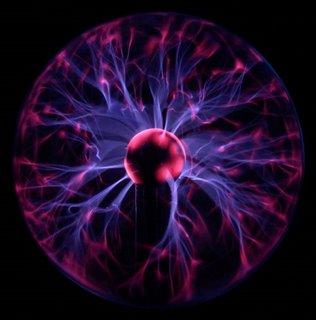
Hot Gas in Space Mimics Life


Electrically charged specks of interstellar dust organize into DNA-like double helixes and display properties normally attributed to living systems, such as evolving and reproducing.

But scientists are hesitant to call the dancing dust particles "alive," and instead say they are just another example of how difficult it is to define life.
[+/-] Click here to expand

Plasma life

The computer model, detailed in the Aug. 14 issue of the New Journal of Physics, shows what happens to microscopic dust particles when they are injected into plasma.

Plasma is the fourth state of matter along with solids, liquids and gases. While unfamiliar to most people, plasma is the most common phase of matter in the universe. Stars are luminous balls of plasma, and diffuse plasma pervades the space between stars. Plasma forms when gas becomes so hot that electrons are stripped from atomic nuclei, leaving behind a soup of charged particles.

Past studies on Earth have shown that if enough particles are injected into a low-temperature plasma, they will spontaneously organize into crystal-like structures.

The new computer simulations suggest that in the gravity-free environment of space, the plasma particles will bead together to form string-like filaments that then twist into corkscrew shapes. The helical strands resemble DNA and are themselves electrically charged and attracted to one another.

The computer-modeled plasma particles can also divide to form two copies of the original structure and even "evolve" into more stable structures that are better able to survive in the plasma.

"These complex, self-organized plasma structures exhibit all the necessary properties to qualify them as candidates for inorganic living matter," said study team member V.N. Tsytovich of the Russian Academy of Science.

Is it alive?

Nevertheless, Tsytovich's colleague and study team member, Gregor Morfill of the Max Planck Institute for Extraterrestrial Physics in Garching, Germany, is hesitant to call the plasma particles alive.

"Maybe it's a question of upbringing," Morfill said. "I would hesitate to call it life. The reason why we published this paper is not because we wanted to suggest this could evolve into life, but because we wanted to start the discussion ... once more of what exactly do we mean by life."

Seth Shostak, a senior astronomer at the SETI Institute in Mountain View, California, also was cautious in calling the particles alive. The facts are, we still don't have a good definition of what 'life' is.

Shostak points out that while most high-school biology textbooks include as requirements for life the ability to metabolize and reproduce, it's easy to think of things that break these rules. Fire, for example, reproduces and metabolizes, but most people would not say it is alive; and mules, which are clearly alive, can't reproduce.

"We still stumble on what it means to be alive, and that means that these complex molecules are in a never-never land between the living and the merely reacting," Shostak added.

If the particles were considered alive though, Shostak said, it would completely overturn another common assumption about life.

"We've always assumed that life was a planetary phenomenon. Only on planets would you have the liquids thought necessary for the chemistry of life," he said. "So if you could have life in the hot gases of a star, or in the hot, interstellar gas that suffuses the space between the stars, well, not only would that be 'life as we don't know it' but it might be the most common type of life."

Hot Gas in Space Mimics Life
By Ker Than from Space.com
________________________________________________________
________________________________________________________
Life's Cometary Arrival Unlikely by Centauri Dreams
Life on Comets? - New Theory from Cardiff University
Physicists Discover Dust With Lifelike Qualities from Science Daily

________________________________________________________
________________________________________________________

Labels: , ,

Friday, April 20, 2007

Scorching Hot O Stars


Image credit: NASA/JPL-Caltech

Astronomers Map Out Planetary Danger Zone
The further on the edge, the hotter the intensity. Cooler stars like our sun live in the danger zones around scorching hot stars, called O-stars. The closer a young, maverick star happens to be to a super hot O-star, the more likely its burgeoning planets will be blasted into space.

This movie animation illustrates how the process works. Showing an O-star (top right in the image above) in a murky star-forming region. It then pans out to show a young, cooler star and its swirling disk of planet-forming material. Disks like this one, called protoplanetary disks, are where planets are born. Gas and dust in a disk clumps together into tiny balls that sweep through the material, growing in size to eventually become full-grown planets.

The young star happens to lie within the "danger zone" around the O-star, which means that it is too close to the hot star to keep its disk. Radiation and winds from the O-star boil and blow away the material, respectively. This process, called photoevaporation, is sped up here but takes anywhere from 100,000 to about 1,000,000 years. Without a disk, the young star will not be able to produce planets.

Our own sun and its suite of planets might have grown up on the edge of an O-star's danger zone before migrating to its current, spacious home. However, we know that our young sun didn't linger for too long in any hazardous territory, or our planets, and life, wouldn't be here today.

NASA's Spitzer Space Telescope surveyed the danger zones around five O-stars in the Rosette nebula. It was able to determine that the zones are spheres with a radius of approximately 1.6 light-years, or 10 trillion miles.
_______________________________________________________
_______________________________________________________

Labels: , ,

Tuesday, March 13, 2007

Near-Earth Space


CLUSTER a collection of four spacecraft flying in formation around Earth, opens a new window on ‘magnetic reconnection’ in the near-Earth space

Magnetic reconnection is a process that can occur almost anywhere that a magnetic field is found. In a reconnection event, the magnetic field lines are squeezed together somehow and spontaneously reconfigure themselves, releasing energy.

When it occurs near the surface of the Sun, such an event powers giant solar flares that can release thousands of millions of tonnes of electrically charged particles into space.

The Earth's magnetic field creates a buffer zone, the magnetosphere, between our planet's atmosphere and the particles released during these eruptions. The Sun also releases a steadier flow of charged particles called the solar wind. On the large-scale, any heading this way buffet the magnetosphere, and are deflected by it. Plasma physicists describe this behaviour with a theory called 'magneto-hydrodynamics' (MHD).

On smaller scales, however, the picture becomes rather more complicated. The particles can actually flow across the magnetic field lines.This makes the mathematics of the behaviour more difficult. First to misbehave are the ions (positively charged particles). These break away from simple MHD on scales of less than a few hundred kilometres. On even smaller scales, less than 10 kilometres, the electrons (negatively charged particles) begin playing by other rules, too.

Magnetic reconnection within Earth's magnetosphere regularly takes place on the night-time side of our planet, where the flow of the solar wind stretches out the magnetic field into a long tail. When the field reconnects in this region, it triggers jets of energetic particles that can cause auroral lights but can also damage satellites.

Read more from ESA International
Cluster opens a new window on ‘magnetic reconnection’ in the near-Earth space
The original paper, "Cluster PEACE observations of electron pressure tensor divergence in the magnetotail," by P.D. Henderson et al., is published in Geophysical Research letters (Vol. 33, L22106, doi:10.1029/2006GL027868, 2006).
_______________________________________________________
_______________________________________________________
A Step Toward Fusion Energy from Science Daily
Solar Energy Conversion Offers A Solution To Help Mitigate Global Warming
New Gadget To Study Plasma Bubbles That Can Disrupt Satellite Communications
_______________________________________________________
_______________________________________________________

Labels: , , ,

Friday, February 09, 2007

Polar Lights


In an old television tube (not the recent LCD or plasma TV screens), accelerated electrons hit a phosphorescent screen and cause the phosphor to glow. The acceleration region generating the aurora works similarly.

Electrons in the atmosphere get accelerated in an 'acceleration region' between about 5000 and 8000 kilometres altitude, and rush down to the Earth's ionosphere – a region of the upper atmosphere. They finally crash into ionospheric atoms and molecules, transferring to them some of the energy and cause them to glow, creating aurorae.

Giant electrical circuits power the magical open-air light show of the auroras, forming arcs in high-latitude regions like Scandinavia. New results obtained thanks to ESA's Cluster satellites provide a new insight into the source of the difference between the two types of electrical circuits currently known to be associated to the auroral arcs.


Auroras form in high latitude regions of Earth, and appear in many different shapes.

The aurora in the early evening sky forms a green arc that stretches across the sky in an east-west direction. The longitudinal extent (length) of an auroral arc can be as large as several thousands kilometres, but its width can be as small as 100 metres.
The deep mechanisms that rule the creation of such beutiful natural light displays (also called polar lights), have been the subject of studies that have been keeping solar and plasma scientists busy for years, with more to come. While early rockets and ground-observations have already provided a few important clues for the understanding of these phenomena, the real break-throughs in our knowledge have started with dedicated auroral satellites, such as S3-3, Dynamics Explorer, Viking, Freja and FAST, and have now come to full fruition with ESA's multi-point mission Cluster.

Photo Credits: Jan Curtis, Fairbanks, Alaska


Artistic view of electrons, responsible for aurora, spiralling down magnetic field lines. The U-shaped potential structure illustrates the region where electrons get accelerated on their way down to the upper atmosphere. Here they are stopped by collisions with neutral atoms and molecules, primarily oxygen and nitrogen, at altitudes of a few hundreds kilometres down to 80 kilometres. Each collision transfers part of the electron energy to these atmospheric particles. In turn, they get rid of this energy excess by emitting visible emissions in specific wavelength (or colours) such as green (oxygen) or purple (nitrogen).

It has been observed that these electric potential structures are mainly of two types - symmetric (U-shaped) or asymmetric (S-shaped), and typically occur at the boundaries between magnetospheric regions with different properties.

The former type (U-shaped) was found at a plasma boundary between the so-called ‘central plasma sheet’, situated in the magnetotail at equatorial latitudes, and the ‘plasma sheet boundary layer’, an adjacent area located at higher latitudes. The latter type (S-shaped) was found at the boundary between the ‘plasma sheet boundary layer’ and the polar cap, further up in latitude.

Image Credits: ESA
Read more
Cluster – new insights into the electric circuits of polar lights
______________________________________________________
Auroras: Paintings in the sky from Exploratorium
Looking at exoplanet atmospheres from Centauri Dreams
Magnetic Explosions In The Distant Universe from Science Daily
______________________________________________________
______________________________________________________

Labels: , , ,

Monday, January 29, 2007

Plasma & Ionosphere


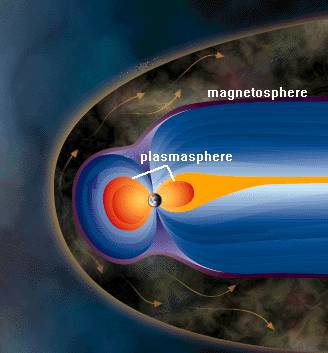
The plasmasphere, or inner magnetosphere is a region of the Earth's magnetosphere consisting of low energy (cool) plasma. It is located above the ionosphere. The outer boundary of the plasmasphere is known as the plasmapause, which is defined by an order of magnitude drop in plasma density.

Traditionally, the plasmasphere has been regarded as a well behaved cold plasma with particle motion dominated entirely by the geomagnetic field and hence corotating with the Earth. In contrast, recent satellite observations have shown that density irregularities such as plumes or biteouts may form. It has also been shown that the plasmasphere does not always co-rotate with the Earth.

The ionosphere is the part of the atmosphere that is ionized by solar radiation. It plays an important part in atmospheric electricity and forms the inner edge of the magnetosphere.

The lowest part of the Earth's atmosphere is called the troposphere and it extends from the surface up to about 10 km (6 miles). The atmosphere above 10 km is called the stratosphere, followed by the mesosphere. It is in the stratosphere that incoming solar radiation creates the ozone layer.

At heights of above 80 km (50 miles), in the thermosphere, the atmosphere is so thin that free electrons can exist for short periods of time before they are captured by a nearby positive ion. The number of these free electrons is sufficient to affect radio propagation. This portion of the atmosphere is ionized and contains a plasma which is referred to as the ionosphere.

In a plasma, the negative free electrons and the positive ions are attracted to each other by the electromagnetic force, but they are too energetic to stay fixed together in an electrically neutral molecule.

Solar radiation at ultraviolet (UV) and shorter X-Ray wavelengths is considered to be ionizing since photons at these frequencies are capable of dislodging an electron from a neutral gas atom or molecule during a collision. At the same time, however, an opposing process called recombination begins to take place in which a free electron is "captured" by a positive ion if it moves close enough to it. As the gas density increases at lower altitudes, the recombination process accelerates since the gas molecules and ions are closer together. The point of balance between these two processes determines the degree of ionization present at any given time.

The ionization depends primarily on the Sun and its activity. The amount of ionization in the ionosphere varies greatly with the amount of radiation received from the sun. Thus there is a diurnal (time of day) effect and a seasonal effect. The local winter hemisphere is tipped away from the Sun, thus there is less received solar radiation. The activity of the sun is associated with the sunspot cycle, with more radiation occurring with more sunspots. Radiation received also varies with geographical location (polar, auroral zones, mid-latitudes, and equatorial regions). There are also mechanisms that disturb the ionosphere and decrease the ionization. There are disturbances such as solar flares and the associated release of charged particles into the solar wind which reaches the Earth and interacts with its geomagnetic field.

Solar radiation, acting on the different compositions of the atmosphere with height, generates layers of ionization:

The D layer is the innermost layer, 50 km to 90 km above the surface of the Earth. During the night cosmic rays produce a residual amount of ionization. Recombination is high in this layer, thus the net ionization effect is very low and as a result high-frequency (HF) radio waves aren't reflected by the D layer.

The frequency of collision between electrons and other particles in this region during the day is about 10 million collisions per second. The D layer is mainly responsible for absorption of HF radio waves, particularly at 10 MHz and below, with progressively smaller absorption as the frequency gets higher. The absorption is small at night and greatest about midday. The layer reduces greatly after sunset, but remains due to galactic cosmic rays. A common example of the D layer in action is the disappearance of distant AM broadcast band stations in the daytime.

The E layer is the middle layer, 90 km to 120 km above the surface of the Earth. Ionization is due to soft X-ray (1-10 nm) and far ultraviolet (UV) solar radiation ionization of molecular oxygen (O2). This layer can only reflect radio waves having frequencies less than about 10 MHz. It has a negative effect on frequencies above 10 MHz due to its partial absorption of these waves.

The vertical structure of the E layer is primarily determined by the competing effects of ionization and recombination. At night the E layer begins to disappear because the primary source of ionization is no longer present. This results in an increase in the height where the layer maximizes because recombination is faster in the lower layers. Diurnal changes in the high altitude neutral winds also plays a role. The increase in the height of the E layer maximum increases the range to which radio waves can travel by reflection from the layer.

The statements above assumed that each layer was smooth and uniform. In reality the ionosphere is a lumpy, cloudy layer with irregular patches of ionization.


The Equatorial Anomaly is the occurrence of a trough of concentrated ionization in the F2 layer. The Earth's magnetic field lines are horizontal at the magnetic equator. Solar heating and tidal oscillations in the lower ionosphere move plasma up and across the magnetic field lines. This sets up a sheet of electric current in the E region which, with the horizontal magnetic field, forces ionization up into the F layer, concentrating at ± 20 degrees from the magnetic equator. This phenomenon is known as the equatorial fountain.

Protons: polar cap absorption (PCA)
Associated with solar flares is a release of high-energy protons. These particles can hit the earth within 15 minutes to 2 hours of the solar flare. The protons spiral around and down the magnetic field lines of the Earth and penetrate into the atmosphere near the magnetic poles increasing the ionization of the D and E layers. PCA's typically last anywhere from about an hour to several days, with an average of around 24 to 36 hours.
_______________________________________________________
_______________________________________________________

Labels: ,

Saturday, January 27, 2007

Plasma & Spin


_______________________________________________________

Plasma - The Fourth State of Matter
In physics and chemistry, a plasma is typically an ionized gas, and is usually considered to be a distinct state of matter in contrast to solids, liquids, and gases because of its unique properties. "Ionized" means that at least one electron has been dissociated from a proportion of the atoms or molecules. The free electric charges make the plasma electrically conductive so that it responds strongly to electromagnetic fields.

Except near the electrodes, where there are sheaths containing very few electrons, the ionized gas contains ions and electrons in about equal numbers so that the resultant space charge is very small. We shall use the name plasma to describe this region containing balanced charges of ions and electrons.

Plasma typically takes the form of neutral gas-like clouds or charged ion beams, but may also include dust and grains (called dusty plasmas). They are typically formed by heating and ionizing a gas, stripping electrons away from atoms, thereby enabling the positive and negative charges to move freely.

Common Plasmas
Plasmas are the most common phase of matter. Some estimates suggest that up to 99% of the entire visible universe is plasma. Since the space between the stars is filled with a plasma, albeit a very sparse one (see interstellar medium and intergalactic space), essentially the entire volume of the universe is plasma (see astrophysical plasmas).

Notable plasma physicist Hannes Alfvén also noted that due to their electric charge, very small grains also behave as ions and form part of plasma (see dusty plasmas).

The Earth's Plasmasphere (inner magnetosphere)


The Earth's "plasma fountain", showing oxygen, helium, and hydrogen ions that gush into space from regions near the Earth's poles. The faint yellow area shown above the north pole represents gas lost from Earth into space; the green area is the aurora borealis-or plasma energy pouring back into the atmosphere.

Plasma properties are strongly dependent on the bulk (or average) parameters. Some of the most important plasma parameters are the degree of ionization, the plasma temperature, the density and the magnetic field in the plasma region.

Definition of a plasma
Although a plasma is loosely described as an electrically neutral medium of positive and negative particles, a more rigorous definition requires three criteria to be satisfied:

The plasma approximation: Charged particles must be close enough together that each particle influences many nearby charged particles, rather than just interacting with the closest particle (these collective effects are a distinguishing feature of a plasma). The plasma approximation is valid when the number of electrons within the sphere of influence (called the Debye sphere whose radius is the Debye (screening) length) of a particular particle is large. The average number of particles in the Debye sphere is given by the plasma parameter, Λ.

Bulk interactions: The Debye screening length (defined above) is short compared to the physical size of the plasma. This criterion means that interactions in the bulk of the plasma are more important than those at its edges, where boundary effects may take place.

Plasma frequency: The electron plasma frequency (measuring plasma oscillations of the electrons) is large compared to the electron-neutral collision frequency (measuring frequency of collisions between electrons and neutral particles). When this condition is valid, plasmas act to shield charges very rapidly (quasineutrality is another defining property of plasmas).

Range of Plasmas Density increases upwards, temperature increases towards the right. The free electrons in a metal may be considered an electron plasma


A candle flame.
Fire can be considered to be a low temperature partial plasma.

Plasma temperature
Plasma temperature is commonly measured in kelvins or electronvolts, and is (roughly speaking) a measure of the thermal kinetic energy per particle. In most cases the electrons are close enough to thermal equilibrium that their temperature is relatively well-defined, even when there is a significant deviation from a Maxwellian energy distribution function, for example due to UV radiation, energetic particles, or strong electric fields.

Because of the large difference in mass, the electrons come to thermodynamic equilibrium among themselves much faster than they come into equilibrium with the ions or neutral atoms. For this reason the ion temperature may be very different from (usually lower than) the electron temperature. This is especially common in weakly ionized technological plasmas, where the ions are often near the ambient temperature.

Based on the relative temperatures of the electrons, ions and neutrals, plasmas are classified as thermal or non-thermal. Thermal plasmas have electrons and the heavy particles at the same temperature i.e. they are in thermal equilibrium with each other. Non thermal plasmas on the other hand have the ions and neutrals at a much lower temperature (normally room temperature) whereas electrons are much "hotter".

Temperature controls the degree of plasma ionization. In particular, plasma ionization is determined by the electron temperature relative to the ionization energy (and more weakly by the density) in accordance with the Saha equation.

A plasma is sometimes referred to as being hot if it is nearly fully ionized, or cold if only a small fraction (for example 1%) of the gas molecules are ionized (but other definitions of the terms hot plasma and cold plasma are common). Even in a "cold" plasma the electron temperature is still typically several thousand degrees Celsius. Plasmas utilized in plasma technology ("technological plasmas") are usually cold in this sense.


_______________________________________________________
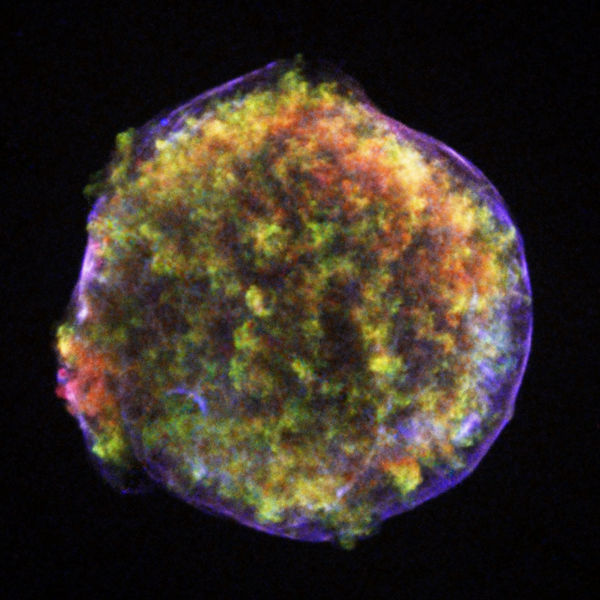
The remnant of Tycho's Supernova, a huge ball of expanding plasma.
The blue outer shell arises from X-ray emission by high-speed electrons.

Although the underlying equations governing plasmas are relatively simple, plasma behaviour is extraordinarily varied and subtle: the emergence of unexpected behaviour from a simple model is a typical feature of a complex system. Such systems lie in some sense on the boundary between ordered and disordered behaviour, and cannot typically be described either by simple, smooth, mathematical functions, or by pure randomness. The spontaneous formation of interesting spatial features on a wide range of length scales is one manifestation of plasma complexity.

Quasineutrality of a plasma requires that plasma currents close on themselves in electric circuits. Such circuits follow Kirchhoff's circuit laws, and possess a resistance and inductance. These circuits must generally be treated as a strongly coupled system, with the behaviour in each plasma region dependent on the entire circuit. It is this strong coupling between system elements, together with nonlinearity, which may lead to complex behaviour.


_____________________________________________________
A solar coronal mass ejection blasts plasma throughout the solar system.

Electrical circuits in plasmas store inductive (magnetic) energy, and should the circuit be disrupted, for example, by a plasma instability, the inductive energy will be released as plasma heating and acceleration. This is a common explanation for the heating which takes place in the solar corona. Electric currents, and in particular, magnetic-field-aligned electric currents (which are sometimes generically referred to as Birkeland currents), are also observed in the Earth's aurora, and in plasma filaments.
_______________________________________________________
_______________________________________________________
Famous Quotes:
Essentially the entire volume of the Universe is Plasma.
_______________________________________________________
_______________________________________________________

Labels:

Plasma & Spin - 2


_______________________________________________________
A schematic representation of the Heliospheric current sheet, the largest structure in the Solar System, resulting from the influence of the Sun's rotating magnetic field on the plasma in the interplanetary medium (Solar Wind). It is sometimes informally refered to as the 'Ballerina Skirt' model.


Ordinarily, the current sheet circles the Sun's equator like a wavy skirt around a ballerina's waist. But during the double north pole event of March 2000, the current sheet was radically altered: The waviness increased. Irregularities appeared. Its topology "morphed" from a ballerina's skirt to a giant seashell.

Cellular structure
Narrow sheets with sharp gradients may separate regions with different properties such as magnetization, density, and temperature, resulting in cell-like regions. Examples include the magnetosphere, heliosphere, and heliospheric current sheet.

From the cosmological point of view, the most important new space research discovery is probably the cellular structure of space. As has been seen, in every region of space which is accessible to in situ measurements, there are a number of `cell walls', sheets of electric currents, which divide space into compartments with different magnetization, temperature, density, etc


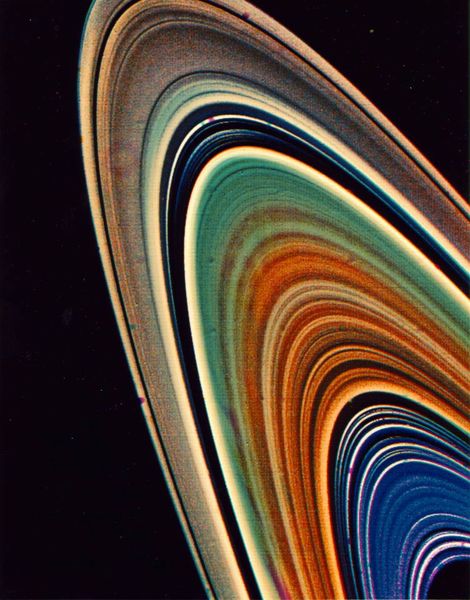
Saturn's rings
in which certain effects have been suggested are due to dusty plasmas (false colour image)

Ultracold Plasma
It is possible to create ultracold plasmas, by using lasers to trap and cool neutral atoms to temperatures of 1 mK lower. Another laser then ionizes the atoms by giving each of the outermost electrons just enough energy to escape the electrical attraction of its parent ion.

The key point about ultracold plasmas is that by manipulating the atoms with lasers, the kinetic energy of the liberated electrons can be controlled. Using standard pulsed lasers, the electron energy can be made to correspond to a temperature of as low as 0.1 K,­ a limit set by the frequency bandwidth of the laser pulse.

The ions, however, retain the millikelvin temperatures of the neutral atoms. This type of non-equilibrium ultracold plasma evolves rapidly, and many fundamental questions about its behaviour remain unanswered. Experiments conducted so far have revealed surprising dynamics and recombination behaviour that are pushing the limits of our knowledge of plasma physics.


_______________________________________________________
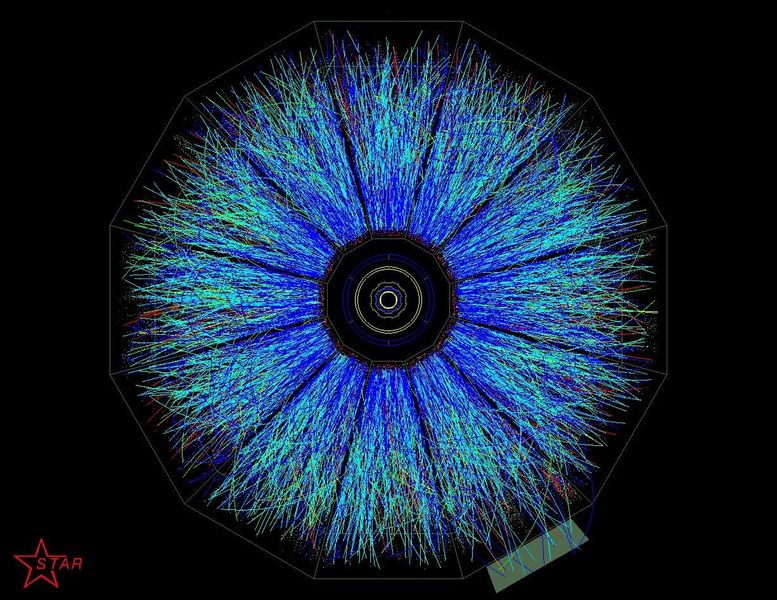
A Quark Gluon Plasma QGP is formed at the collision point of two relativistically accelerated gold ions in the center of the STAR detector at the RHIC.

A quark-gluon plasma (QGP) is a phase of quantum chromodynamics (QCD) which exists at extremely high temperature and density. It is believed to have existed during the first 20 or 30 microseconds after the universe came into existence in the Big Bang.

Experiments at CERN's Super Proton Synchrotron (SPS) first tried to create the QGP in the 1980s and 1990s, and may have been partially successful. Currently, experiments at Brookhaven National Laboratory's Relativistic Heavy Ion Collider (RHIC) are continuing this effort. Three new experiments running on CERN's Large Hadron Collider (LHC), ALICE, ATLAS and CMS, will continue studying properties of QGP.


_______________________________________________________
Hall effect thruster - Plasma Thrusters.
The electric field in a plasma double layer is so effective at accelerating ions, that electric fields are used in ion drives

Double layers involve localised charge separation, which causes a large potential difference across the layer, but does not generate an electric field outside the layer. Double layers separate adjacent plasma regions with different physical characteristics, and are often found in current carrying plasmas. They accelerate both ions and electrons.

More on PLASMA SCIENCES
Credits @ wikipedia - Plasma (physics)
_______________________________________________________
_______________________________________________________
Famous Quotes: The most important plasma & space
research discovery is the cellular structure of space
_______________________________________________________
_______________________________________________________

Labels: