Tuesday, May 01, 2007

Sombrero Galaxy M104


The Sombrero, also known as M104, is one of the largest galaxies in the nearby Virgo cluster, about 28 million light years from Earth. This Great Observatories view of the famous Sombrero galaxy was made using NASA's Chandra X-ray Observatory, Hubble Space Telescope and Spitzer Space Telescope. The main figure shows the combined image from the three telescopes, while the three inset images show the separate observatory views.

The Chandra X-ray image (in blue) shows hot gas in the galaxy and point sources that are a mixture of objects within the Sombrero as well as quasars in the background. The Chandra observations show that diffuse X-ray emission extends over 60,000 light years from the center of the Sombrero. (The galaxy itself spans 50,000 light years across.) Scientists think this extended X-ray glow may be the result of a wind from the galaxy, primarily being driven by supernovas that have exploded within its bulge and disk. The Hubble optical image (green) shows a bulge of starlight partially blocked by a rim of dust, as this spiral galaxy is being observed edge on. That same rim of dust appears bright in Spitzer's infrared image, which also reveals that Sombrero's central bulge of stars.

Chandra featured stories
________________________________________________________
________________________________________________________
If light travels the shortest distance between two points,
even if from the remotest parts of the observable universe
and all things being equal there is nothing between point A & B
what exactly would Carl Sagan et al have us tunneling thru
that would get us to point B from point A - faster than light.

Nova, It's String Theory - The Elegant Universe
________________________________________________________
________________________________________________________

Labels: , ,

Sunday, January 21, 2007

Blue Horse & Sombrero


_______________________________________________________
APoD Horse Head Shaped Reflection Nebula IC 4592
Credit & Copyright: Jim Misti & Steve Mazlin, (acquisition), Robert Gendler (processing)

Do you see the horse's head?
What you are seeing is not the famous Horsehead nebula toward Orion but rather a fainter nebula that only takes on a familiar form with deeper imaging. The main part of the above imaged molecular cloud complex is a reflection nebula cataloged as IC 4592. Reflection nebulas are actually made up of very fine dust that normally appears dark but can look quite blue when reflecting the light of energetic nearby stars. In this case, the source of much of the reflected light is a star at the eye of the horse. That star is part of Nu Scorpii, one of the brighter star systems toward the constellation of Scorpius. A second reflection nebula dubbed IC 4601 is visible surrounding two stars on the far right.


_______________________________________________________
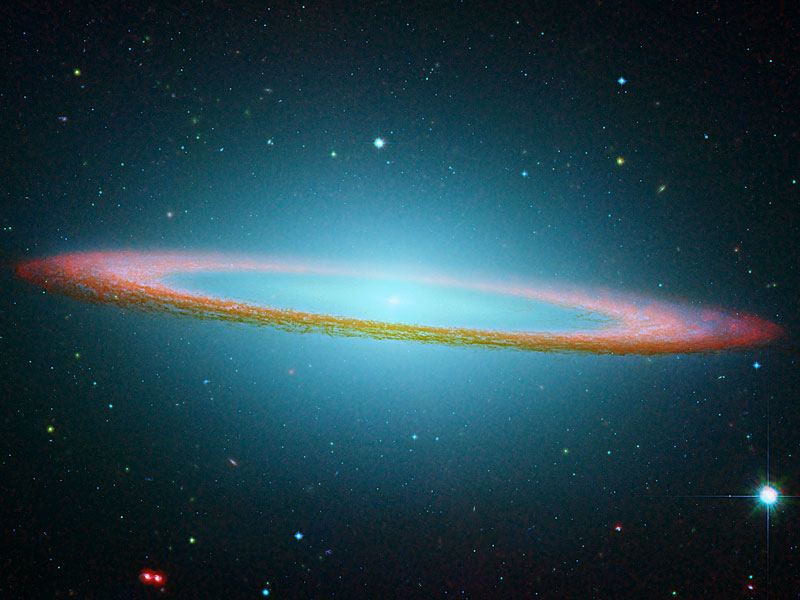
APoD The Sombrero Galaxy in Infrared
Credit: R. Kennicutt (Steward Obs.) et al., SSC, JPL, Caltech, NASA

This floating ring is the size of a galaxy.
In fact, it is part of the photogenic Sombrero Galaxy, one of the largest galaxies in the nearby Virgo Cluster of Galaxies. The dark band of dust that obscures the mid-section of the Sombrero Galaxy in optical light actually glows brightly in infrared light. The above image shows the infrared glow, recently recorded by the orbiting Spitzer Space Telescope, superposed in false-color on an existing image taken by NASA's Hubble Space Telescope in optical light. The Sombrero Galaxy, also known as M104, spans about 50,000 light years across and lies 28 million light years away. M104 can be seen with a small telescope in the direction of the constellation Virgo.
_______________________________________________________
_______________________________________________________
Famous Quotes: Fortune favours the bold. Virgil _______________________________________________________
_______________________________________________________

Labels: , , ,