Saturday, February 09, 2008

Cosmic Fossil


NGC 1132 A Mysterious Elliptical. Credit: Chanda

The NASA/ESA Hubble Space Telescope has captured a new image of the galaxy NGC 1132 which is, most likely, a cosmic fossil - the aftermath of an enormous multi-galactic pile-up, where the carnage of collision after collision has built up a brilliant but fuzzy giant elliptical galaxy far outshining typical galaxies.

The elliptical galaxy NGC 1132, seen in this latest image from Hubble, belongs to a category of galaxies called giant ellipticals. NGC 1132, together with the small dwarf galaxies surrounding it, are dubbed a "fossil group" as they are most likely the remains of a group of galaxies that merged together in the recent past.

In visible light NGC 1132 appears as a single, isolated, giant elliptical galaxy, but this is only the tip of the iceberg. Scientists have found that NGC 1132 resides in an enormous halo of dark matter, comparable to the amount of dark matter usually found in an entire group of tens or hundreds of galaxies.

It also has a strong X-ray glow from an abundant amount of hot gas - an amount normally only found in galaxy groups. Its X-ray glow extends over a region of space ten times larger than the 120,000 light-year radius it has in visible light. An X-ray glow that is equal in size to that of an entire group of galaxies.

The origin of fossil group systems remains a puzzle. The most likely explanation is that they are the end-products of a cosmic feeding frenzy in which a large cannibal galaxy devours all of its neighbours. A less likely explanation is that they may be very rare objects that formed in a region or period of time where the growth of moderate-sized galaxies was somehow suppressed, and only one large galaxy formed.

Many galaxies reside in groups that are gravitationally bound together, including our own Milky Way, which is part of the Local Group. Sometimes gravity makes galaxies collide and eventually merge into one single galaxy. There is strong evidence that the Milky Way is one such cannibal that has snacked on numerous smaller galaxies during its lifetime, inheriting their stars in the process.

Scientists are keenly studying the environment surrounding galaxies such as NGC 1132 using space telescopes like Hubble, and they try to trace the history of the formation these galaxies by analysing their properties.

In this Hubble image, NGC 1132 is seen surrounded by thousands of ancient globular clusters, swarming around the galaxy like bees around a hive. These globular clusters are likely to be the survivors of the disruption of their cannibalised parent galaxies that have been eaten by NGC 1132 and may reveal its merger history. In the background, there is a stunning tapestry of numerous galaxies that are much further away.

Elliptical galaxies are smooth and featureless. They contain hundreds of millions to trillions of stars, and their shapes range from nearly spherical to very elongated in shape. Their overall yellowish colour is a telltale sign of their great age. Because elliptical galaxies do not contain much cool gas they can no longer make new stars.

NGC 1132 is located approximately 320 million light-years away in the constellation of Eridanus, the River. This image of NGC 1132 was taken with Hubble's Advanced Camera for Surveys. Data obtained in 2005 and 2006 through green and near-infrared filters were used to produce a colour composite.
___________________________________________________________
___________________________________________________________

Labels: , , ,

Friday, February 01, 2008

Young Star Cluster


Credit: NASA/CXC/Univ. de Liège/Y. Naze et al

Westerlund 2, a young star cluster with an estimated age of about one or two million years. Until recently little was known about this cluster because it is heavily obscured by dust and gas. However, using infrared and X-ray observations to overcome this obscuration, Westerlund 2 has become regarded as one of the most interesting star clusters in the Milky Way galaxy. It contains some of the hottest, brightest and most massive stars known.

This Chandra image of Westerlund 2 shows low energy X-rays in red, intermediate energy X-rays in green and high energy X-rays in blue. The image shows a very high density of massive stars that are bright in X-rays, plus diffuse X-ray emission.

An incredibly massive double star system called WR20a is visible as the bright yellow point just below and to the right of the cluster's center. This system contains stars with masses of 82 and 83 times that of the Sun. The dense streams of matter steadily ejected by these two massive stars, called stellar winds, collide with each other and produce copious amounts of X-ray emission. This collision is seen at different angles as the stars orbit around each other every 3.7 days. Several other bright X-ray sources may also show evidence for collisions between winds in massive binary systems.

Spitzer Infrared Images of Westerlund 2
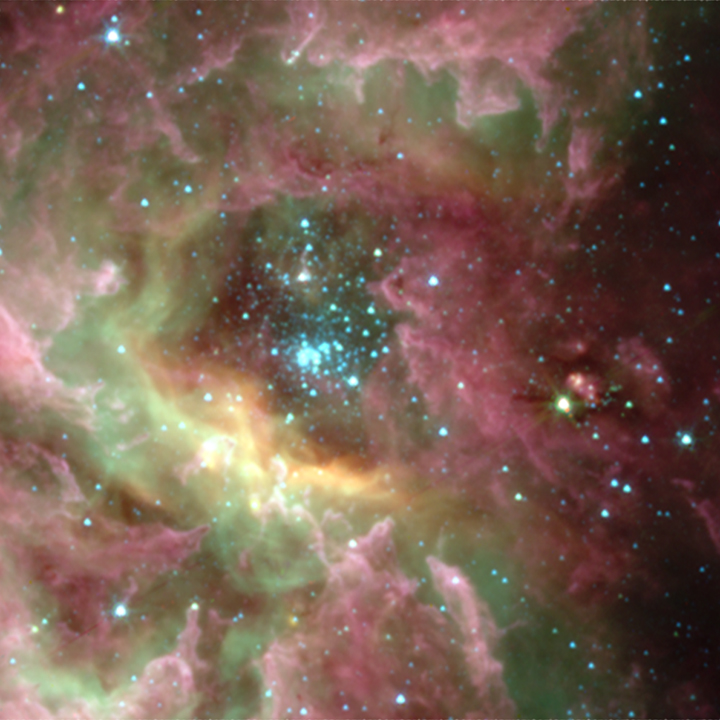
RCW 49 is the surrounding HII region around the young stellar cluster Westerlund 2 (Wd2). Because many of the stars in RCW 49 are deeply embedded in plumes of dust, they cannot be seen at visible wavelengths. When viewed with Spitzer's infrared eyes, however, RCW 49 becomes transparent.

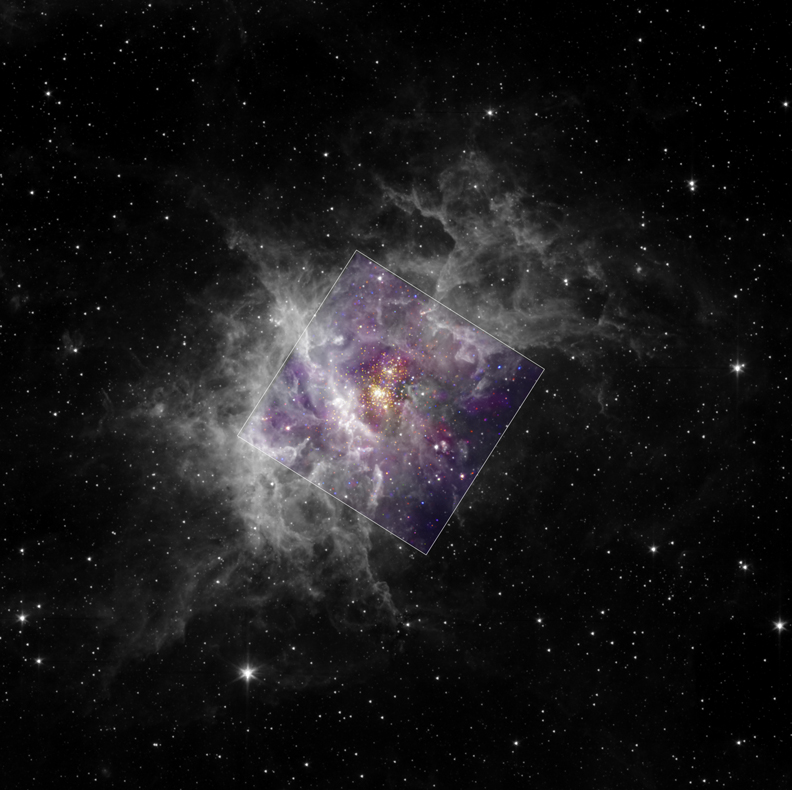
Chandra X-ray & Spitzer Infrared Image of Westerlund 2
This coloured Chandra X-ray Observatory image (inset) shows Westerlund 2 in context with the Spitzer infrared observation. ___________________________________________________________
___________________________________________________________

Labels: , , ,

Wednesday, January 16, 2008

Spinning Black Holes


Results from NASA's Chandra X-ray Observatory, combined with new theoretical calculations, provide one of the best pieces of evidence yet that many supermassive black holes are spinning extremely rapidly.

The images below show 4 out of the 9 large galaxies included in the Chandra study, each containing a supermassive black hole in its center.


The Chandra images show pairs of huge bubbles, or cavities, in the hot gaseous atmospheres of the galaxies, created in each case by jets produced by a central supermassive black hole. Studying these cavities allows the power output of the jets to be calculated. This sets constraints on the spin of the black holes when combined with theoretical models.

The Chandra images were also used to estimate how much fuel is available for each supermassive black hole, using a simple model for the way matter falls towards such an object. The artist's impression on the right side of the main graphic shows gas within a "sphere of influence" falling straight inwards towards a black hole before joining a rapidly spinning disk of matter near the center.

Most of the material in this disk is swallowed by the black hole, but some of it is swept outwards in jets (coloured blue) by quickly spinning magnetic fields close to the black hole.
_________________________________________________________
_________________________________________________________

Labels: , , ,

Monday, December 17, 2007

Death Star Galaxy


Credit: NASA, ESA, and D. Evans (Harvard-Smithsonian Center for Astrophysics)

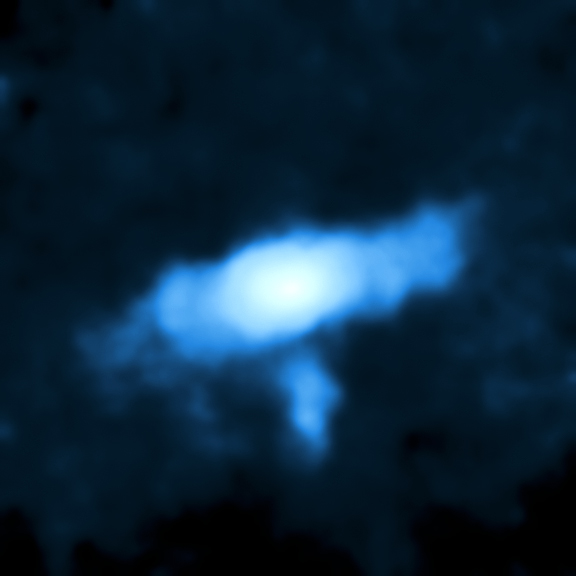
A powerful jet from a supermassive black hole is blasting a nearby galaxy, according to new data from NASA observatories. This never-before witnessed galactic violence may have a profound effect on planets in the jet's path and trigger a burst of star formation in its destructive wake.

Known as 3C 321, the system contains two galaxies in orbit around each other. Data from NASA's Chandra X-ray Observatory show both galaxies contain supermassive black holes at their centers, but the larger galaxy has a jet emanating from the vicinity of its black hole. The smaller galaxy apparently has swung into the path of this jet.

This "death star galaxy" was discovered through the combined efforts of both space and ground-based telescopes. NASA's Chandra X-ray Observatory, Hubble Space Telescope, and Spitzer Space Telescope were part of the effort. The Very Large Array (VLA) in Socorro, N.M., and the Multi-Element Radio Linked Interferometer Network (MERLIN) telescopes in the United Kingdom also were needed for the finding.

Jets from supermassive black holes produce high amounts of radiation, especially high-energy X-rays and gamma-rays, which can be lethal in large quantities. The combined effects of this radiation and particles traveling at almost the speed of light could severely damage the atmospheres of planets lying in the path of the jet. For example, protective layers of ozone in the upper atmosphere of planets could be destroyed.

Jets produced by supermassive black holes transport enormous amounts of energy far from the black holes and enable them to affect matter on scales vastly larger than the size of the black hole. Learning more about jets is a key goal for astrophysical research.

The effect of the jet on the companion galaxy is likely to be substantial, because the galaxies in 3C 321 are extremely close at a distance of only about 20,000 light-years apart, approximately the same distance as Earth is from the center of the Milky Way galaxy.

A bright spot in the VLA and MERLIN images shows where the jet has struck the side of the galaxy, dissipating some of the jet's energy. The collision disrupted and deflected the jet.

Another unique aspect of the discovery in 3C 321 is how relatively short-lived this event is on a cosmic time scale. Features seen in the VLA and Chandra images indicate that the jet began impacting the galaxy about one million years ago, a small fraction of the system's lifetime. This means that such an alignment is quite rare in the nearby universe, making 3C 321 an important opportunity to study such a phenomenon.

It is possible the event is not all bad news for the galaxy being struck by the jet. The massive influx of energy and radiation from the jet could induce the formation of large numbers of stars and planets after its initial wake of destruction is complete.

For more images and information about 3C 321, visit:
http://chandra.harvard.edu
__________________________________________________________
__________________________________________________________

Labels: , , ,

Wednesday, November 28, 2007

3 million miles per hour


Click on Image to Enlarge.

This graphic shows a wide-field view of the Puppis A supernova remnant along with a close-up image of the neutron star, known as RX J0822-4300. The larger field-of-view is a composite of X-ray data from the ROSAT satellite (pink) and optical data (purple), from the Cerro Tololo Inter-American Observatory 0.9-meter telescope, which highlights oxygen emission. Astronomers think Puppis A was created when a massive star ended its life in a supernova explosion about 3,700 years ago, forming an incredibly dense object called a neutron star and releasing debris into space.

The neutron star was ejected by the explosion. The inset box shows two observations of this neutron star obtained with the Chandra X-ray Observatory over the span of five years, between December 1999 and April 2005. By combining how far it has moved across the sky with its distance from Earth, astronomers determined the cosmic cannonball is moving at over 3 million miles per hour, one of the fastest moving stars ever observed. At this rate, RX J0822-4300 is destined to escape from the Milky Way after millions of years, even though it has only traveled about 20 light years so far.

The results from this study suggest the supernova explosion was lop-sided, kicking the neutron star in one direction and much of the debris from the explosion in the other. The estimated location of the explosion is shown in the above composite image. The direction of motion of the cannonball, shown by an arrow, is in the opposite direction to the overall motion of the oxygen debris, seen in the upper left. The arrows show the estimated motion over the next 1,000 years. The oxygen clumps are believed to be massive enough so that momentum is conserved in the aftermath of the explosion.

Credit: Chandra: NASA/CXC/Middlebury College/F.Winkler et al.; ROSAT: NASA/GSFC/S.Snowden et al.; Optical: NOAO/CTIO/Middlebury College/F.Winkler et al.
___________________________________________________________
___________________________________________________________
Star cluster's extreme speed puzzles astronomers from New Scientist
ESO's VLT takes the search for young galaxies to new limits from ESO
___________________________________________________________
___________________________________________________________

Labels: , , ,

Thursday, November 15, 2007

Bustling Hub of Star Formation


Credit: X-ray: NASA/CXC/CfA/S.Wolk et al;
Optical: NSF/AURA/WIYN/Univ. of Alaska/T.A.Rector


NGC 281 is a bustling hub of star formation about 10,000 light years away in the Constellation of Cassiopeia. This composite image of optical and X-ray emission includes regions where new stars are forming and older regions containing stars about 3 million years old.

The optical data (seen in red, orange, and yellow) show a small open cluster of stars, large lanes of obscuring gas and dust, and dense knots where stars may still be forming. The X-ray data (purple), based on a Chandra observation lasting more than a day, shows a different view. More than 300 individual X-ray sources are seen, most of them associated with IC 1590, the central cluster.

The edge-on aspect of NGC 281 allows scientists to study the effects of powerful X-rays on the gas in the region, the raw material for star formation.

A second group of X-ray sources is seen on either side of a dense molecular cloud, known as NGC 281 West, a cool cloud of dust grains and gas, much of which is in the form of molecules. The bulk of the sources around the molecular cloud are coincident with emission from polycyclic aromatic hydrocarbons, a family of organic molecules containing carbon and hydrogen.

There also appears to be cool diffuse gas associated with IC 1590 that extends toward NGC 281 West.

The X-ray spectrum of this region shows that the gas is a few million degrees and contains significant amounts of magnesium, sulfur and silicon. The presence of these elements suggests that supernova recently went off in that area.

More Images of NGC 281 from Chandra
___________________________________________________________
___________________________________________________________
Hubble's Island Universes: Watching Galaxies Grow Old Gracefully
___________________________________________________________
___________________________________________________________

Labels: , ,

Thursday, November 08, 2007

Light from Young Galaxies


The artist's illustration shows a typical massive galaxy as it would have appeared when the universe was only about a quarter of its current age. This young galaxy contains an active galactic nucleus (AGN), or quasar, in its center, a luminous object powered by the rapid growth of a supermassive black hole. Some of the light from the AGN is obscured by dense gas and dust near the center of the galaxy. The galaxy itself is undergoing a growth spurt, as shown by bright regions of star formation in the spiral arms.

Spitzer Space Telescope observations are extremely efficient at detecting distant AGN like this because dust and gas should absorb high-energy radiation from the AGN and re-emit it at longer wavelengths, generating copious amounts of infrared emission.

Large numbers of galaxies thought to contain such highly obscured AGN have been discovered in the Great Observatories Origins Deep Survey. The infrared emission for these galaxies exceeds the levels likely to be caused by star formation. However, X-ray observations were required to confirm the presence of obscured AGN, by looking for the high energy X-rays expected from such objects (less energetic X-rays are mostly absorbed).
[+/-] Click here to expand


The image on the left shows a "stacked" Chandra image of distant, massive galaxies detected with Spitzer. Image stacking is a procedure used to detect emission from objects that is too faint to be detected in single images. To enhance the signal, images of these faint objects are stacked on top of one another. In this image, low-energy X-rays are shown in orange and high-energy X-rays in blue, and the stacked object is in the center of the image (the other sources beyond the center of the image are individual AGN that were directly detected and are not part of the source stacking).

The blue stacked source confirms the hypothesis that large numbers of these young, massive galaxies contain heavily obscured AGN. Spitzer also detected infrared emission from young, massive galaxies that is consistent with expectations for star formation. These galaxies do not contain AGN, because their supermassive black holes are dormant.

A stacked Chandra image (right) of these "normal" massive galaxies shows mainly soft X-ray emission at the center, as expected.

This image, taken with Spitzer's infrared vision, shows a fraction of these black holes, which are located deep in the bellies of distant, massive galaxies. Spitzer originally scanned the field of galaxies shown in the picture as part of a multiwavelength program called the Great Observatories Origins Deep Survey, or Goods.

This picture shows a portion of the Goods field called Goods-South. When astronomers saw the Spitzer data, they were surprised to find that hundreds of the galaxies between 9 and 11 billion light years away were shining with an unexpected excess of infrared light.

They then followed up with X-ray data from Chandra of the same field, and applied a technique called stacking, which adds up the faint light of multiple galaxies. The results revealed that the infrared-bright galaxies are hiding many black holes that had been theorized about before but never seen. This excess infrared light is being produced by the growing black holes.

Credit: Illustration: NASA/JPL-Caltech/T.Pyle (SSC); X-ray: NASA/CXC/Durham/D.Alexander et al.; Infrared: NASA/JPL-Caltech/CEA/E.Daddi

__________________________________________________________
__________________________________________________________
Monster black holes power highest-energy cosmic rays from SNS
Cosmic 'Bullets' Traced to Galactic Black Holes from Live Science
'Violent' Black Holes Linked To High Energy Cosmic Rays from Scientic Blogging
Finding Antimatter & Collecting Natural Antimatter Centauri Dreams
__________________________________________________________
__________________________________________________________

Labels: , , ,

Tuesday, October 23, 2007

G292.0+1.8


Credit: X-ray: NASA/CXC/Penn State/S.Park et al.; Optical: Pal.Obs. DSS

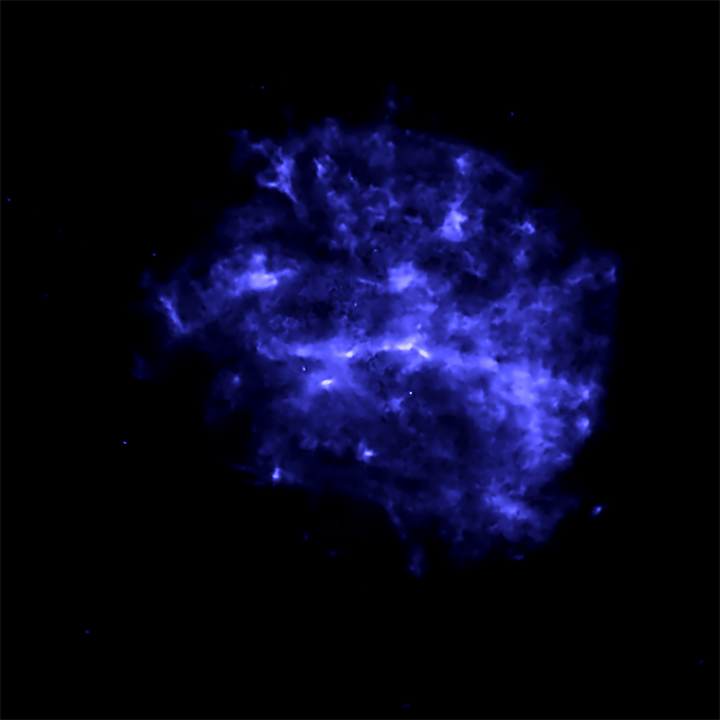
When a massive star explodes, it creates a shell of hot gas that glows brightly in X-rays. Chandra is able to observe the stellar debris, revealing the dynamics of the explosion.

Located about 20,000 light years away in the constellation of Centaurus, G292.0+1.8 is shown in beautiful detail in this new composite image. In colour is the Chandra X-ray Observatory image - easily the deepest X-ray image ever obtained of this supernova remnant - and in white is optical data from the Digitized Sky Survey.

Although considered a "textbook" case of a supernova remnant, the intricate structure shown here reveals a few surprises.

Near the center of G292.0+1.8 is the so-called pulsar wind nebula, most easily seen in high energy X-rays. This is the magnetized bubble of high-energy particles that surrounds the "pulsar", a rapidly rotating neutron star that remained behind after the original, massive star exploded. The narrow, jet-like feature running from north to south in the image is likely parallel to the spin axis of the pulsar.
[+/-] Click here to expand

The pulsar is located slightly below and to the left of the center of G292.0+1.8. Assuming that the pulsar was born at the center of the remnant, it is thought that recoil from the lopsided explosion may have kicked the pulsar in this direction. However, the kick direction and the pulsar spin direction do not appear to be aligned, in contrast to apparent spin-kick alignments seen in some other supernova remnants.

Another key feature of this remnant is the long white line running from left to right across the center called the equatorial belt. This structure is thought to be created when the star - before it died - expelled material from around its equator via winds. The orientation of the equatorial belt suggests the parent star maintained the same spin axis both before and after it exploded.

One puzzling aspect of the image is the lack of evidence for thin filaments of high energy X-ray emission, thought to be an important site for cosmic ray acceleration in supernova remnants. These filaments are seen in other supernova remnants such as Cassiopeia A, Tycho and Kepler.

One explanation may be that efficient acceleration occurs primarily in very early stages of supernova remnant evolution, and G292.0+1.8, with an estimated age of several thousand years, is too old to show these effects. Casseiopeia A, Tycho and Kepler, with ages of several hundred years, are much younger.

___________________________________________________________
___________________________________________________________

Labels: , , ,

Wednesday, October 17, 2007

Extreme Stellar Black Hole


Credit: NASA/CXC/M. Weiss

An artist's representation of M33 X-7: a binary system in the nearby galaxy M33, containing a massive blue star feeding material to a black hole surrounded by a small accretion disk.

Stellar black holes form when stars with masses around 20 times that of the sun collapse under the weight of their own gravity at the ends of their lives. Most stellar black holes weigh in at around 10 solar masses when the smoke blows away.

The black hole in M33 X-7 located 2.7 million light-years from Earth, is also the most distant stellar black hole ever observed.

The findings, detailed in the Oct. 17 issue of the journal Nature, could help improve formation models of "binary" systems containing a black hole and a star. It could also help explain one of the brightest star explosions ever observed.

The blackhole orbits a companion star in the spiral galaxy Messier 33. The companion star of M33 X-7 passes directly in front of the black hole as seen from Earth once every three days, completely eclipsing its X-ray emissions. It is the only known binary system in which this occurs, and it was this unusual arrangement that allowed astronomers to calculate the pair's masses very precisely.

The tight orbits of the black hole and star suggests the system underwent a violent stage of star evolution called the common-envelope phase, in which a dying star swells so much it sucks the companion inside its gas envelope.

The result is either a merger between the two stars or the formation of a tight binary in which one star is stripped of its outer layers. The latter scenario may be what happens in the case of M33 X-7, and the stripped star explodes as a supernova before imploding to form a black hole.

However, something unusual must have happened to M33 X-7 during this phase to create such a massive black hole. The black hole must have lost a large amount of mass for the two objects to be so close, but on the other hand, it must have retained enough mass to form such a heavy black hole.

M33 X-7 might thus provide both the upper and lower limits on the amount of mass loss and orbital tightening that can occur in the common envelope.

While the estimated 16 solar masses of the black hole in M33 X-7 is hefty for a stellar black hole, it is miniscule compared with the black holes thought to lie in the heart of many large galaxies.

Such "supermassive" black holes have masses millions to billions times that of our sun, but they are thought to form by mechanisms different from the stellar variety.

M33 X-7: Heaviest Stellar Black Hole Discovered in Nearby Galaxy from Chandra
___________________________________________________________
___________________________________________________________
The fantastic skies of Orphan Stars from NASA Science
Hubble finds Youthful-looking galaxy conceals ancient stars
___________________________________________________________
___________________________________________________________

Labels: , ,

Wednesday, October 03, 2007

Invisible Dark Matter


Photo by Chandra X-ray telescope team.

The Dark Matter Of The Universe Has A Long Lifetime

The two clusters of galaxies, called Bullet Cluster, are in the process of moving through each other. The red curves show gravitational measurements of the combined mass that consists of partly the visible matter of the galaxies and partly the invisible dark matter.

X-ray measurements of the two clusters of galaxies show that the clouds of gas have been pushed out at the collision between the two clusters of galaxies. In the cluster of galaxies to the right there is a lot of dark matter, but very little x-ray, so the dark matter decays very slowly and thus has a very, very long lifetime.

The universe consists not just of visible celestial bodies, stars, planets and galaxies. It also has a mystical fellow player - dark matter. New research from the Niels Bohr Institute presents new information that adds another piece of knowledge to the jigsaw puzzle of the dark mystery of the universe - dark matter.

The research has just been published in the Physical Review Letters: Searching for Decaying Axionlike Dark Matter from Clusters of Galaxies

Astronomers can measure that dark matter exists in big quantities but no one knows what it is, nobody has seen it. It does not emit light and it does not reflect light. It is invisible. It is a mystery and the researchers have many theories.

The dark matter has caused the researchers headaches for decades since it was detected in the 1970s, and there is intense research into the phenomena. It is invisible but it has got mass, and thus it has got gravitation that can be measured.

By analysing the galaxies it is possible to weigh them, and it turns out that by far the greatest matter of the collective mass of the galaxy is dark matter.

Just like stars get together in galaxies, the galaxies get together in clusters of galaxies of up to several thousand galaxies. Signe Riemer-Sorensen, astrophysicist at the Niels Bohr Institute, has analysed two clusters of galaxies that collide.
[+/-] Click here to expand

When the two clusters of galaxies meet neither the galaxies nor the dark matter collide. However, about 12 per cent of the mass of the cluster of galaxies consists of huge clouds of gas and dust and these clouds collide.

The gas clouds are hot and emit x-ray that can be observed, and it is possible to see how the clouds are actually pushed out of the two clusters of galaxies at the collision. When the clouds of gas collide they become even hotter and emit more x-ray so that a whole shock front of warn gas is generated.

Observations indicate that the dark matter can be a new and still undetected type of particle. Among the suggestions for the dark matter, are particles that when they decay they emit x-ray.

One is the so called axions that are particles which is explained in theories with extra dimensions. So to be able to look for x-ray from dark matter the researchers are looking in places where there is a big concentration of dark matter, but no gas.

Such places are found in the two colliding clusters of galaxies where the gas clouds have been pushed out at the collision. Sorensen has analysed the one of the two clusters of galaxies that are in the process of colliding.

The analyses show that it is a very heavy cluster with many galaxies, and measurement of the gravitation show that there is a very big amount of dark matter, up to 85 per cent of the collective mass. However, no x-ray of any consequence was measured.

When the dark matter does not emit significant x-ray it is possible to calculate an upper limit to how quickly the particles decay and thus calculate their lifetime.

The result is that if axions are to be the dark matter they must have a life span that is longer that 3.000.000 billion years. In that case there is not very much dark matter that has decayed yet if it was formed 13.7 billion years ago. The conclusion is that dark matter has a very, very long lifetime.

_________________________________________________________
_________________________________________________________

Labels: , ,

Friday, September 14, 2007

Coronet Cluster


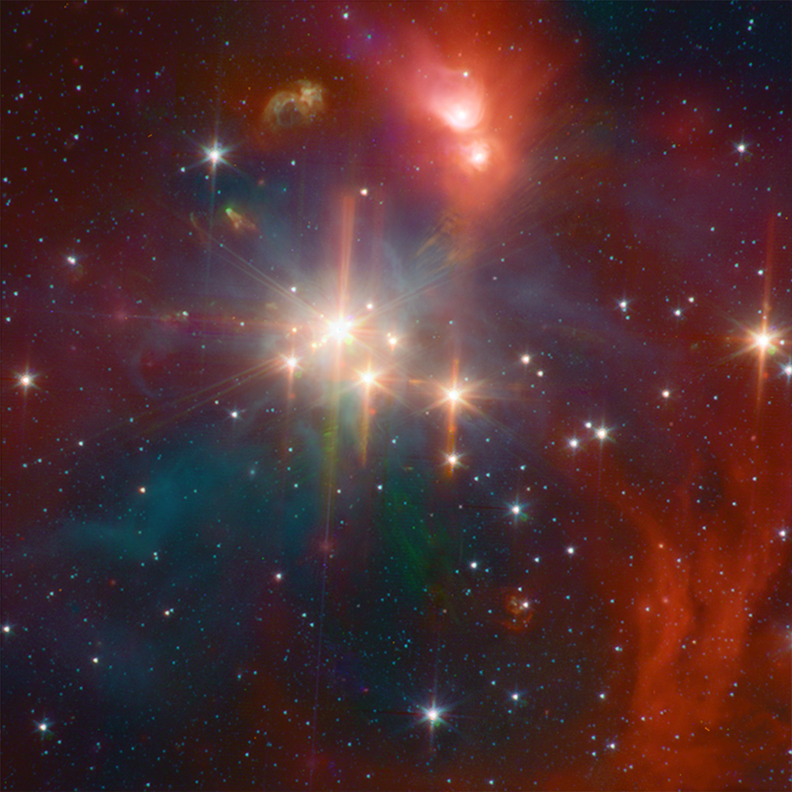
The Coronet Cluster in the heart of the Corona Australis region, is one of the nearest and most active regions of ongoing star formation. At only about 420 light years away, the Coronet is over three times closer than the Orion Nebula is to Earth.

The Coronet contains a loose cluster of a few dozen young stars with a wide range of masses and at various stages of evolution, giving astronomers an opportunity to observe "protostars" simultaneously in several wavelengths.

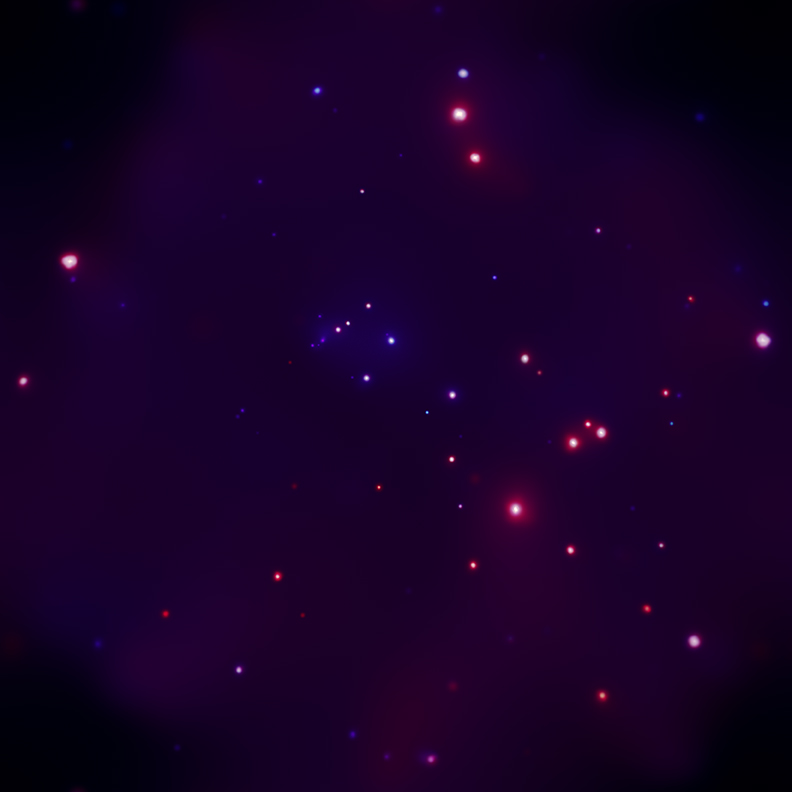
This composite image shows the coronet in X-Rays from Chandra (purple) and infrared emission from Spitzer (orange, green, and cyan). The Spitzer image shows young stars plus diffuse emission from dust.

In the Chandra data only, many of these young stars appear as blue objects, revealing their output of high-energy X-rays and the amount of obscuring dust and gas in the region. The reason for the blue appearance is that lower energy X-rays, depicted as red and green, are absorbed by this veil of material and hence are not seen.

The Chandra data also support the idea that X-rays from very young stars are generated largely from magnetic activity in the outer atmospheres. Due to the host of young stars in different life stages in the Coronet, astronomers can use these data to pinpoint details of how the youngest stars evolve.

Coronet Cluster Images from Chandra
__________________________________________________________
__________________________________________________________
Building the Celestial Bestiary from Centauri Dreams
Two Cosmic Mysteries explained by the same particle?
Galaxy 'Hunting' Made Easy from European Southern Observatory
__________________________________________________________
__________________________________________________________

Labels: , ,

Monday, August 13, 2007

Stellar Debris N49


This is a composite image of N49, the brightest supernova remnant in optical light in the Large Magellanic Cloud.

The Chandra X-ray image (blue) shows million-degree gas in the center. Much cooler gas at the outer parts of the remnant is seen in the infrared image from Spitzer (red). While astronomers expected that dust particles were generating most of the infrared emission, the study of this object indicates that much of the infrared is instead generated in heated gas.

The unique filamentary structure seen in the optical image by Hubble (white & yellow) has long set N49 apart from other well understood supernova remnants, as most supernova remnants appear roughly circular in visible light. Recent mapping of molecular clouds suggests that this supernova remnant is expanding into a denser region to the southeast, which would cause its asymmetrical appearance. This idea is confirmed by the Chandra data. Although X-rays reveal a round shell of emission, the X-rays also show brightening in the southeast, confirming the idea of colliding material in that area.

N49 is about 160,000 light years (distance to Large Magellanic Cloud) in the Dorado Constellation

Credit X-ray: NASA/CXC/Caltech/S.Kulkarni et al.; Optical: NASA/STScI/UIUC/Y.H.Chu & R.Williams et al.; IR: NASA/JPL-Caltech/R.Gehrz et al.
_________________________________________________________
_________________________________________________________
More Images of N49 and Zoom into N49 with Chandra
Supernovas & Supernova Remnants from Chandra X-Ray Observatory
Taking it to the Edge RCW 86 & G347.3-0.5 Chandra & XMM Newton X-Ray Images
__________________________________________________________
__________________________________________________________

Labels: , , ,

Wednesday, July 18, 2007

The Bullet Cluster


Composite image of the Bullet Cluster.

When individual galaxies collide and spiral into one another, they discard trails of hot gas that stretch across space, providing signposts to the mayhem. Recognising the signs of collisions between whole clusters of galaxies, however, is not as easy.

The orbiting X-ray telescopes XXM-Newton and Chandra have caught a pair of galaxy clusters merging into a giant cluster. The discovery adds to existing evidence that galaxy clusters can collide faster than previously thought.

During the collision the hot gas (shown in pink) in each cluster is slowed and distorted by a drag force, similar to air resistance. A bullet-shaped cloud of gas forms in one of the clusters.

The optical image from the Magellan and the Hubble Space Telescope shows galaxies in orange and white in the background. Hot gas, which contains the bulk of the normal matter in the cluster, is shown by the Chandra X-ray image, which shows the hot intracluster gas in pink. Gravitational lensing and the distortion of background images by mass in the cluster, reveals the mass of the cluster may be dominated by dark matter (blue), an exotic form of matter abundant in the Universe, with very different properties compared to normal matter.

Major cluster-cluster collisions are expected to be rare, with estimates of their frequency ranging from less than one in a thousand clusters to one in a hundred. On collision, their internal gas is thrown out of equilibrium and if unrecognised, causes underestimation of its mass by between 5 and 20 percent.

This is important because the masses of the various galaxy clusters are used to estimate the cosmological parameters that describe how the Universe expands. So, identifying colliding systems is extremely important to our understanding of the Universe.

X-ray satellites discover the biggest collisions in the Universe from ESA
Image Credits: X-ray: NASA/CXC/CfA/M.Markevitch, Optical and lensing map: NASA/STScI, Magellan/U.Arizona/D.Clowe, Lensing map: ESO WFI

_________________________________________________________
_________________________________________________________
Biggest Collisions in the Universe from Universe Today
A Close Stellar Encounter? debris disk around HD 15115 from Centauri Dreams
_________________________________________________________
_________________________________________________________

Labels: , , ,

Saturday, July 14, 2007

Star with Mystery Partner?


When stars are more massive than about 8 times the Sun, they end their lives in a spectacular explosion called a supernova.

The outer layers of the star are hurtled out into space at thousands of miles an hour, leaving a debris field of gas and dust. Where the star once was located, a small, incredibly dense object called a neutron star is often found. While only 10 miles or so across, the tightly packed neutrons in such a star contain more mass than the entire Sun.
[+/-] Click here to expand

A new X-ray image shows the 2,000 year-old-remnant of such a cosmic explosion, known as RCW 103, which occurred about 10,000 light years from Earth. In Chandra's image, the colours of red, green, and blue are mapped to low, medium, and high-energy X-rays. At the center, the bright blue dot is likely the neutron star that astronomers believe formed when the star exploded.

For several years astronomers have struggled to understand the behaviour of this object, which exhibits unusually large variations in its X-ray emission over a period of years. New evidence from Chandra implies that the neutron star near the center is rotating once every 6.7 hours, confirming recent work from XMM-Newton. This is much slower than a neutron star of its age should be spinning.

One possible solution to this mystery is that the massive progenitor star to RCW 103 may not have exploded in isolation. Rather, a low-mass star that is too dim to see directly may be orbiting around the neutron star. Gas flowing from the unseen neighbour onto the neutron star might be powering its X-ray emission, and the interaction of the magnetic field of the two stars could have caused the neutron star to slow its rotation.

RCW 103: A Star with a Mystery Partner?
Credit: NASA/CXC/Penn State/G.Garmire et al


Neutron Star
For a sufficiently massive star, an iron core is formed and still the gravitational collapse has enough energy to heat it up to a high enough temperature to either fuse or fission iron. Either in the aftermath of a supernova or in just a collapsing massive star, the energy gets high enough to break down the iron into alpha particles and other smaller units, and still the pressure continues to build.

When it reaches the threshold of energy necessary to force the combining of electrons and protons to form neutrons, the electron degeneracy limit has been passed and the collapse continues until it is stopped by neutron degeneracy. At this point it appears that the collapse will stop for stars with mass less than two or three solar masses, and the resulting collection of neutrons is called a neutron star. Pulsars are thought to be neutron stars.

If the mass exceeds about three solar masses, then even neutron degeneracy will not stop the collapse, and the core shrinks toward the black hole condition.

This neutron degeneracy radius is about 20 km for a solar mass, compared to about earth size for a solar mass white dwarf. The density is quoted as about a billion tons per teaspoonful compared to 5 tons per teaspoonful for the white dwarf.

Neutron stars may be crystalline with crusts on the order of 100 meters thick and an atmosphere a few centimeters thick. They may have 10 to the 11 times the earth's gravity and a powerful magnetic field. A neutron star might have an atmosphere a few centimeters thick and mountain ranges poking up a few centimeters through the atmosphere. A neutron star is thought to be about 1/100,000 the diameter of the Sun, and a nucleus is on the order of 100,000 times smaller than an atom.

________________________________________________________
________________________________________________________
First Light from The Canarias Telescope by Stefan @ BackReaction
Supernova theory strengthened by new observations - ESO release
________________________________________________________
________________________________________________________

Labels: , ,

Tuesday, June 26, 2007

Circinus X-1


Neutron Stars Join The Black Hole Jet Set

This artist's illustration depicts the jet of relativistic particles blasting out of Circinus X-1, a system where a neutron star is in orbit with a star several times the mass of the Sun.

The neutron star, an extremely dense remnant of an exploded star consisting of tightly packed neutrons, is seen as the sphere at the center of the disk. The powerful gravity of the neutron star pulls material from the companion star (shown as the blue star in the background) into a so-called accretion disk surrounding it.

Through a process that is not fully understood, a jet of material moving at nearly the speed of light is generated. A high percentage of the energy available from material falling toward the neutron star is converted into powering this jet.
[+/-] Click here to expand

The image in the inset is Chandra's X-ray image of the neutron star in Circinus X-1. Low energy X-rays are shown in red, medium energy X-rays in green and high energies in blue. The jet itself is seen to the upper right corner and consists of two fingers of X-ray emission (shown in red) separated by about 30 degrees. These two fingers, located at least about 5 light years from the neutron star, may represent the outer walls of a wide jet. Alternatively, they may represent two separate, highly collimated jets produced at different times by a precessing neutron star. That is, the neutron star may wobble like a top as it spins and the jet fires at different angles at different times. The structures on the opposite side (red, to the lower left) may be evidence for counter jets. The rest of the colored areas surrounding the bright central source are instrumental artifacts and not representative of structures associated with Circinus X-1.

The jet in Circinus X-1 is helping astronomers better understand how neutron stars, and not just black holes, can generate these powerful beams. Many jets have been found originating near black holes (both the supermassive and stellar-mass variety), but the Circinus X-1 jet is the first extended X-ray jet associated with a neutron star in a binary system. This detection shows that the unusual properties of black holes -- such as presence of an event horizon and the lack of an actual surface -- may not be required to form powerful jets. The result also reveals how efficient neutron stars can be as cosmic power factories.

Circinus Constellation about 31,000 light years from Earth
Credit: X-ray: NASA/CXC/S.Heintz et al; Illustration: NASA/CXC/M.Weiss
_________________________________________________________
_________________________________________________________

Labels: , ,

Sunday, June 24, 2007

New view of ETA


Composite image of the Eta Carinae from NASA's Chandra X-ray Observatory and Hubble Space Telescope shows the remnants of a massive eruption from the star during the 1840s.

Eta Carinae is a mysterious, extremely bright and unstable star located about 7,500 light years from Earth. The star is thought to be consuming its nuclear fuel at an incredible rate, while quickly drawing closer to its ultimate explosive demise.

When Eta Carinae does explode, it will be a spectacular fireworks display seen from Earth, perhaps rivaling the moon in brilliance. Its fate has been foreshadowed by the recent discovery of SN2006gy, a supernova in a nearby galaxy that was the brightest stellar explosion ever seen. The erratic behavior of the star that later exploded as SN2006gy suggests that Eta Carinae may explode at any time.

Eta Carinae, a star between 100 and 150 times more massive than the Sun, is near a point of unstable equilibrium where the star's gravity is almost balanced by the outward pressure of the intense radiation generated in the nuclear furnace. This means that slight perturbations of the star might cause enormous ejections of matter from its surface.

In the 1840s, Eta Carinae had a massive eruption by ejecting more than 10 times the mass of the sun, to briefly become the second brightest star in the sky. This explosion would have torn most other stars to pieces but somehow Eta Carinae survived.

This hot shroud extends far beyond the cooler, optical nebula and represents the outer edge of the interaction region. The X-ray observations show that the ejected outer material is enriched by complex atoms, especially nitrogen, cooked inside the star's nuclear furnace and dredged up onto the stellar surface.

The Chandra observations also show that the inner optical nebula glows faintly due to X-ray reflection. The X-rays reflected by the optical nebula come from very close to the star itself; these X-rays are generated by the high-speed collision of wind flowing from Eta Carinae's surface (moving at about 1 million miles per hour) with the wind of the companion star (which is about five times faster).

The companion is not directly visible, but variability in X-rays in the regions close to the star signals the star's presence. Astronomers don't know exactly what role the companion has played in the evolution of Eta Carinae, or what role it will play in its future.

Original Source Chandra: A new view of doomed star
_________________________________________________________
_________________________________________________________

Labels: ,

Tuesday, May 22, 2007

A Close Neighbour


Andromeda, the nearest major galaxy to the Milky Way, is shown here in this wide-field optical image from Kitt Peak.

Located in the constellation of Andromeda (the Princess), the Andromeda Galaxy is a large spiral galaxy over 65,000 light years in diameter and approximately 2.9 million light years from Earth.
(Credit: NOAO/AURA/NSF/T.Rector & B.A.Wolpa)

The central region of Andromeda is shown in a composite image, with X-rays from NASA's Chandra X-ray Observatory (blue) combined with the optical image. Astronomers believe that Andromeda, also known as Andromeda Galaxy (M31), and the Milky Way will merge in a few billion years.

In the composite image (insert), hot, X-ray bright gas is seen to envelop the middle of Andromeda. Point sources are also prominent, which mostly reveal pairs of stars that are interacting with each other. Many of these double stars are thought to include white dwarfs pulling large amounts of material away from a companion star. When the amount of gas being dumped onto the white dwarf gets too high a thermonuclear explosion occurs on the surface of the white dwarf, emitting bright X-rays. (Credit: NASA/CXC/MPE/W.Pietsch et al)

Andromeda Galaxy (M31):
A New Look at a Close Neighbor
from Chandra
_________________________________________________________
_________________________________________________________

Labels: , , ,

Monday, May 07, 2007

Brightest Supernova


U.S. astronomers say an exploding star first observed in September 06 has become the largest and most luminous supernova ever seen.

According to observations by NASA's Chandra X-ray Observatory and ground-based optical telescopes, the supernova SN 2006gy is the brightest and most energetic stellar explosion ever recorded and may be a long-sought new type of explosion.

The top panel of this graphic is an artist's illustration that shows what SN 2006gy may have looked like if viewed at a close distance. The fireworks-like material in white shows the explosion of an extremely massive star. This debris is pushing back two lobes of cool, red gas that were expelled in a large eruption from the star before it exploded. The green, blue and yellow regions in these lobes shows where gas is being heated in a shock front as the explosion material crashes into it and pushes it backwards. Most of the optical light generated by the supernova is thought to come from debris that has been heated by radioactivity, but some likely comes from the shocked gas.

The bottom left panel is an infrared image, using adaptive optics at the Lick Observatory, of NGC 1260, the galaxy containing SN 2006gy. The dimmer source to the lower left in that panel is the center of NGC 1260, while the much brighter source to the upper right is SN 2006gy.

The panel to the right shows Chandra's X-ray image of the same field of view, again showing the nucleus of NGC 1260 and SN 2006gy. The Chandra observation allowed astronomers to determine that SN 2006gy was indeed caused by the collapse of an extremely massive star, and not the most likely alternative explanation for the explosion, the destruction of a low-mass star. If the supernova was caused by a white dwarf star exploding into a dense, hydrogen-rich environment, SN 2006gy would have been about 1,000 times brighter in X-rays than what Chandra detected.

NASA's Chandra Sees Brightest Supernova Ever
_______________________________________________________
_______________________________________________________

Labels: , ,

Tuesday, May 01, 2007

Sombrero Galaxy M104


The Sombrero, also known as M104, is one of the largest galaxies in the nearby Virgo cluster, about 28 million light years from Earth. This Great Observatories view of the famous Sombrero galaxy was made using NASA's Chandra X-ray Observatory, Hubble Space Telescope and Spitzer Space Telescope. The main figure shows the combined image from the three telescopes, while the three inset images show the separate observatory views.

The Chandra X-ray image (in blue) shows hot gas in the galaxy and point sources that are a mixture of objects within the Sombrero as well as quasars in the background. The Chandra observations show that diffuse X-ray emission extends over 60,000 light years from the center of the Sombrero. (The galaxy itself spans 50,000 light years across.) Scientists think this extended X-ray glow may be the result of a wind from the galaxy, primarily being driven by supernovas that have exploded within its bulge and disk. The Hubble optical image (green) shows a bulge of starlight partially blocked by a rim of dust, as this spiral galaxy is being observed edge on. That same rim of dust appears bright in Spitzer's infrared image, which also reveals that Sombrero's central bulge of stars.

Chandra featured stories
________________________________________________________
________________________________________________________
If light travels the shortest distance between two points,
even if from the remotest parts of the observable universe
and all things being equal there is nothing between point A & B
what exactly would Carl Sagan et al have us tunneling thru
that would get us to point B from point A - faster than light.

Nova, It's String Theory - The Elegant Universe
________________________________________________________
________________________________________________________

Labels: , ,

Saturday, April 14, 2007

Black Hole Eclipse


Chandra observations of the galaxy NGC 1365 have captured a remarkable eclipse of the supermassive black hole at its center. A dense cloud of gas passed in front of the black hole, which blocked high-energy X-rays from material close to the black hole. This serendipitous alignment allowed astronomers to measure the size of the disk of material around the black hole, a relatively tiny structure on galactic scales.

Astronomers were able to measure the disk's size by observing how long it took for the black hole to go in and out of the eclipse. This was revealed during a series of observations of NGC 1365 obtained every two days over a period of two weeks in April 2006. During five of the observations, high-energy X-rays from the central X-ray source were visible, but in the second one - corresponding to the eclipse - they were not.


The Chandra image contains a bright X-ray source in the middle, which reveals the position of the supermassive black hole. An optical view of the galaxy from the European Space Observatory's Very Large Telescope shows the context of the Chandra data.

NGC 1365 contains a so-called active galactic nucleus, or AGN. Scientists believe that the black hole at the center of the AGN is fed by a steady stream of material, presumably in the form of a disk.

Material just about to fall into a black hole should be heated to millions of degrees before passing over the event horizon, or point of no return. The process causes the disk of gas around the central black hole in NGC 1365 to produce copious X-rays, but the structure is much too small to resolve directly with a telescope.

NGC 1365 is about 60 million light years
in the Constellation of Fornax (furnace).

Chandra Sees Remarkable Eclipse Of Black Hole from Science Daily 12th April 2007
More Images of NGC 1365 Eclipse from Chandra X-Ray Observatory
_______________________________________________________
_______________________________________________________

Labels: , ,