Monday, November 12, 2007

Highest-Energy Cosmic Rays

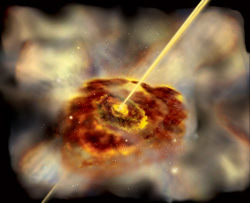
Active Galactic Nuclei (AGN) are found at the hearts of some galaxies and are thought to be powered by supermassive black holes that are devouring large amounts of matter.

They have long been considered sites where high-energy particle production might take place. They swallow gas, dust and other matter from their host galaxies and spew out particles and energy.

While most galaxies have black holes at their centre, only a fraction of all galaxies have an AGN. The exact mechanism of how AGNs can accelerate particles to energies 100 million times higher than the most powerful particle accelerator on Earth is still a mystery.
[+/-] Click here to expand

Cosmic rays are protons and atomic nuclei that travel across the universe at close to the speed of light. When these particles smash into the upper atmosphere of our planet, they create a cascade of secondary particles called an air shower that can spread across 40 or more square kilometres as they reach the Earth’s surface.

Professor Subir Sarkar of the Physics Department at Oxford University, a member of the Auger Collaboration, said: ‘The Auger data indicates that the sources of ultrahigh energy cosmic rays are associated with nearby 'active galaxies' which harbour supermassive black holes that are gobbling up stellar matter and ejecting huge jets of plasma. Our own galaxy too has such a black hole at its centre but, fortunately for us, it is not 'feeding' at the moment!’

The Pierre Auger Observatory records cosmic ray showers through an array of 1,600 particle detectors placed 1.5 kms apart in a grid spread across 3,000 square kms. Twenty-four specially designed telescopes record the emission of fluorescence light from the air shower. The combination of particle detectors and fluorescence telescopes provides an exceptionally powerful instrument for this research.

While the observatory has recorded almost a million cosmic-ray showers, only the rare, highest-energy cosmic rays can be linked to their sources with sufficient precision. Auger scientists so far have recorded 81 cosmic rays with energy above 4 x10¹⁹ electron volts, or 40 EeV. This is the largest number of cosmic rays with energy above 40 EeV recorded by any observatory.

At these ultra-high energies, the uncertainty in the direction from which the cosmic ray arrived is only a few degrees, allowing scientists to determine the location of the particle’s cosmic source.

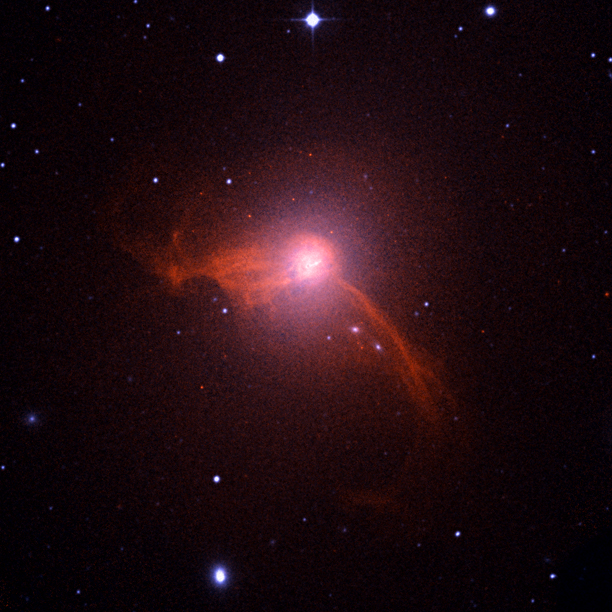
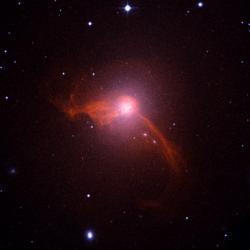
The Auger collaboration discovered that the 27 highest-energy events, with energy above 57 EeV, do not come equally from all directions. Comparing the clustering of these events with the known locations of 381 Active Galactic Nuclei, the collaboration found that most of these events correlated well with the locations of AGNs in some nearby galaxies, such as Centaurus A.

Click Image to Enlarge: Centaurus A

Low-energy cosmic rays are abundant and come from all directions, mostly from within our own Milky Way galaxy. Until now the only source of cosmic ray particles known with certainty has been the sun. Cosmic rays from other likely sources such as exploding stars take meandering paths through space so that when they reach Earth it is impossible to determine their origins.

"But when you look at the highest-energy cosmic rays from the most violent sources, they point back to their sources. The challenge now is to record enough of these cosmic bullets to understand the processes that hurl them into space," said Paul Mantsch, project manager of the Pierre Auger Observatory.

Cosmic rays with energy higher than about 60 EeV lose energy in collisions with the cosmic microwave background, (radiation left over from the Big Bang that fills all of space). But cosmic rays from nearby sources are less likely to lose energy in collisions on their relatively short trip to Earth. Auger scientists found that most of the 27 events with energy above 57 EeV came from locations in the sky that include the nearest AGNs, within a few hundred million light years of Earth.

Scientists think that most galaxies have black holes at their centres, with masses ranging from a million to a few billion times the mass of our sun. The black hole at the centre of our Milky Way galaxy weighs about 3 million solar masses, but it is not an AGN. Galaxies that have an AGN seem to be those that suffered a collision with another galaxy or some other massive disruption in the last few hundred million years. The AGN swallows the mass coming its way while releasing prodigious amounts of radiation. The Auger result indicates that AGNs may also produce the universe's highest-energy particles.

Cosmic-ray astronomy is challenging, because low-energy cosmic rays provide no reliable information on the location of their sources: as they travel across the cosmos, they are deflected by galactic and intergalactic magnetic fields that lead to blurry images. In contrast, the most energetic particles come almost straight from their sources, as they are barely affected by the magnetic fields. Unfortunately, they hit Earth at a rate of only about one event per square kilometre per century, which demands a very large observatory.

Because of its size, the Auger Observatory can record about 30 ultra-high-energy events per year. The Auger collaboration is developing plans for a second, larger installation in Colorado to extend coverage to the entire sky while substantially increasing the number of high-energy events recorded.

"Our current results show the promising future of cosmic-ray astronomy," said Auger co-spokesperson Giorgio Matthiae, of the University of Rome. "So far we have installed 1400 of the 1600 particle detectors of the Auger Observatory in Argentina. A northern site would let us look at more galaxies and black holes, increasing the sensitivity of our observatory. There are even more nearby AGNs in the northern sky than in the southern sky."

Source: Auger Observatory closes in on long standing mystery, links highest-energy cosmic rays with violent black holes

________________________________________________________
________________________________________________________
Breakthrough in Cosmic Ray mystery from SciTech
AGN and Ultra High Energy Cosmic Rays from Space Daily
AUGER: millions of TeV cosmic rays from black holes from The Reference Frame
Ultra High Energy Cosmic Rays (UHECR) from Auger @ BackReaction
_________________________________________________________
_________________________________________________________

Labels: , , ,

Thursday, November 08, 2007

Light from Young Galaxies


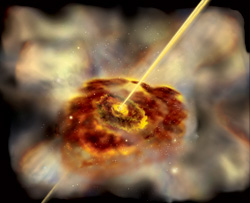
The artist's illustration shows a typical massive galaxy as it would have appeared when the universe was only about a quarter of its current age. This young galaxy contains an active galactic nucleus (AGN), or quasar, in its center, a luminous object powered by the rapid growth of a supermassive black hole. Some of the light from the AGN is obscured by dense gas and dust near the center of the galaxy. The galaxy itself is undergoing a growth spurt, as shown by bright regions of star formation in the spiral arms.

Spitzer Space Telescope observations are extremely efficient at detecting distant AGN like this because dust and gas should absorb high-energy radiation from the AGN and re-emit it at longer wavelengths, generating copious amounts of infrared emission.

Large numbers of galaxies thought to contain such highly obscured AGN have been discovered in the Great Observatories Origins Deep Survey. The infrared emission for these galaxies exceeds the levels likely to be caused by star formation. However, X-ray observations were required to confirm the presence of obscured AGN, by looking for the high energy X-rays expected from such objects (less energetic X-rays are mostly absorbed).
[+/-] Click here to expand


The image on the left shows a "stacked" Chandra image of distant, massive galaxies detected with Spitzer. Image stacking is a procedure used to detect emission from objects that is too faint to be detected in single images. To enhance the signal, images of these faint objects are stacked on top of one another. In this image, low-energy X-rays are shown in orange and high-energy X-rays in blue, and the stacked object is in the center of the image (the other sources beyond the center of the image are individual AGN that were directly detected and are not part of the source stacking).

The blue stacked source confirms the hypothesis that large numbers of these young, massive galaxies contain heavily obscured AGN. Spitzer also detected infrared emission from young, massive galaxies that is consistent with expectations for star formation. These galaxies do not contain AGN, because their supermassive black holes are dormant.

A stacked Chandra image (right) of these "normal" massive galaxies shows mainly soft X-ray emission at the center, as expected.

This image, taken with Spitzer's infrared vision, shows a fraction of these black holes, which are located deep in the bellies of distant, massive galaxies. Spitzer originally scanned the field of galaxies shown in the picture as part of a multiwavelength program called the Great Observatories Origins Deep Survey, or Goods.

This picture shows a portion of the Goods field called Goods-South. When astronomers saw the Spitzer data, they were surprised to find that hundreds of the galaxies between 9 and 11 billion light years away were shining with an unexpected excess of infrared light.

They then followed up with X-ray data from Chandra of the same field, and applied a technique called stacking, which adds up the faint light of multiple galaxies. The results revealed that the infrared-bright galaxies are hiding many black holes that had been theorized about before but never seen. This excess infrared light is being produced by the growing black holes.

Credit: Illustration: NASA/JPL-Caltech/T.Pyle (SSC); X-ray: NASA/CXC/Durham/D.Alexander et al.; Infrared: NASA/JPL-Caltech/CEA/E.Daddi

__________________________________________________________
__________________________________________________________
Monster black holes power highest-energy cosmic rays from SNS
Cosmic 'Bullets' Traced to Galactic Black Holes from Live Science
'Violent' Black Holes Linked To High Energy Cosmic Rays from Scientic Blogging
Finding Antimatter & Collecting Natural Antimatter Centauri Dreams
__________________________________________________________
__________________________________________________________

Labels: , , ,

Monday, July 30, 2007

New Type of Active Galaxy


Image credit: Aurore Simonnet, Sonoma State University.

This illustration shows the different features of an active galactic nucleus (AGN), and how our viewing angle determines what type of AGN we observe. The extreme luminosity of an AGN is powered by a supermassive black hole at the center. Some AGN have jets, while others do not.
[+/-] Click here to expand

Japanese and NASA Satellites Unveil New Type of Active Galaxy

Active Galactic Nuclei AGN, the extraordinarily energetic cores of galaxies such as Quasars, Blazars, and Seyfert galaxies, powered by accreting supermassive black holes, are among the most luminous objects in our Universe, often pouring out the energy of billions of stars from a region no larger than our solar system.

By using Swift and Suzaku, a team of astronomers has discovered that a relatively common class of AGN escaped detection…until now. These objects are so heavily shrouded in gas and dust that virtually no light gets out.

Evidence for this new type of AGN began surfacing over the past two years. Using Swift’s Burst Alert Telescope (BAT), a team led by Tueller has found several hundred relatively nearby AGNs that were previously missed because their visible and ultraviolet light was smothered by gas and dust. The BAT was able to detect high-energy X-rays from these heavily blanketed AGNs because, unlike visible light, high-energy X-rays can punch through thick gas and dust.

According to popular models, AGNs are surrounded by a donut-shaped ring of material, which partially obscures our view of the black hole. Our viewing angle with respect to the donut determines what type of object we see.
But team member Richard Mushotzky, also at NASA Goddard, thinks these newly discovered AGN are completely surrounded by a shell of obscuring material.

Another possibility is that these AGN have little gas in their vicinity. In other AGN, the gas scatters light at other wavelengths, which makes the AGN visible even if they are shrouded in obscuring material. The results imply that there must be a large number of yet unrecognized obscured AGNs in the local universe.

In fact, these objects might comprise about 20 percent of point sources comprising the X-ray background, a glow of X-ray radiation that pervades our Universe. NASA’s Chandra X-ray Observatory has found that this background is actually produced by huge numbers of AGNs, but was unable to identify the nature of all the sources.

By missing this new class, previous AGN surveys were heavily biased, and thus gave an incomplete picture of how supermassive black holes and their host galaxies have evolved over cosmic history.


"We think these black holes have played a crucial role in controlling the formation of galaxies, and they control the flow of matter into clusters," says Tueller. "You can’t understand the universe without understanding giant black holes and what they’re doing."
________________________________________________________
________________________________________________________

Labels: , , ,

Thursday, December 07, 2006

Black hole feeds


____________________________________________________
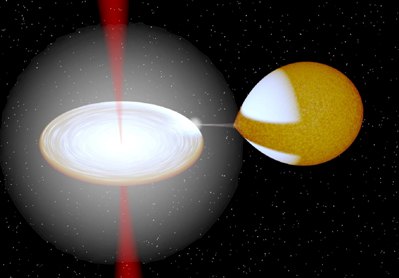
An accreting black hole and a binary star Credit: R Hynes ENLARGE Image

No matter their size black holes "feed" in the same way
Research by UK astronomers, published today in Nature (7th December 2006) reveals that the processes at work in black holes of all sizes are the same and that supermassive black holes are simply scaled up versions of small Galactic black holes.
For many years astronomers have been trying to understand the similarities between stellar-mass sized Galactic black hole systems and the supermassive black holes in active galactic nuclei (AGN). In particular, do they vary fundamentally in the same way, but perhaps with any characteristic timescales being scaled up in proportion to the mass of the black hole. If so, the researchers proposed, we could determine how AGN should behave on cosmological timescales by studying the brighter and much faster galactic systems.

An Artist's impression of an
intermediate sized black hole
Credit: NASA Goddard
ENLARGE Image
The research shows that the characteristic timescale changes linearly with black hole mass, but inversely with the accretion rate (when measured relative to the maximum possible accretion rate). This result means that the accretion process is the same in black holes of all sizes. By measuring the characteristic timescale and the accretion rate, the team argues this simple relationship can help determine black hole masses where other methods are very difficult, for example in obscured AGN or in the much sought after intermediate mass black holes.

Accretion of matter into a black hole produces strong X-ray emission from very close to the black hole itself. So, studying the way in which the X-ray emission varies with time, known as the X-ray lightcurves, provides one of the best ways of understanding the behaviour of black holes.

It has been known for over two decades that characteristic timescales can be seen in the X-ray lightcurves of Galactic black hole systems. The timescales are short and so can be found on short observations. However to find equivalent timescales is much harder as we must observe for months or years at a time.

In their paper, the team show that the width of the lines is correlated very strongly with the characteristic X-ray timescales. "Using some basic physical assumptions about the gas which emits the emission lines, and some very simple mathematics, we showed that the observed relationship between line width and characteristic timescale is exactly what is expected, as long as the characteristic timescale is proportional to the ratio of the black hole mass and accretion rate,' says Professor McHardy.' Our optical observations provide very strong confirmation that the characteristic timescale which links large and small black holes is just proportional to the ratio of the black hole mass to accretion rate. So active galactic nuclei AGN really are just scaled-up galactic black holes."

Read more @ PPARC press release 07 Dec 2006
_______________________________________________________
Supermassive Blackhole consumes A Star @ Universe Today
Where do stars go when they die? Podcast @ Universe Today
Do Galaxies follow Darwinian Evolution? from ESO Outreach.
______________________________________________________
______________________________________________________

Labels: , ,

Tuesday, October 10, 2006

Active Galaxies


Artist's concept of an active galaxy.
ENLARGE Image
Credit: Aurore Simonnet
NASA E/PO,
Sonoma State University

Nearly every massive galaxy seems to have a supermassive black hole, but only a few percent appear to be active. Our galaxy's central black hole is dormant, and this and similar black holes are not included in the Swift satellite census. All black holes were likely once active, and why some remain active and others are dormant in the modern, local universe is a mystery.

The all-sky survey contains more than 200 supermassive black holes called Active Galactic Nuclei, or AGN, and provides a definitive census of black hole activity in the local universe. The team uncovered many new black holes that were previously missed, even in well-studied galaxies, and other surprises as well.

AGN have a mass of millions to billions of suns, which are confined within a region about the size of our solar system. The term "active" refers to the process of actively pulling in gas and whole stars and generating copious amounts of energy from a tiny galactic core in the process. Examples include quasars and Seyfert galaxies.

The Swift satellite was built primarily to study gamma-ray bursts. During waiting times between bursts, Swift's Burst Alert Telescope, which is sensitive to the highest-energy X-rays, scans the sky. AGN generate X-rays as well as many other forms of light. Many AGN, however, are hidden behind dust and gas, which block lower-energy light, such as visible light. Because higher-energy X-rays are so penetrating, Swift can detect AGN missed by other surveys, allowing for an unbiased count.

For more visit: NASA Performs Headcount of Local Black Holes
_______________________________________________________
Chandra Reviews Black hole Musical
_______________________________________________________

A gigantic sonic boom generated by a supermassive black hole has been found with NASA's Chandra X-ray Observatory, along with evidence for a cacophony of deep sound.
ENLARGE Image


This discovery was made by using data from the longest X-ray observation ever of M87, a nearby giant elliptical galaxy. M87 is centrally located in the Virgo cluster of galaxies and is known to harbor one of the Universe's most massive black holes.

Scientists detected loops and rings in the hot, X-ray emitting gas that permeates the cluster and surrounds the galaxy. These loops provide evidence for periodic eruptions that occurred near the supermassive black hole, and that generate changes in pressure, or pressure waves, in the cluster gas that manifested themselves as sound.

"We can tell that many deep and different sounds have been rumbling through this cluster for most of the lifetime of the Universe," said William Forman of the Harvard-Smithsonian Center for Astrophysics (CfA).

The outbursts in M87, which happen every few million years, prevent the huge reservoir of gas in the cluster from cooling and forming many new stars. Without these outbursts and resultant heating, M87 would not be the elliptical galaxy it is today

"If this black hole wasn't making all of this noise, M87 could have been a completely different type of galaxy," said team member Paul Nulsen, also of the CfA, "possibly a huge spiral galaxy about 30 times brighter than the Milky Way."

The outbursts result when material falls toward the black hole. While most of the matter is swallowed, some of it was violently ejected in jets. These jets are launched from regions close to the black hole (neither light nor sound can escape from the black hole itself) and push into the cluster's gas, generating cavities and sound which then propagate outwards.

Chandra's M87 observations also give the strongest evidence to date of a shock wave produced by the supermassive black hole, a clear sign of a powerful explosion. This shock wave appears as a nearly circular ring of high-energy X-rays that is 85,000 light years in diameter and centered on the black hole.

For more & animations visit Chandra Reviews Black Hole Musical
more links to NOVA origins by Lubos Motl
_______________________________________________________
_______________________________________________________

Labels: , ,