Saturday, January 19, 2008

Pools of Invisible Matter


Super Clusters Credit: Hubble NASA, ESA, C. Heymans (University of British Columbia), M. Gray (University of Nottingham), and the STAGES Collaboration

NASA's Hubble Space Telescope is helping astronomers to dissect one of the largest structures in the universe, in a quest to understand the violent lives of galaxies, and providing indirect evidence of unseen dark matter tugging on galaxies in the crowded, rough-and-tumble environment of a massive supercluster of hundreds of galaxies.

The images are part of the Space Telescope Abell 901/902 Galaxy Evolution Survey (STAGES), which covers one of the largest patches of sky ever observed by the Hubble telescope.

The area surveyed is so wide that it took 80 Hubble images to cover the entire STAGES field. The new work is led by Meghan Gray of the University of Nottingham in the United Kingdom and Catherine Heymans of the University of British Columbia in Vancouver, along with an international team of scientists.

The Hubble study pinpointed four main areas in the supercluster where dark matter has pooled into dense clumps, totaling 100 trillion times the Sun's mass. These areas match the location of hundreds of old galaxies that have experienced a violent history in their passage from the outskirts of the supercluster into these dense regions. These galaxies make up four separate galaxy clusters.

The dark matter map was constructed by measuring the distorted shapes of over 60,000 faraway galaxies.
[+/-] Click here to expand

To reach Earth, the galaxies' light traveled through the dark matter that surrounds the supercluster galaxies and was bent by the massive gravitational field. Heymans used the observed, subtle distortion of the galaxies' shapes to reconstruct the dark matter distribution in the supercluster using a method called weak gravitational lensing. The dark matter map is 2.5 times sharper than a previous ground-based survey of the supercluster.

On Earth, the pace of quiet country life is vastly different from the hustle of the big city. In the same way, galaxies living lonely isolated lives look very different from those found in the most crowded regions of the universe, like a supercluster. "We've known for a long time that galaxies in crowded environments tend to be older, redder, and rounder than those in the field," Gray said. "Galaxies are continually drawn into larger and larger groups and clusters by the inevitable force of gravity as the universe evolves."

In such busy environments galaxies are subject to a life of violence: high-speed collisions with other galaxies; the stripping away of gas, the fuel supply they use to form new stars; and distortion due to the strong gravitational pull of the underlying invisible dark matter. "Any or all of these effects may play a role in the transformation of galaxies, which is what we're trying to determine," Gray said.

The STAGES survey's simultaneous focus on both the big picture and the details can be likened to studying a big city. "It's as if we're trying to learn everything we can about New York City and New Yorkers," Gray explained. "We're examining large-scale features, like mapping the roads, counting skyscrapers, monitoring traffic. At the same time we're also studying the residents to figure out how the lifestyles of people living downtown differ from those out in the suburbs. But in our case the city is a supercluster, the roads are dark matter, and the people are galaxies."

___________________________________________________________
___________________________________________________________

Labels: , , ,

Monday, December 03, 2007

Dark Stars of Creation (?)


The universe's first stars may have been bloated behemoths powered by dark matter, suggests a speculative, new study. These 'dark stars' might have delayed the creation of heavy elements, which make up everything from planets to people, as well as cosmic reionisation, which made the universe transparent to light billions of years ago.

Theorists believe the first stars formed in cradles of dark matter, condensing from clouds of gas until their cores became so dense that nuclear fusion ignited, preventing the cores from collapsing further.

But previous research did not consider how the dark matter cradles themselves might affect star formation. When they accounted for dark matter, they discovered it could have had a profound influence on the first stars.

Just what that effect is is still unclear, since no one knows what dark matter is – astronomers merely detect its gravitational pull on normal matter. But if it is made of weakly interacting massive particles, or WIMPs, as many scientists believe, Spolyar and his colleagues say it could drastically alter the physics of the earliest stars.

They used a candidate WIMP called a neutralino in their calculations and found that as a primordial gas cloud contracted, it reached a threshold density in which the dark matter particles swaddling it began to interact with each other. They annihilated on contact, producing particles such as electrons as well as photons of light that then deposited energy into the cloud.
[+/-] Click here to expand

This could heat up the cloud so much that it would stop contracting, so that it was supported by the annihilation of dark matter rather than by nuclear fusion, like normal stars. Such a 'dark star' would be about as massive as the Sun and would glow at infrared wavelengths. But it would be much larger – depending on the mass of the neutralino used, the star could span anywhere from the distance between the Sun and Uranus in our solar system to nearly 60 times that size.

"To call it a dark star is a bit of a misnomer – it simply has a different source of internal energy to support the star against gravity," says Volker Bromm of the University of Texas in Austin, US, an expert on the universe's first stars who is not a member of the study. "It would be a ball of gas that would have a reddish glow."

Could any of these stars still survive today? Possibly, depending on the neutralino mass, say the researchers. "They could be flying around our galaxy, in which case, the very first generation of stars in the universe (population III' stars) would have been very different from that previously thought", the team says.

Nearly all of the elements in the universe aside from hydrogen and helium were forged inside stars, and "the first stars are the first step in that process". If the first stars were dark, "there could be a major delay or even a stopping of this process", says team member Freese.

"It may turn out that the early star formation and consequently the synthesis of elements went differently than we thought," comments Igor Moskalenko of Stanford University in California, US. "If so, we have evidence of the dark matter presence literally in every cell of our body."

Other 'pop III' stars – which formed inside early galaxies rather than isolated dark matter cradles – would thus have been responsible for seeding the universe with its first heavy elements.

That suggests that heavy elements may not be spread evenly throughout space, since the stars in early galaxies would have enriched their surroundings in these elements and left voids of relatively empty space unenriched, says Bromm. If astronomers ever find a truly primordial cloud of gas in the universe, then it might hint that the first stars were dark.

Similarly, the first stars are thought to have helped ionise the universe within a few hundred million years after the big bang, making it transparent to ultraviolet light. (This phenomenon is actually referred to as 'reionisation', since the universe was a scalding soup of charged particles immediately after the big bang. It then cooled down enough for ions to coalesce into neutral atoms after 370,000 years or so.)

If the first stars were dark, then that suggests the stars in early dwarf galaxies would have been responsible for reionising the universe, says Bromm.

"Another thing that's exciting to me is that we may have a new type of star and we can go look for these things," says Freese. Neutrinos produced by the annihilation of dark matter in the stars might turn up in detectors such as AMANDA and IceCube at the South Pole, and gamma-ray photons produced in the same process could be picked up by NASA's GLAST spacecraft, due to launch in mid-2008.

Bromm says the research is quite speculative, since there are "incredibly many degrees of freedom when it comes to the properties of dark matter". But he adds that the work helps to bridge the gap between studies of dark matter on a particle physics scale and its effect on astronomical objects.

This paper is one of the first in this line of convergence between micro and macro physics.

Universe's first stars may have been dark by Maggie Mckee @ NewScientistSpace

__________________________________________________________
__________________________________________________________
Out Among the Dark Stars - by Paul Gilster @ Centauri Dreams
Were The First Stars Dark? - News Account @ Scientific Blogging
Invisible Matter Loses Cosmic Battle by Jeanna Bryner @ LiveScience
__________________________________________________________
__________________________________________________________

Labels: , ,

Wednesday, October 03, 2007

Invisible Dark Matter


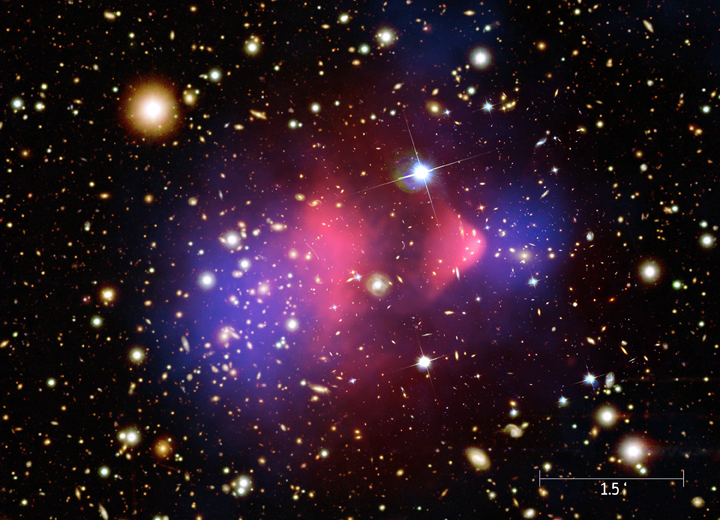
Photo by Chandra X-ray telescope team.

The Dark Matter Of The Universe Has A Long Lifetime

The two clusters of galaxies, called Bullet Cluster, are in the process of moving through each other. The red curves show gravitational measurements of the combined mass that consists of partly the visible matter of the galaxies and partly the invisible dark matter.

X-ray measurements of the two clusters of galaxies show that the clouds of gas have been pushed out at the collision between the two clusters of galaxies. In the cluster of galaxies to the right there is a lot of dark matter, but very little x-ray, so the dark matter decays very slowly and thus has a very, very long lifetime.

The universe consists not just of visible celestial bodies, stars, planets and galaxies. It also has a mystical fellow player - dark matter. New research from the Niels Bohr Institute presents new information that adds another piece of knowledge to the jigsaw puzzle of the dark mystery of the universe - dark matter.

The research has just been published in the Physical Review Letters: Searching for Decaying Axionlike Dark Matter from Clusters of Galaxies

Astronomers can measure that dark matter exists in big quantities but no one knows what it is, nobody has seen it. It does not emit light and it does not reflect light. It is invisible. It is a mystery and the researchers have many theories.

The dark matter has caused the researchers headaches for decades since it was detected in the 1970s, and there is intense research into the phenomena. It is invisible but it has got mass, and thus it has got gravitation that can be measured.

By analysing the galaxies it is possible to weigh them, and it turns out that by far the greatest matter of the collective mass of the galaxy is dark matter.

Just like stars get together in galaxies, the galaxies get together in clusters of galaxies of up to several thousand galaxies. Signe Riemer-Sorensen, astrophysicist at the Niels Bohr Institute, has analysed two clusters of galaxies that collide.
[+/-] Click here to expand

When the two clusters of galaxies meet neither the galaxies nor the dark matter collide. However, about 12 per cent of the mass of the cluster of galaxies consists of huge clouds of gas and dust and these clouds collide.

The gas clouds are hot and emit x-ray that can be observed, and it is possible to see how the clouds are actually pushed out of the two clusters of galaxies at the collision. When the clouds of gas collide they become even hotter and emit more x-ray so that a whole shock front of warn gas is generated.

Observations indicate that the dark matter can be a new and still undetected type of particle. Among the suggestions for the dark matter, are particles that when they decay they emit x-ray.

One is the so called axions that are particles which is explained in theories with extra dimensions. So to be able to look for x-ray from dark matter the researchers are looking in places where there is a big concentration of dark matter, but no gas.

Such places are found in the two colliding clusters of galaxies where the gas clouds have been pushed out at the collision. Sorensen has analysed the one of the two clusters of galaxies that are in the process of colliding.

The analyses show that it is a very heavy cluster with many galaxies, and measurement of the gravitation show that there is a very big amount of dark matter, up to 85 per cent of the collective mass. However, no x-ray of any consequence was measured.

When the dark matter does not emit significant x-ray it is possible to calculate an upper limit to how quickly the particles decay and thus calculate their lifetime.

The result is that if axions are to be the dark matter they must have a life span that is longer that 3.000.000 billion years. In that case there is not very much dark matter that has decayed yet if it was formed 13.7 billion years ago. The conclusion is that dark matter has a very, very long lifetime.

_________________________________________________________
_________________________________________________________

Labels: , ,

Thursday, September 13, 2007

Dark Matter - could be warm


Dark matter may be made of fast, lightweight particles, according to a new computer simulation. That could explain the peculiarly pure chemical makeup of some stars in the Milky Way, and the enormous mass of black holes that live at the hearts of large galaxies.

Because 'dark matter' reveals itself only by its gravity, astronomers have few clues to its nature. The most popular model is cold dark matter: heavy subatomic particles that tend to move very slowly.

Another possibility is warm dark matter: lighter particles that move faster. The rapid motion of these particles smoothes out the small dense knots of matter that would could or should otherwise form in the cores of galaxies, and there are hints that such dense knots are indeed missing.
[+/-] Click here to expand

Liang Gao and Tom Theuns of Durham University in the UK have built a computer simulation to compare the behaviour of cold and warm dark matter in the early universe. At first the two varieties behave alike, collapsing under gravity into a network of filaments that crisscross the universe.

But cold dark matter then coalesces into blobs or haloes, while warm dark matter does not. The random motion of its particles smoothes out these blobs, so warm dark matter filaments just keep collapsing and getting denser until there is a narrow tube of matter typically 10,000 light years long with the mass of 10 million Suns.

Ordinary gas is dragged in by the dark matter, and eventually the first stars form. They are made almost entirely of hydrogen and helium, the two main elements created in the big bang.

With cold dark matter, one large star forms in the middle of each large halo. These large stars burn fast, fusing hydrogen and helium into heavier elements. They soon exhaust their fuel and then explode to seed the universe with denser elements, which go into the next generation of stars. No pure hydrogen-helium stars survive.

But in the dense filaments formed by warm dark matter, the formation is likely to be more chaotic, with stars of different sizes forming from random-sized bits of filament.

Some would be small stars, which burn slowly, so a few pure stars formed in these filaments could still be shining today.

In the past few years, astronomers have indeed discovered small stars in the Milky Way that are very low in heavy elements. It is suggestive that maybe dark matter is warm. If astronomers see a star with absolutely no heavy elements, that will be good evidence.

These filaments may also be good at making big black holes. Although many of the isolated stars created by cold dark matter would give birth to black holes, they would only be a few times the mass of the Sun, which seems too small to seed the billion-solar-mass black holes that are known to lurk in many galaxies.

But each warm-dark-matter filament should eventually collapse along its length, say Gao and Theuns, forcing stars, gas clouds and small black holes close together in the perfect environment for growing much bigger black holes.


In the simulation, researchers assumed a dark matter particle with just 0.6% of the mass of an electron. That would fit the gravitino, a particle predicted by the speculative theory called - supersymmetry – although any particle as light would have a similar effect.
________________________________________________________
________________________________________________________
Did our galaxy's black hole eat its baby brother? @ SNS
Small 'Hobbit' Galaxies Made Almost Entirely of Dark Matter
Explanation of Dark Matter Might Lie in Origin of Stars @ Live Science
_________________________________________________________
_________________________________________________________

Labels: , ,

Friday, August 17, 2007

Cosmic Mystery Deepens


The difficulties trying to fathom and understand what we detect and observe or see billions of light years away.

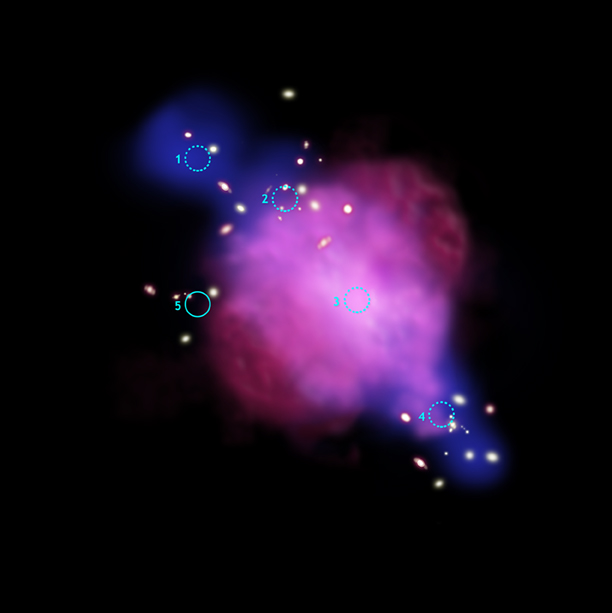
Abell 520 in the Constellation of Orion some 2.4 billion light years away, where astronomers have discovered a chaotic scene unlike any witnessed before in a collision between giant galaxy clusters. The results challenge our understanding of the way clusters merge, they possibly make us even reexamine the nature of dark matter itself.

There are three main components to galaxy clusters: individual galaxies composed of billions of stars, hot gas in between the galaxies, and dark matter, a mysterious substance that dominates the cluster mass and can be detected only through its gravitational effects.
[+/-] Click here to expand

Optical telescopes can observe the starlight from the individual galaxies, and can infer the location of dark matter by its subtle light-bending effects on distant galaxies. X-ray telescopes like Chandra detect the multimillion-degree gas.

A popular theory of dark matter predicts that dark matter and galaxies should stay together, even during a violent collision, as observed in the case of the so-called Bullet Cluster.

However, when the Chandra data of the galaxy cluster system known as Abell 520 was mapped along with the optical data from the Canada-France-Hawaii Telescope and Subaru Telescope atop Mauna Kea (Hawaii), a puzzling picture emerged. A dark matter core was found, which also contained hot gas but no bright galaxies.

In addition to the dark matter core, a corresponding "light region" containing a group of galaxies with little or no dark matter was also detected. The dark matter appears to have separated from the galaxies.

In the Bullet Cluster, the hot gas is slowed down during the collision but the galaxies and dark matter appear to continue on unimpeded. In Abell 520, it appears that the galaxies were unimpeded by the collision, as expected, while a significant amount of dark matter has remained in the middle of the cluster along with the hot gas.

While the components of Abell 520 - galaxies, hot gas, and dark matter - are found in unexpected places, the overall amount of these components totals what scientists expect.

The results lead to two possible explanations: one involving how galaxy clusters interact, and the other about the nature of dark matter itself. Both of these explanations would pose uncomfortable problems for current prevailing theories.

The first option is that the galaxies were separated from the dark matter through a complex set of gravitational "slingshots." This explanation is problematic because computer simulations have not been able to produce slingshots that are nearly powerful enough to cause such a separation.

The second option is that dark matter is affected not only by gravity, but also by an as-yet-unknown interaction between dark matter particles. This exciting alternative would require new physics and could be difficult to reconcile with observations of other galaxies and galaxy clusters, such as the aforementioned Bullet Cluster.

Credit:
X-ray: NASA/CXC/UVic./A.Mahdavi et al. Optical/Lensing: CFHT/UVic./A.Mahdavi et al.

________________________________________________________
________________________________________________________

Labels: , , ,