Wednesday, January 23, 2008

Cosmic Interactions


Credit: ESA Cosmic Interactions NGC 7173, 7174 and 7176

ESO's Very Large Telescope (VLT) images triplet of dancing galaxies intertwined in a cosmic dance.

The three galaxies: NGC 7173 (top), 7174 (bottom right) and 7176 (bottom left), are located 106 million light-years away towards the constellation of Piscis Austrinus (the 'Southern Fish').

NGC 7173 and 7176 are elliptical galaxies, while NGC 7174 is a spiral galaxy with quite disturbed dust lanes and a long, twisted tail.

This seems to indicate that the two bottom galaxies are currently interacting, with NGC 7176 providing fresh material to NGC 7174. Matter present in great quantity around the triplet's members also points to the fact that NGC 7176 and NGC 7173 have interacted in the past.

Astronomers have suggested that The three galaxies will finally merge into a giant 'island universe', tens to hundreds of times as massive as our own Milky Way.

The triplet is part of a so-called 'Compact Group', as compiled by Canadian astronomer Paul Hickson in the early 1980s. The group, which is the 90th entry in the catalogue and is therefore known as HCG 90, actually contains four major members. One of them - NGC 7192 - lies above the trio, outside of this image, and is another peculiar spiral galaxy.

Compact groups are small, relatively isolated, systems of typically four to ten galaxies in close proximity to one another. Another striking example is Robert's Quartet. Compact groups are excellent laboratories for the study of galaxy interactions and their effects, in particular the formation of stars.

As the striking image reveals, there are many other galaxies in the field. Some are distant ones, while others seem to be part of the family. Studies made with other telescopes have indeed revealed that the HCG 90 group contains 16 members, most of them much smaller in size than the four members with an entry in the NGC catalogue.
__________________________________________________________
__________________________________________________________

Labels: , , ,

Sunday, December 23, 2007

The Cosmic Bird


Credit: ESO Press Photo 54a/07

Using ESO's Very Large Telescope, an international team of astronomers has discovered a stunning rare case of a triple merger of galaxies. This system, which astronomers have dubbed 'The Bird' - composed of two massive spiral galaxies and a third irregular galaxy.

The galaxy ESO 593-IG 008, or IRAS 19115-2124, was previously merely known as an interacting pair of galaxies at a distance of 650 million light-years. But surprises were revealed by observations made with the NACO instrument attached to ESO's VLT, which peered through the all-pervasive dust clouds, using adaptive optics to resolve the finest details.

Underneath the chaotic appearance of the optical Hubble images - retrieved from the Hubble Space Telescope archive - the NACO images show two unmistakable galaxies, one a barred spiral while the other is more irregular.

The surprise lay in the clear identification of a third, clearly separate component, an irregular, yet fairly massive galaxy that seems to be forming stars at a frantic rate.

Because of the resemblance of the system to a bird, the object was dubbed as such, with the 'head' being the third component, and the 'heart' and 'body' making the two major galaxy nuclei in-between of tidal tails, the 'wings'. The latter extend more than 100,000 light-years, or the size of our own Milky Way.

Subsequent optical spectroscopy with the new Southern African Large Telescope, and archive mid-infrared data from the NASA Spitzer space observatory, confirmed the separate nature of the 'head', but also added further surprises. The 'head' and major parts of the 'Bird' are moving apart at more than 400 km/s (1.4 million km/h!). Observing such high velocities is very rare in merging galaxies. Also, the 'head' appears to be the major source of infrared luminosity in the system, though it is the smallest of the three galaxies.

The 'head' is forming stars violently, at a rate of nearly 200 solar masses per year, while the other two galaxies appear to be at a more quiescent epoch of their interaction-induced star formation history.

The 'Bird' belongs to the family of luminous infrared galaxies, with an infrared luminosity nearly one thousand billion times that of the Sun. This family of galaxies has long been thought to signpost important events in galaxy evolution, such as mergers of galaxies, which in turn trigger bursts of star formation, and may eventually lead to the formation of a single elliptical galaxy.
___________________________________________________________
___________________________________________________________
Is it all an illusion or light from a beam
Reality is relative, and always supreme
though for a moment it may not so seem
May the new year fulfill your every dream

Hubblesite presents - Striking Galaxy Encounters

___________________________________________________________
___________________________________________________________

Labels: , ,

Thursday, September 27, 2007

The Ant Nebula


The Ant Nebula (Planetary Nebula Menzel 3, or Mz3) - from Hubble

The Ant Nebula (Mz3) is located about 5 000 light-years away. The central star is as bright as 10 000 Suns and has a temperature of 35 thousand degrees Celsius. It is the last phase before this solar-like star will become a white dwarf.

From ground-based telescopes, the so-called "ant nebula" resembles the head and thorax of a garden-variety ant. This dramatic 2001 NASA/ESA Hubble Space Telescope image, reveals the "ant's" body as a pair of fiery lobes protruding from a dying, Sun-like star.

The ejection of gas from the dying star at the center of Mz 3 has intriguing symmetrical patterns unlike the chaotic patterns expected from an ordinary explosion. Scientists using Hubble would like to understand how a spherical star can produce such prominent, non-spherical symmetries in the gas that it ejects.

One possibility is that the central star of Mz 3 has a closely orbiting companion that exerts strong gravitational tidal forces, which shape the outflowing gas. For this to work, the orbiting companion star would have to be close to the dying star, about the distance of the Earth from the Sun. At that distance the orbiting companion star wouldn't be far outside the hugely bloated hulk of the dying star. It's even possible that the dying star has consumed its companion, which now orbits inside of it.

A second possibility is that, as the dying star spins, its strong magnetic fields are wound up into complex shapes. Charged winds moving at speeds up to 1000 kilometers per second from the star, much like those in our Sun's solar wind but millions of times denser, are able to follow the twisted field lines on their way out into space. These dense winds can be rendered visible by ultraviolet light from the hot central star or from highly supersonic collisions with the ambient gas that excites the material into florescence.


The frugal Cosmic Ant - from ESO

These new images revealing the Ant Nebula disc, which cannot be detected with a single 8.2-m VLT Unit Telescope, were uncovered in the interferometric mode, through the MID-infrared Interferometric instrument (MIDI). Interferometry works by combining the light of two or more telescopes, so that they act as a single, giant telescope, as large as the entire group.

With ESO's Very Large Telescope Interferometer (VLTI), when combining two of the 8.2-m Unit Telescopes, up to 25 times finer detail can be observed than with the individual telescopes.

The observations reveal a flat, nearly edge-on disc whose major axis is perpendicular to the axis of the bipolar lobes. The disc extends from about 9 times the mean distance between the Earth and the Sun (9 Astronomical Units or 9 AU) to more than 500 AU.

At the distance of the Ant Nebula, this corresponds to having detected structures that subtend an angle of only 6 milli-arcseconds. This is similar to distinguishing a two-storey building on the Moon.

The dust mass stored in the disc appears to be only one hundred thousandth the mass of the Sun and is a hundred times smaller than the mass found in the bipolar lobes.

Team leader Olivier Chesneau, from the Observatoire de la Côte d'Azur (France) suggests "We must therefore conclude that the disc is too light to have a significant impact on the outflowing material and cannot explain the shape of the Ant Nebula. Instead, it looks more like this disc is some remnant of the material expelled by the star."

The observations also provide unquestionable evidence that the disc is primarily composed of amorphous silicate. "This," says Chesneau, "most likely indicates that the disc is young, perhaps as young as the planetary nebula itself."

The astronomers favour the possibility that the large quantity of material in the lobes was propelled by several large-scale events, triggered with the help of a cool stellar companion. The solution of the mystery thus resides in the core of the system, and requires better characterisation of the hot central star and its putative companion, currently hidden from our view by the dusty disc.
_________________________________________________________
_________________________________________________________
VLT Interferometer detects disc around aged star from ESO
Nasa's Galex witnesses a spiral galaxy being stripped of its star
_________________________________________________________
_________________________________________________________

Labels: , , ,

Monday, September 24, 2007

Hidden Galaxies detected


Until now astronomers couldn't see foreground galaxies outshined by the dazzling quasars behind them. The difficulty in actually spotting and seeing these galaxies stems from the fact that the glare of the quasar is too strong compared to the dim light of the galaxy.

A new technique can pick apart the intense pattern of light emitted by quasars, finding irregularities in the image where "invisible" galaxies are absorbing some of the quasar light.

Quasars are small, distant and extremely bright cosmic beacons that produce more light than typically comes from an entire large galaxy. In spite of their brightness, however, some of the light is soaked up by intervening objects during its long journey to Earth's telescopes.

To locate the so-called "invisible" galaxies, Nicholas Bouche - an astronomer at the Max Planck Institute for Extraterrestrial Physics in Munich, Germany - and his team looked through huge catalogues of quasar data and picked out those with "dips" in their light signatures. Then, using the European Southern Observatory's (ESO) Very Large Telescope (VLT), located in the mountains of northern Chile, the team searched for galaxies close to the pulse of quasar light.

The astronomers capitalized on the VLT's special infrared spectrometer, called SINFONI, to pick apart 20 patches of sky around the quasars to search for galaxies from the time when the universe was about 6 billion years old. Seventy percent of the time, they found a galaxy hiding in the "headlights" of a quasar.

The astronomers who pioneered the technique have detected 14 hidden galaxies by targeting the VLT on unusual quasar light signatures. Bouche said he is surprised by not only the amount of galaxies he and his colleagues have found hiding near quasars, but also by the types of these galaxies. "These are not just ordinary galaxies," he said. "They are actively forming a lot of new stars and qualifying as starburst galaxies."

Source: Space dotcom
________________________________________________________
________________________________________________________
Quasar Jets Create Cosmic Pileups
Hidden Black Holes Found Behind Gas Veils at Quasars
Screaming to the Stars, Quasar Echos from Pamela Star Stryder
________________________________________________________
________________________________________________________

Labels: , ,

Wednesday, July 25, 2007

Matter at Ultra Speed


The REM Telescope courtesy of P Aniol. ESO Release.

Matter Flashed at Ultra Speed

Astronomers using REM have for the first time measured the velocity of the explosions known as gamma-ray bursts (GRBs). The material is travelling at the extraordinary speed of more than 99.999% of the velocity of light, the maximum speed limit in the Universe.
[+/-] Click here to expand

Gamma Ray Burts are short flashes of energetic gamma-rays lasting from less than a second to several minutes. They release a tremendous quantity of energy in this short time making them the most powerful events since the Big Bang. They come in two different flavours, long and short ones. Over the past few years, international efforts have convincingly shown that long GRBs are linked with the ultimate explosion of massive stars (hypernovae) while the short ones most likely originate from the violent collision of neutron stars and/or black holes . Irrespective of the original source of the GRB energy, the injection of so much energy into a confined volume will cause a fireball to form. Gamma-ray photons have nearly a million times more energy than the 'visual' photons the eye can see.

On 18 April and 7 June 2006, the NASA/PPARC/ASI Swift satellite detected two bright gamma-ray bursts. In a matter of a few seconds, their position was transmitted to the ground, and the REM telescope began automatically to observe the two GRB fields, detecting the near-infrared afterglows, and monitored the evolution of their luminosity as a function of time (the light curve).

The gamma-ray bursts were located 9.3 and 11.5 billion light-years away, respectively. For both events, the afterglow light curve initially rose, then reached a peak, and eventually started to decline, as is typical of GRB afterglows.

The peak is, however, only rarely detected. Its determination is very important, since it allows a direct measurement of the expansion velocity of the explosion of the material.

For both bursts, the velocity turns out to be very close to the speed of light, precisely 99.9997% of this value. Scientists use a special number, called the Lorentz factor, to express these high velocities. Objects moving much slower than light have a Lorentz factor of about 1, while for the two GRBs it is about 400.

While single particles in the Universe can be accelerated to still larger velocities - one has to realise that in the present cases, it is the equivalent of about 200 times the mass of the Earth that acquired this incredible speed.

"You certainly wouldn't like to be in the way"
"The next question is which kind of 'engine' can accelerate matter to such enormous speeds," said Stefano Covino.

Notes. Strictly speaking, the Lorentz factor is the ratio between the total and rest-mass energy of the fireball.
REM (Rapid Eye Mount) is a small (60 cm mirror diameter) rapid reaction automatic telescope dedicated to monitor the prompt afterglow of Gamma Ray Burst events. It is located at the ESO La Silla Observatory in Chile.

REM Measures Speed of Material Ejected in Cosmic Death from ESO
____________________________________________________
____________________________________________________
VLT Automatically Takes Detailed Spectra of Gamma-Ray Burst Afterglows
Pierre Auger Observatory & GZK cutoff - by Stefan @ BackReaction.
Chandra captures Supermassive Black Holes in 'younger' Galaxies

____________________________________________________
____________________________________________________

Labels: , ,

Tuesday, June 05, 2007

Pulsating Red Giant S-Ori


Sketch of the structure of a pulsating red giant, as derived by the recent interferometric study on S Orionis. The environment around the parent star is made up by three main components: a molecular shell (inner red layer), a dust shell (outer red layer) and a maser shell (red and green speckles). Grains of aluminum oxide constitute most of the dust shell (observed in the infrared band), while the maser radio emission comes from silicon monoxide molecules. The maser spots velocities indicates that the gas is expanding, at a speed of about 10 km/s. (Credit: ESO)

A star such as the Sun will lose between a third and half of its mass during the Mira phase.
[+/-] Click here to expand

S Orionis (S Ori) belongs to the class of Mira-type variable stars. It is a solar-mass star that, as will be the fate of our Sun in 5 billion years, is nearing its gloomy end as a white dwarf. When it will become a red giant, such as S Orionis, its average size will enshroud the orbit of Mercury, Venus, the Earth and Mars. Jupiter's orbit will be just outside the maser shell.

Mira stars are very large and lose huge amounts of matter. Every year, S Ori ejects as much as the equivalent of Earth's mass into the cosmos, and pulsates with a period of 420 days. In the course of its cycle, it changes its brightness by a factor of the order of 500, while its diameter varies by about 20%.

Although such stars are enormous - they are typically larger than the current Sun by a factor of a few hundred, i.e. they encompass the orbit of the Earth around the Sun - they are also distant and to peer into their deep envelopes requires very high resolution. This can only be achieved with interferometric techniques.

The maser emission comes from silicon monoxide (SiO) molecules and can be used to image and track the motion of gas clouds in the stellar envelope roughly 10 times the size of the Sun.

The astronomers observed S Ori with two of the largest interferometric facilities available: the ESO Very Large Telescope Interferometer (VLTI) at Paranal, observing in the near- and mid-infrared, and the NRAO-operated Very Long Baseline Array (VLBA), that takes measurements in the radio wave domain.

Because the star's luminosity changes periodically, the astronomers observed it simultaneously with both instruments, at different epochs. The first epoch occurred close to the stellar minimum luminosity and the last just after the maximum on the next cycle.

The star's diameter varies between 7.9 milliarcseconds and 9.7 milliarcseconds. At the distance of S Ori, this corresponds to a change of the radius from about 1.9 to 2.3 times the distance between the Earth and the Sun, or between 400 and 500 solar radii!

As if such sizes were not enough, the inner dust shell is found to be about twice as big. The maser spots, which also form at about twice the radius of the star, show the typical structure of partial to full rings with a clumpy distribution. Their velocities indicate that the gas is expanding radially, moving away at a speed of about 10 km/s.

The multi-wavelength analysis indicates that near the minimum there is more dust production and mass ejection: in these phases indeed the amount of dust is significantly higher than in the others. After this intense matter production and ejection the star continues its pulsation and when it reaches the maximum luminosity, it displays a much more expanded dust shell. This supports a strong connection between the Mira pulsation and the dust production and expulsion.

Astronomers further found that grains of aluminum oxide - also called corundum - constitute most of S Ori's dust shell: the grain size is estimated to be of the order of 10 millionths of a centimetre, that is one thousand times smaller than the diameter of a human hair.


"Because we are all stardust, studying the phases in the life of a star when processed matter is sent back to the interstellar medium to be used for the next generation of stars, planets... and humans, is very important" - Markus Wittkowski.

Original source ESO Press Release
___________________________________________________________
___________________________________________________________
Note: A maser is the microwave equivalent to a laser, which emits visible light. A maser emits powerful microwave radiation instead and its study requires radio telescopes. An astrophysical maser is a naturally occurring source of stimulated emission that may arise in molecular clouds, comets, planetary atmospheres, stellar atmospheres, or from various conditions in interstellar space.
___________________________________________________________
___________________________________________________________

Labels: , , ,

Thursday, May 24, 2007

Brown Dwarf joins Jet Set


Image Credit: Copyright ESO

Jets of matter have been discovered around a very low mass 'failed star', mimicking a process seen in young stars. This suggests that these 'brown dwarfs' form in a similar manner to normal stars but also that outflows are driven out by objects as massive as hundreds of millions of solar masses down to Jupiter-sized objects.

The brown dwarf with the name 2MASS1207-3932 is full of surprises. Its companion, a 5 Jupiter-mass giant, was the first confirmed exoplanet for which astronomers could obtain an image , thereby opening a new field of research - the direct detection of alien worlds. It was then later found that the brown dwarf has a disc surrounding it, not unlike very young stars.

Now, astronomers using ESO's Very Large Telescope (VLT) have found that the young brown dwarf is also spewing jets, a behaviour again quite similar to young stars.

The outflows were discovered using an amazing technique known as spectro-astrometry, based on high resolution spectra taken with UVES on the VLT. While in normal young stars - known as T-Tauri stars for the prototype of their class - the jets are large and bright enough to be seen directly, this is not the case around brown dwarfs: the length scale of the jets, recovered with spectro-astrometry is only about 0.1 arcsecond long.

The jets stretch about 1 billion kilometres and the material is rushing away from the brown dwarf with a speed of a few kilometres per second. Astronomers had to rely on the power of the VLT because the observed emission is extremely faint and only UVES on the VLT could provide both the sensitivity and the spectral resolution they required.

Using the same technique and the same telescope, the team had previously discovered outflows in another young brown dwarf. The new discovery sets a record for the lowest mass object in which jets are seen.

Outflows in the Universe, are observed rushing away from the active nuclei of galaxies (AGNs) and emerging from young stars. These observations show the outflow mechanism extends over an enormous range of masses, from several tens of millions of solar mass (for AGNs) down to a few tens of Jupiter masses (for brown dwarfs).

VLT Finds Smallest Galactic Object with Jets ESO press release
_________________________________________________________
_________________________________________________________
A Brown Dwarf Joins the Jet Set from Science Daily
Brown Dwarf with jets discovered from Universe Today
Merging Stars create a new class of explosion from Universe Today
_________________________________________________________
_________________________________________________________

Labels: , ,

Friday, May 11, 2007

Cosmic Clock


The Star, HE 1523-0901. Credit ESO Click Image to Enlarge

Using ESO's VLT, astronomers recently measured the age of a star located in our Galaxy.

"It is very hard to pin down the age of a star", the lead author of the paper reporting the results, Anna Frebel, explains. "This requires measuring very precisely the abundance of the radioactive elements thorium or uranium, a feat only the largest telescopes such as ESO's VLT can achieve."

The technique is analogous to the carbon-14 dating method that has been so successful in archaeology over time spans of up to a few tens of thousands of years. In astronomy, however, this technique must obviously be applied to vastly longer timescales.

For the method to work well, the right choice of radioactive isotope is critical. Unlike other, stable elements that formed at the same time, the abundance of a radioactive (unstable) isotope decreases all the time. The faster the decay, the less there will be left of the radioactive isotope after a certain time, so the greater will be the abundance difference when compared to a stable isotope, and the more accurate is the resulting age.

Yet, for the clock to remain useful, the radioactive element must not decay too fast - there must still be enough left of it to allow an accurate measurement, even after several billion years.
Large amounts of these elements have been found in the star HE 1523-0901, an old, relatively bright star that was discovered within the Hamburg/ESO survey. The star was then observed with UVES on the Very Large Telescope (VLT) for a total of 7.5 hours.

For the first time, the age dating involved both radioactive elements in combination with the three other neutron-capture elements europium, osmium, and iridium. "Until now, it has not been possible to measure more than a single cosmic clock for a star. Now, however, we have managed to make six measurements in this one star"," says Frebel.

HE 1523-0901, estimated to be 13.2 billion years old was clearly formed very early in the life of our own Galaxy. Born at the dawn of time in the observable Universe, estimated to be 13.7 billion years old.

Nearby Star A Galactic Fossil ESO Press Release

This research is reported in a paper published in the 10 May issue of the Astrophysical Journal "Discovery of HE 1523-0901, a Strongly r-Process Enhanced Metal-Poor Star with Detected Uranium", by A. Frebel et al.
________________________________________________________
________________________________________________________

Labels: , , ,

Thursday, March 08, 2007

Centaurus A


This image of Centaurus A , also known as NGC 5128 , is an example of how frontier science can be combined with esthetic aspects.

This galaxy is a most interesting object for the present attempts to understand active galaxies . It is being investigated by means of observations in all spectral regions, from radio via infrared and optical wavelengths to X- and gamma-rays. It is one of the most extensively studied objects in the southern sky.

Centaurus A is one of the foremost examples of a radio-loud active galactic nucleus (AGN) . On images obtained at optical wavelengths, thick dust layers almost completely obscure the galaxy's centre. This structure was first reported by Sir John Herschel in 1847. Until 1949, NGC 5128 was thought to be a strange object in the Milky Way, but it was then identified as a powerful radio galaxy and designated Centaurus A .

The distance is about 10-13 million light-years (3-4 Mpc) and the apparent visual magnitude is about 8, or 5 times too faint to be seen with the unaided eye.

The core of Centaurus A is the smallest known extragalactic radio source, only 10 light-days across. A jet of high energy particles from this centre is observed in radio and X-ray images. The core probably contains a supermassive black hole with a mass of about 100 million solar masses.


Colour image of the two galaxies NGC 5011B (top) and NGC 5011C (bottom blue galaxy). NGC 5011C is a dwarf galaxy located in the Centaurus A group, while its companion on the sky is in fact a galaxy located 12 times further away and belonging to the Centaurus cluster of galaxies.

With this new distance determination, the astronomers also established that NGC 5011C lies 500,000 light-years away from the dominant galaxy in its group, Centaurus A. Centaurus A (NGC 5128) is the nearest giant elliptical galaxy, at a distance of about 13 million light-years. It is currently merging with a spiral companion galaxy. It possesses a very massive black hole at its centre and is a source of strong radio and X-ray emission.

The Giant That Turned Out To Be A Dwarf from European Southern Observatory.
_______________________________________________________
_______________________________________________________
Learning How Galaxies Form by Centauri Dreams
Double-star Systems Cycle Between Big And Small Blasts from SD
Jet Of Molecular Hydrogen Arising From A Forming High-mass Star
_______________________________________________________
_______________________________________________________

Labels: , ,

Monday, February 26, 2007

Pulsar's creation.


Volume rendering of 3-D simulation of a pulsar's formation. Credit: Image courtesy of North Carolina State University

Pulsars are rapidly rotating neutron stars formed in supernova explosions, which occur when a massive star reaches the end of its life and explodes. The remaining matter is compressed into a dense, rapidly spinning mass – a neutron star, or pulsar – so-called because scientists first discovered them due to their regularly timed radio emissions.

Pulsars spin very rapidly – 20 or more times per second. Scientists have assumed that the spin was caused by the conservation of angular momentum from a star that was spinning before it exploded.

“Think about figure skaters,” Blondin says. “They start a spin with their arms and legs farther out from the body, and increase their rotation speed when they pull their limbs in more tightly. That’s what the conservation of angular momentum is – the idea that if you take a large object with a slight rotation and compress it down, the rotation speed will increase.”

However, scientists had no idea if the stars that were producing the pulsars were even spinning to begin with. Blondin and his colleague decided to create a computer model of a supernova explosion using the new Cray X1E supercomputer at the National Center for Computational Sciences, the only computer with enough processing power to accomplish the task. The resultant model demonstrated that a pulsar’s spin doesn’t have anything to do with whether or not the star that created it was spinning; instead, the spin is created by the explosion itself.

“We modeled the shockwave, which starts deep inside the core of the star and then moves outward,” Blondin says. “We discovered that as the shockwave gains both the momentum and the energy needed to blow outward and create the explosion, it starts spiraling all on its own, which starts the neutron star at the center of the star spinning in the opposite direction. None of the previous two-dimensional modeling of supernova explosions had picked up on this phenomena.”

Dr. John Blondin, professor of physics in NC State’s College of Physical and Mathematical Sciences, along with colleague Anthony Mezzacappa at the Oak Ridge National Laboratory.
Their findings are published in the Jan. 4 edition of the journal Nature.

_______________________________________________________
Latest Spin on Neutron Stars from Louise Riofrio
Scientist Discovers New Explanation For Pulsar's Spin from Science Daily

_______________________________________________________
Sunlight heats ice on surface of comet McNaught
_______________________________________________________

The unique images reveal three clear jets of gas, which are seen to spiral away from the nucleus as it rotates, like a Catherine Wheel firework.

"These jets are produced when sunlight heats ices on the surface of the comet, causing them to evaporate into space and create 'geyser' like jets of gas and small dust particles, which stretch over 13,000 km into space - greater than the diameter of the Earth - despite the fact that the nucleus of the comet is probably less than 25 km in diameter,"

By comparing images like this taken at different times, astronomers should be able to calculate how fast the nucleus rotates from the changing pattern of jets.

Other images also reveal that while the gas forms spiral jets, the large dust particles released from the comet follow a different pattern, as they are thrown off the comet's surface on the brightly lit side towards the Sun, producing a bright fan, which is then blown back by the pressure of sunlight itself.

Unique Observations Of Comet McNaught Reveal Sprinkling Nucleus
Comet McNaught. Image courtesy of European Southern Observatory
_______________________________________________________
_______________________________________________________

Labels: , , ,

Thursday, November 30, 2006

Starburst Galaxy


_______________________________________________________
Starburst Galaxy NGC1313 Credit ESO ENLARGE Image

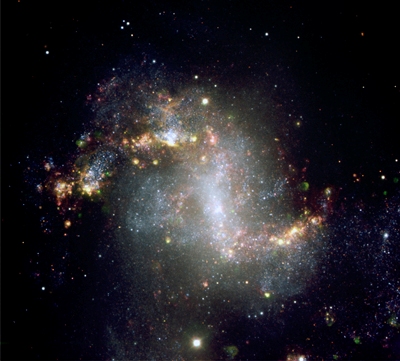
The captivating appearance of this image of the starburst galaxy NGC 1313, taken with the FORS instrument at ESO's Very Large Telescope, belies its inner turmoil. The dense clustering of bright stars and gas in its arms, a sign of an ongoing boom of star births, shows a mere glimpse of the rough times it has seen. Probing ever deeper into the heart of the galaxy, astronomers have revealed many enigmas that continue to defy our understanding.

The galaxy bears some resemblance to some of the Milky Way's closest neighbours, the Magellanic Clouds. NGC 1313 has a barred spiral shape, with the arms emanating outwards in a loose twist from the ends of the bar. The galaxy lies just 15 million light-years away from the Milky Way - a mere skip on cosmological scales. The spiral arms are a hotbed of star-forming activity, with numerous young clusters of hot stars being born continuously at a staggering rate out of the dense clouds of gas and dust. Their light blasts through the surrounding gas, creating an intricately beautiful pattern of light and dark nebulosity.

Starburst galaxies are fascinating objects to study in their own right; in neighbouring galaxies, around one quarter of all massive stars are born in these powerful engines, at rates up to a thousand times higher than in our own Milky Way Galaxy.

In the majority of starbursts the upsurge in star's births is triggered when two galaxies merge, or come too close to each other. The mutual attraction between the galaxies causes immense turmoil in the gas and dust, causing the sudden 'burst' in star formation.


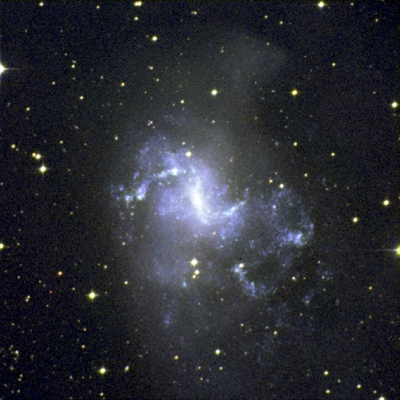
Galaxy NGC1313
view further out
credit ESO
(AAO/ROE/Digital SKy Survey)
ENLARGE Image
_______________________________________________________

Strangely enough NGC 1313 seems to be an isolated galaxy. It is not part of a group and has no neighbour, and it is not clear whether it may have swallowed a small companion in its past. So what caused its asymmetry and stellar baby boom?

An explanation based on the presence of the central bar also does not hold for NGC 1313: the majority of its star formation is actually taking place not in its bar but in dense gassy regions scattered around the arms. By what mechanism the gas is compressed for stars to form at this staggering rate, astronomers simply aren't sure.

In the midst of the cosmic violence of the starburst regions lie two objects that emit large amounts of highly energetic X-rays - so-called ultra-luminous X-ray sources (ULX). Astronomers suspect that they might be black holes with masses of perhaps a few hundred times the mass of our Sun each, that formed as part of a binary star system. How such objects are created out of ordinary stars cannot be conclusively explained by current models.

ESO outreach press release 23rd Nov 2006
_______________________________________________________
van den bergh 152 by Giovanni Benintende @ Universe Today
Where do baby stars come from podcast @ Universe Today
_______________________________________________________
_______________________________________________________
"The more you know the less you need to say." - Jim Rohn
_______________________________________________________
_______________________________________________________

Labels: ,

Monday, October 02, 2006

Proto-Planet Formation


Watching How Planets Form: Anatomy Of A Planet-forming Disc Around A Star More Massive Than The Sun

Artist's impression of a flared proto-planetary disc, similar to what has been deduced around the 2.5 solar mass star HD 97048. Image courtesy of: European Southern Observatory
______________________________________________________
With the VISIR instrument on ESO's Very Large Telescope, astronomers have mapped the disc around a star more massive than the Sun. The very extended and flared disc most likely contains enough gas and dust to spawn planets. It appears as a precursor of debris discs such as the one around Vega-like stars and thus provides the rare opportunity to witness the conditions prevailing prior to or during planet formation.

"Planets form in massive, gaseous and dusty proto-planetary discs that surround nascent stars. This process must be rather ubiquitous as more than 200 planets have now been found around stars other than the Sun," said Pierre-Olivier Lagage, from CEA Saclay (France) and leader of the team that carried out the observations. "However, very little is known about these discs, especially those around stars more massive than the Sun. Such stars are much more luminous and could have a large influence on their disc, possibly quickly destroying the inner part."

The astronomers used the VISIR instrument [1] on ESO's Very Large Telescope to map in the infrared the disc surrounding the young star HD 97048. With an age of a few million years [2], HD 97048 belongs to the Chameleon I dark cloud, a stellar nursery 600 light-years away. The star is 40 times more luminous than our Sun and is 2.5 times as massive.

The astronomers could only have achieved such a detailed view due to the high angular resolution offered by an 8-metre size telescope in the infrared, reaching a resolution of 0.33 arcsecond. They discovered a very large disc, at least 12 times more extended than the orbit of the farthest planet in the Solar System, Neptune. The observations suggest the disc to be flared. "This is the first time such a structure, predicted by some theoretical models, is imaged around a massive star," said Lagage.

Such a geometry can only be explained if the disc contains a large amount of gas, in this case, at least as much as 10 times the mass of Jupiter. It should also contain more than 50 Earth masses in dust.
The dust mass derived here is more than thousand times larger than what is observed in debris discs and Kuiper belt-like structures found around older, 'Vega-like' stars, such as Beta Pictoris, Vega, Fomalhaut and HR 4796. The dust around these stars is thought to be produced by collisions of larger bodies. The dust mass observed around HD 97048 is similar to the mass invoked for the (undetected) parent bodies in the more evolved systems. HD 97048's disc is thus most likely a precursor of debris discs observed around older stars.

"From the structure of the disc, we infer that planetary embryos may be present in the inner part of the disc," said Lagage. "We are planning follow-up observations at higher angular resolution with ESO's VLT interferometer in order to probe these regions."

The scientists report their discovery in the 28 September issue of Science Express, the rapid online publication service of the journal Science: "Anatomy of a flaring proto-planetary disc around a young intermediate-mass star", by P.-O. Lagage et al.
The team is composed of Pierre-Olivier Lagage, Coralie Doucet, and Eric Pantin, (CEA Saclay, France), Sebastien Charnoz (Paris 7 Denis Diderot University), Emilie Habart (Institut d'Astrophysique Spatiale, Orsay, France), Gaspard Duch?TMne, Fran?ßois M?©nard, and Christophe Pinte (Laboratoire d'Astrophysique de Grenoble, France), and Jan-Willem Pel (Groningen University, The Netherlands)

Notes:
[1] VISIR - the VLT Imager and Spectrometer for the InfraRed - is a complex multi-mode instrument designed to operate in the 10 and 20 microns atmospheric windows, i.e. at wavelengths up to about 40 times longer than visible light and to provide images as well as spectra at a wide range of resolving power up to ~ 30 000. It can sample images down to the diffraction limit of the 8.2-m Melipal telescope (0.3 arcsec at 10 microns wavelength, i.e. corresponding to a resolution of 500 m on the Moon).
[2] By comparison, the Sun is about 4.6 billion years old. Translated to a human timescale, these young stars would be just 3 days old, compared to the Sun's 40 years.

Source European Southern Observatory
Original text
Science Daily 30th September 2006.

_______________________________________________________
Astronomers Discover Planet Building Is Big Mess
_______________________________________________________

ENLARGE Image: Medium
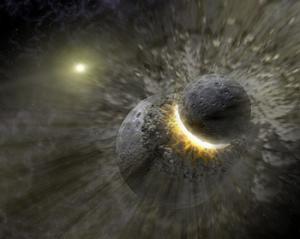
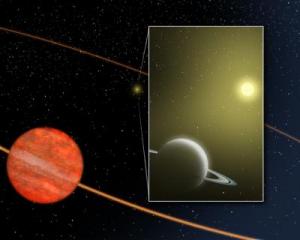
This artist's concept illustrates how planetary systems arise out of massive collisions between rocky bodies. These catastrophes continue to occur around stars even after they have developed full-sized planets, when they are as old as one hundred million years. For reference, our own Sun, at 4.5 billion years old, is far past this late stage of planet formation. In this image, a young star is shown circled by full-sized planets, and rings of dust beyond. These rings, also called "debris discs" arise when embryonic planets smash into each other. One of these collisions is illustrated in the inset above. Spitzer was able to see the dust generated by these collisions with its powerful infrared vision. Credit: NASA/JPL-Caltech/T. Pyle (SSC-Caltech)

Planets are built over a long period of massive collisions between rocky bodies as big as mountain ranges.

Observations from NASA's Spitzer Space Telescope reveal surprisingly large dust clouds around several stars. These clouds most likely flared up when rocky, embryonic planets smashed together. The Earth's own Moon may have formed from such a catastrophe. Prior to these results, astronomers thought planets were formed under less chaotic circumstances.
"It's a mess out there," said Dr. George Rieke of the University of Arizona, Tucson, first author of the findings and a Spitzer scientist. "We are seeing that planets have a long, rocky road to go down before they become full grown."
Spitzer was able to see the dusty aftermaths of these collisions with its powerful infrared vision. When embryonic planets, the rocky cores of planets like Earth and Mars, crash together, they are believed to either merge into a bigger planet or splinter into pieces. The dust generated by these events is warmed by the host star and glows in the infrared, where Spitzer can see it.

They mirror what we know about the formation of our own planetary system. Recent observations from studies of our Moon's impact craters also reveal a turbulent early solar system. "Our Moon took a lot of violent hits when planets had already begun to take shape," Rieke said.

According to the most popular theory, rocky planets form somewhat like snowmen. They start out around young stars as tiny balls in a disc-shaped field of thick dust. Then, through sticky interactions with other dust grains, they gradually accumulate more mass. Eventually, mountain-sized bodies take shape, which further collide to make planets.
Previously, astronomers envisioned this process proceeding smoothly toward a mature planetary system over a few million to a few tens of millions of years. Dusty planet-forming discs, they predicted, should steadily fade away with age, with occasional flare-ups from collisions between leftover rocky bodies.

Rieke and his colleagues have observed a more varied planet-forming environment. They used new Spitzer data, together with previous data from the European Space Agency's Infrared Space Observatory and the joint NASA, United Kingdom and the Netherlands' Infrared Astronomical Satellite. They looked for dusty discs around 266 nearby stars of similar size, about two to three times the mass of the Sun, and various ages. Seventy-one of those stars were found to harbor discs, presumably containing planets at different stages of development. But, instead of seeing the discs disappear in older stars, the astronomers observed the opposite in some cases.

"We thought young stars, about one million years old, would have larger, brighter discs, and older stars from 10 to 100 million years old would have fainter ones," Rieke said. "But we found some young stars missing discs and some old stars with massive discs."
This variability implies planet-forming discs can become choked with dust throughout the discs' lifetime, up to hundreds of millions of years after the host star was formed. "The only way to produce as much dust as we are seeing in these older stars is through huge collisions," Rieke said.

Before Spitzer, only a few dozen planet-forming discs had been observed around stars older than a few million years. Spitzer's uniquely sensitive infrared vision allows it to sense the dim heat from thousands of discs of various ages. "Spitzer has opened a new door to the study of discs and planetary evolution," said Dr. Michael Werner, project scientist for Spitzer at NASA's Jet Propulsion Laboratory, Pasadena, Calif.
"These exciting new findings give us new insights into the process of planetary formation, a process that led to the birth of planet Earth and to life," said Dr. Anne Kinney, director of the universe division in the Science Mission Directorate at NASA Headquarters, Washington. "Spitzer truly embodies NASA's mission to explore the universe and search for life," she said.
JPL manages the Spitzer Space Telescope for NASA's Science Mission Directorate. Artist's concepts and additional information about the Spitzer Space Telescope is available at
http://www.spitzer.caltech.edu.
Source
NASA Jet Propulsion
Original text:
Science Daily 19th October 2004.

_______________________________________________________
Spitzer Sees Dusty Aftermath Of Pluto-Sized Collision
_______________________________________________________

ENLARGE Image: Medium
Massive Smash-Up at Vega: This artist concept illustrates how a massive collision of objects, perhaps as large as the planet Pluto, smashed together to create the dust ring around the nearby star Vega. New observations from NASA's Spitzer Space Telescope indicate the collision took place within the last one million years. Astronomers think that embryonic planets smashed together, shattered into pieces, and repeatedly crashed into other fragments to create ever finer debris. (Credit: NASA/JPL-Caltech/T. Pyle (SSC/Caltech))

Astronomers say a dusty disc swirling around the nearby star Vega is bigger than earlier thought. It was probably caused by collisions of objects, perhaps as big as the planet Pluto, up to 2,000 kilometers (about 1,200 miles) in diameter.

NASA's Spitzer Space Telescope has seen the dusty aftermath of this "run-in." Astronomers think embryonic planets smashed together, shattered into pieces and repeatedly crashed into other fragments to create ever-finer debris. Vega's light heats the debris, and Spitzer's infrared telescope detects the radiation.

Vega, located 25 light-years away in the constellation Lyra, is the fifth brightest star in the night sky. It is 60 times brighter than our Sun. Observations of Vega in 1984, with the Infrared Astronomical Satellite, provided the first evidence for dust particles around a typical star. Because of Vega's proximity and because its pole faces Earth, it provides a great opportunity for detailed study of the dust cloud around it.

Like a drop of ink spreading out in a glass of water, the particles in Vega's dust cloud don't stay close to the star long. The dust we are seeing in the Spitzer images is being blown out by intense light from the star. We are witnessing the aftermath of a relatively recent collision, probably within the last million years.
Scientists say this disc event is short-lived. The majority of the detected material is only a few microns in size, 100 times smaller than a grain of Earth sand. These tiny dust grains leave the system and dissipate into interstellar space on a time scale less than 1,000 years. But there are so many tiny grains. They add up to a total mass equal to one third of the weight of our moon.

The mass of these short-lived grains implies a high dust-production rate. The Vega disc would have to have an improbably massive reservoir of planet-building material and collisions to maintain this amount of dust production throughout the star's life (350 million years, 13 times younger than our Sun). "We think a transient disc phenomenon is more likely," Su said.

Astronomers were struck by other characteristics of Vega's debris disc, including its physical size. It has a radius of at least 815 astronomical units, roughly 20 times larger than our solar system. One astronomical unit is the distance from Earth to the Sun, which is 150million kilometers (93- million miles). A study of the disc's surface brightness indicates the presence of an inner hole at a radius of 86 astronomical units (twice the distance between Pluto and the Sun). Large embryonic planets at the edge of this inner hole may have collided to make the rest of the debris around Vega.

"Spitzer has obtained the first high spatial-resolution infrared images of Vega's disc," said Dr. Michael Werner, co-author and project scientist for Spitzer at NASA's Jet Propulsion Laboratory, Pasadena, Calif. "Its sensitive infrared detectors have allowed us to see that Vega is surrounded by an enormous disc of debris."

JPL manages the Spitzer Space Telescope mission for NASA's Science Mission Directorate, Washington. Science operations are conducted at the Spitzer Science Center at the California Institute of Technology in Pasadena. JPL is a division of Caltech. The multi-band imaging photometer for Spitzer, which made the new disc observations, was built by Ball Aerospace Corporation, Boulder, Colo.; the University of Arizona; and Boeing North American, Canoga Park, Calif. Additional information about the Spitzer Space Telescope is available at http://www.spitzer.caltech.edu.
Source
University of Arizona
Original text:
Science Daily 18th January 2005.

_______________________________________________________
_______________________________________________________
Famous Quotes History is a gallery of pictures
in which there are few originals and many copies.
Alexis de Tocqueville
________________________________________________________

Labels: , ,

Thursday, September 21, 2006

Brown Dwarf Stars


_______________________________________________________
This is an artist's concept of the star HD 3651 as it is orbited by a close-in Saturn-mass planetary companion and the distant brown dwarf companion discovered by Spitzer infrared photographs. The Saturn-mass planet was discovered through Doppler observations in 2003. Its orbit is very small, the size of Mercury's, and is highly elliptical. The gravity of the distant brown dwarf companion may be reponsible for the distorted shape of the inner planet's orbit.
(Credit: NASA / JPL-Caltech / T. Pyle (SSC))

First Images Of Brown Dwarf In Planetary System
Scientists using NASA's Spitzer Space Telescope have discovered and directly imaged a small brown dwarf star, 50 times the mass of Jupiter, orbiting with a planet around a Sun-like star. Such an arrangement has never before been seen but might be common, the scientists say, leading to solar systems with distorted planetary orbits.

The discovery concerns a class of the coldest brown dwarfs, called T dwarfs.
Over the last ten years, astronomers have been extremely successful in finding planets close to their host stars using indirect detection methods," said Luhman, an assistant professor in the Penn State Department of Astronomy and Astrophysics. "Because of its infrared capabilities, Spitzer is well suited for directly detecting cool T dwarfs, and perhaps even large planets, in the outer parts of planetary systems."

Luhman's team also discovered a second brown dwarf that is smaller yet, about 20 times the mass of Jupiter, orbiting another star. This smaller object could be the youngest T dwarf known, offering scientists a snapshot of early brown-dwarf development. The two T dwarfs are the first to be imaged by Spitzer. Shortly after these companions were found, Spitzer also discovered a T dwarf that is floating through space by itelf rather than orbiting a star. The team that discovered that T dwarf is led by Daniel Stern at NASA's Jet Propulsion Laboratory.

Brown dwarfs are small stars that are not massive enough to burn hydrogen, like our Sun does. Their cores are not hot enough to trigger such nuclear fusion. As a result, their surface temperature is only a few thousands of degrees when young, cooling considerably to about the temperature of a planet as they age. Consequently, they are dim and hard to identify and, as a result, the first unambiguous identification came only about ten years ago.

The more massive of the two newly discovered T dwarfs is called HD 3651 B, located in the constellation Pisces. This object is in a solar system containing a star slightly less massive than our Sun that is orbited by a planet slightly smaller than Saturn.

The planet's orbit around the Sun-like star is highly elliptical, which had suggested that the gravity of some unseen object farther away from the star was pulling the planet outward. Sure enough, it was a T dwarf. Many extrasolar planets have been discovered with highly elliptical orbits. The Spitzer discovery is the first evidence to support the theory that small companions such as T dwarfs can hide in such solar systems and can cause the orbits of planets to be extreme.

"The orbit of the planet in this system is similar to Mercury's, but the T dwarf has an orbit over ten times larger than Pluto's," said Brian Patten of the Harvard-Smithsonian Center for Astrophysics (CfA), a co-author. "Although HD 3651 B would be just beyond naked-eye visibility to an intrepid astronomer living on this system's planet, the T dwarf makes its presence known through gravity."

The other T dwarf is called HN Peg B in the constellation Pegasus. Whereas most brown dwarfs are billions of years old, HN Peg B is relatively young, only about 300 million years old. The scientists determined its age by carefully studying the companion star, which was formed at the same time from the same gas cloud. The system also contains a previously discovered disk of dust and rocks.

"Detectable debris disks and T dwarf companions are fairly rare, so the presence of both around the same star makes this a particularly exciting star system," said Giovanni Fazio of CfA, a co-author.

The discoveries were made with Spitzer's infrared camera, built primarily at NASA Goddard Space Flight Center in Greenbelt, Maryland. The instrument's principal investigator is Giovanni Fazio. Other team members include Massimo Marengo, Joseph Hora, Richard Ellis, Michael Schuster, Sarah Sonnett, Elaine Winston, and Robert Gutermuth of the CfA; John Stauffer of Caltech; Tom Megeath of the University of Toledo; Dana Backman of the SOFIA/SETI Institute; Tod Henry of Georgia State University; and Michael Werner of NASA Jet Propulsion Laboratory.

The Jet Propulsion Laboratory, in Pasadena, California, manages the Spitzer Space Telescope mission for NASA's Science Mission Directorate, Washington. Science operations are conducted at the Spitzer Science Center at the California Institute of Technology in Pasadena.

Source: Kevin Luhman, Penn State Astro
Science Daily press releases 19th Sept 2006
_______________________________________________________

__________________________________________
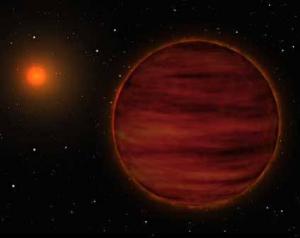
Artist's impression of the SCR 1845-6357 stellar system. The small red star is shown in the background while the newly discovered brown dwarf is at front. (Image courtesy of European Southern Observatory)

The Sun's New Exotic Neighbor: A Very Cool Brown Dwarf
Using the European Southern Observatory's Very Large Telescope in Chile, an international team of researchers discovered a brown dwarf belonging to the 24th closest stellar system to the Sun. Brown dwarfs are intermediate objects that are neither stars nor planets. This object is the third closest brown dwarf to the Earth yet discovered, and one of the coolest, having a temperature of about 750 degrees Centigrade. It orbits a very small star at about 4.5 times the mean distance between the Earth and the Sun. Its mass is estimated to be somewhere between 9 and 65 times the mass of Jupiter.

At a time when astronomers are peering into the most distant Universe, looking at objects as far as 13 billion light-years away, one may think that our close neighbourhood would be very well known. Not so. Astronomers still find new star-like objects in our immediate vicinity. Using ESO's VLT, they just discovered a brown dwarf companion to the red star SCR 1845-6357, the 36th closest star to the Sun.

"This newly found brown dwarf is a valuable object because its distance is well known, allowing us to determine with precision its intrinsic brightness", said team member Markus Kasper (ESO). "Moreover, from its orbital motion, we should be able in a few years to estimate its mass. These properties are vital for understanding the nature of brown dwarfs."
To discover this brown dwarf, the team used the high-contrast adaptive optics NACO

Simultaneous Differential Imager (SDI) on ESO's Very Large Telescope, an instrument specifically developed to search for extrasolar planets. The SDI camera enhances the ability of the VLT and its adaptive optics system to detect faint companions that would normally be lost in the glare of the primary star. In particular, the SDI camera provides additional, often very useful spectral information which can be used to determine a rough temperature for the object without follow-up observations.

Located 12.7 light-years away from us, the newly found object is nevertheless not the closest brown dwarf. This honour goes indeed to the two brown dwarfs surrounding the star Epsilon Indi, located 11.8 light years away.

However, this newly discovered brown dwarf is unique in many aspects. "Besides being extremely close to Earth, this object is a T dwarf - a very cool brown dwarf - and the only such object found as a companion to a low-mass star," said Beth Biller, a graduate student at the University of Arizona and lead author of the paper reporting the discovery. "It is also likely the brightest known object of its temperature because it is so close."

The discovery of this brown dwarf hints that, at least close to the Sun, cool brown dwarfs prefer to be part of a couple with a star or another brown dwarf, rather than wandering alone in the cosmic emptiness. Indeed, of the seven cool brown dwarfs that reside within 20 light years of the Sun, five have a companion.

The work presented is a Letter to the Editor in the Astrophysical Journal:
"Very Nearby to the Sun: A Methane Rich Brown Dwarf"
Source: European Southern Observatory
Science Daily press releases 22nd March 2006
_______________________________________________________
_______________________________________________________

Labels: , , ,