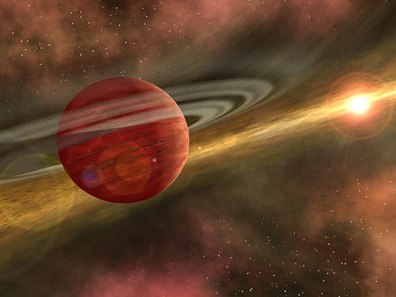
Watching How Planets Form: Anatomy Of A Planet-forming Disc Around A Star More Massive Than The SunArtist's impression of a flared proto-planetary disc, similar to what has been deduced around the 2.5 solar mass star HD 97048. Image courtesy of: European Southern Observatory
______________________________________________________
With the VISIR instrument on ESO's Very Large Telescope, astronomers have mapped the disc around a star more massive than the Sun. The very extended and flared disc most likely contains enough gas and dust to spawn planets. It appears as a precursor of debris discs such as the one around Vega-like stars and thus provides the rare opportunity to witness the conditions prevailing prior to or during planet formation.
"Planets form in massive, gaseous and dusty proto-planetary discs that surround nascent stars. This process must be rather ubiquitous as more than 200 planets have now been found around stars other than the Sun," said Pierre-Olivier Lagage, from CEA Saclay (France) and leader of the team that carried out the observations. "However, very little is known about these discs, especially those around stars more massive than the Sun. Such stars are much more luminous and could have a large influence on their disc, possibly quickly destroying the inner part."
The astronomers used the VISIR instrument [1] on ESO's Very Large Telescope to map in the infrared the disc surrounding the young star HD 97048. With an age of a few million years [2], HD 97048 belongs to the Chameleon I dark cloud, a stellar nursery 600 light-years away. The star is 40 times more luminous than our Sun and is 2.5 times as massive.
The astronomers could only have achieved such a detailed view due to the high angular resolution offered by an 8-metre size telescope in the infrared, reaching a resolution of 0.33 arcsecond. They discovered a very large disc, at least 12 times more extended than the orbit of the farthest planet in the Solar System, Neptune. The observations suggest the disc to be flared. "This is the first time such a structure, predicted by some theoretical models, is imaged around a massive star," said Lagage.
Such a geometry can only be explained if the disc contains a large amount of gas, in this case, at least as much as 10 times the mass of Jupiter. It should also contain more than 50 Earth masses in dust.
The dust mass derived here is more than thousand times larger than what is observed in debris discs and Kuiper belt-like structures found around older, 'Vega-like' stars, such as Beta Pictoris, Vega, Fomalhaut and HR 4796. The dust around these stars is thought to be produced by collisions of larger bodies. The dust mass observed around HD 97048 is similar to the mass invoked for the (undetected) parent bodies in the more evolved systems. HD 97048's disc is thus most likely a precursor of debris discs observed around older stars.
"From the structure of the disc, we infer that planetary embryos may be present in the inner part of the disc," said Lagage. "We are planning follow-up observations at higher angular resolution with ESO's VLT interferometer in order to probe these regions."
The scientists report their discovery in the 28 September issue of Science Express, the rapid online publication service of the journal Science: "Anatomy of a flaring proto-planetary disc around a young intermediate-mass star", by P.-O. Lagage et al.
The team is composed of Pierre-Olivier Lagage, Coralie Doucet, and Eric Pantin, (CEA Saclay, France), Sebastien Charnoz (Paris 7 Denis Diderot University), Emilie Habart (Institut d'Astrophysique Spatiale, Orsay, France), Gaspard Duch?TMne, Fran?ßois M?©nard, and Christophe Pinte (Laboratoire d'Astrophysique de Grenoble, France), and Jan-Willem Pel (Groningen University, The Netherlands)
Notes:
[1] VISIR - the VLT Imager and Spectrometer for the InfraRed - is a complex multi-mode instrument designed to operate in the 10 and 20 microns atmospheric windows, i.e. at wavelengths up to about 40 times longer than visible light and to provide images as well as spectra at a wide range of resolving power up to ~ 30 000. It can sample images down to the diffraction limit of the 8.2-m Melipal telescope (0.3 arcsec at 10 microns wavelength, i.e. corresponding to a resolution of 500 m on the Moon).
[2] By comparison, the Sun is about 4.6 billion years old. Translated to a human timescale, these young stars would be just 3 days old, compared to the Sun's 40 years. Source European Southern Observatory
Original text Science Daily 30th September 2006._______________________________________________________
Astronomers Discover Planet Building Is Big Mess_______________________________________________________
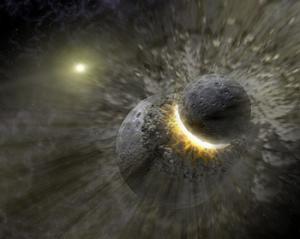
 ENLARGE Image: Medium This artist's concept illustrates how planetary systems arise out of massive collisions between rocky bodies. These catastrophes continue to occur around stars even after they have developed full-sized planets, when they are as old as one hundred million years. For reference, our own Sun, at 4.5 billion years old, is far past this late stage of planet formation. In this image, a young star is shown circled by full-sized planets, and rings of dust beyond. These rings, also called "debris discs" arise when embryonic planets smash into each other. One of these collisions is illustrated in the inset above. Spitzer was able to see the dust generated by these collisions with its powerful infrared vision. Credit: NASA/JPL-Caltech/T. Pyle (SSC-Caltech)Planets are built over a long period of massive collisions between rocky bodies as big as mountain ranges.
Observations from NASA's Spitzer Space Telescope reveal surprisingly large dust clouds around several stars. These clouds most likely flared up when rocky, embryonic planets smashed together. The Earth's own Moon may have formed from such a catastrophe. Prior to these results, astronomers thought planets were formed under less chaotic circumstances.
"It's a mess out there," said Dr. George Rieke of the University of Arizona, Tucson, first author of the findings and a Spitzer scientist. "We are seeing that planets have a long, rocky road to go down before they become full grown."Spitzer was able to see the dusty aftermaths of these collisions with its powerful infrared vision. When embryonic planets, the rocky cores of planets like Earth and Mars, crash together, they are believed to either merge into a bigger planet or splinter into pieces. The dust generated by these events is warmed by the host star and glows in the infrared, where Spitzer can see it.
They mirror what we know about the formation of our own planetary system. Recent observations from studies of our Moon's impact craters also reveal a turbulent early solar system. "Our Moon took a lot of violent hits when planets had already begun to take shape," Rieke said.
According to the most popular theory, rocky planets form somewhat like snowmen. They start out around young stars as tiny balls in a disc-shaped field of thick dust. Then, through sticky interactions with other dust grains, they gradually accumulate more mass. Eventually, mountain-sized bodies take shape, which further collide to make planets.
Previously, astronomers envisioned this process proceeding smoothly toward a mature planetary system over a few million to a few tens of millions of years. Dusty planet-forming discs, they predicted, should steadily fade away with age, with occasional flare-ups from collisions between leftover rocky bodies.
Rieke and his colleagues have observed a more varied planet-forming environment. They used new Spitzer data, together with previous data from the European Space Agency's Infrared Space Observatory and the joint NASA, United Kingdom and the Netherlands' Infrared Astronomical Satellite. They looked for dusty discs around 266 nearby stars of similar size, about two to three times the mass of the Sun, and various ages. Seventy-one of those stars were found to harbor discs, presumably containing planets at different stages of development. But, instead of seeing the discs disappear in older stars, the astronomers observed the opposite in some cases.
"We thought young stars, about one million years old, would have larger, brighter discs, and older stars from 10 to 100 million years old would have fainter ones," Rieke said. "But we found some young stars missing discs and some old stars with massive discs."
This variability implies planet-forming discs can become choked with dust throughout the discs' lifetime, up to hundreds of millions of years after the host star was formed. "The only way to produce as much dust as we are seeing in these older stars is through huge collisions," Rieke said.
Before Spitzer, only a few dozen planet-forming discs had been observed around stars older than a few million years. Spitzer's uniquely sensitive infrared vision allows it to sense the dim heat from thousands of discs of various ages. "Spitzer has opened a new door to the study of discs and planetary evolution," said Dr. Michael Werner, project scientist for Spitzer at NASA's Jet Propulsion Laboratory, Pasadena, Calif. "These exciting new findings give us new insights into the process of planetary formation, a process that led to the birth of planet Earth and to life," said Dr. Anne Kinney, director of the universe division in the Science Mission Directorate at NASA Headquarters, Washington. "Spitzer truly embodies NASA's mission to explore the universe and search for life," she said.
JPL manages the Spitzer Space Telescope for NASA's Science Mission Directorate. Artist's concepts and additional information about the Spitzer Space Telescope is available at http://www.spitzer.caltech.edu.
Source NASA Jet Propulsion
Original text: Science Daily 19th October 2004._______________________________________________________
Spitzer Sees Dusty Aftermath Of Pluto-Sized Collision_______________________________________________________
 ENLARGE Image: Medium Massive Smash-Up at Vega: This artist concept illustrates how a massive collision of objects, perhaps as large as the planet Pluto, smashed together to create the dust ring around the nearby star Vega. New observations from NASA's Spitzer Space Telescope indicate the collision took place within the last one million years. Astronomers think that embryonic planets smashed together, shattered into pieces, and repeatedly crashed into other fragments to create ever finer debris. (Credit: NASA/JPL-Caltech/T. Pyle (SSC/Caltech))
Astronomers say a dusty disc swirling around the nearby star Vega is bigger than earlier thought. It was probably caused by collisions of objects, perhaps as big as the planet Pluto, up to 2,000 kilometers (about 1,200 miles) in diameter.
NASA's Spitzer Space Telescope has seen the dusty aftermath of this "run-in." Astronomers think embryonic planets smashed together, shattered into pieces and repeatedly crashed into other fragments to create ever-finer debris. Vega's light heats the debris, and Spitzer's infrared telescope detects the radiation.
Vega, located 25 light-years away in the constellation Lyra, is the fifth brightest star in the night sky. It is 60 times brighter than our Sun. Observations of Vega in 1984, with the Infrared Astronomical Satellite, provided the first evidence for dust particles around a typical star. Because of Vega's proximity and because its pole faces Earth, it provides a great opportunity for detailed study of the dust cloud around it.
Like a drop of ink spreading out in a glass of water, the particles in Vega's dust cloud don't stay close to the star long. The dust we are seeing in the Spitzer images is being blown out by intense light from the star. We are witnessing the aftermath of a relatively recent collision, probably within the last million years.Scientists say this disc event is short-lived. The majority of the detected material is only a few microns in size, 100 times smaller than a grain of Earth sand. These tiny dust grains leave the system and dissipate into interstellar space on a time scale less than 1,000 years. But there are so many tiny grains. They add up to a total mass equal to one third of the weight of our moon.
The mass of these short-lived grains implies a high dust-production rate. The Vega disc would have to have an improbably massive reservoir of planet-building material and collisions to maintain this amount of dust production throughout the star's life (350 million years, 13 times younger than our Sun). "We think a transient disc phenomenon is more likely," Su said.
Astronomers were struck by other characteristics of Vega's debris disc, including its physical size. It has a radius of at least 815 astronomical units, roughly 20 times larger than our solar system. One astronomical unit is the distance from Earth to the Sun, which is 150million kilometers (93- million miles). A study of the disc's surface brightness indicates the presence of an inner hole at a radius of 86 astronomical units (twice the distance between Pluto and the Sun). Large embryonic planets at the edge of this inner hole may have collided to make the rest of the debris around Vega.
"Spitzer has obtained the first high spatial-resolution infrared images of Vega's disc," said Dr. Michael Werner, co-author and project scientist for Spitzer at NASA's Jet Propulsion Laboratory, Pasadena, Calif. "Its sensitive infrared detectors have allowed us to see that Vega is surrounded by an enormous disc of debris."
JPL manages the Spitzer Space Telescope mission for NASA's Science Mission Directorate, Washington. Science operations are conducted at the Spitzer Science Center at the California Institute of Technology in Pasadena. JPL is a division of Caltech. The multi-band imaging photometer for Spitzer, which made the new disc observations, was built by Ball Aerospace Corporation, Boulder, Colo.; the University of Arizona; and Boeing North American, Canoga Park, Calif. Additional information about the Spitzer Space Telescope is available at http://www.spitzer.caltech.edu.
Source University of Arizona
Original text: Science Daily 18th January 2005._______________________________________________________
_______________________________________________________
Famous Quotes History is a gallery of pictures in which there are few originals and many copies. Alexis de Tocqueville________________________________________________________
Labels: ESO, Proto-Planets, Spitzer