Saturday, May 05, 2007

SOHO & Sun Ripples


The Solar and Heliospheric Observatory (SOHO) may have glimpsed long-sought oscillations on the Sun’s surface.

The subtle variations reveal themselves as a miniscule ripple in the overall movement of the solar surface. Astronomers have been searching for ripples of this kind since the 1970s, when they first detected that the solar surface was oscillating in and out.

The so-called ‘g-modes’ are driven by gravity and provide information about the deep interior of the Sun. They are thought to occur when gas churning below the solar surface plunges even deeper into our star and collides with denser material, sending ripples propagating through the Sun’s interior and up to the surface. It is the equivalent of dropping a stone in a pond.

Unfortunately for observers, these waves are badly degraded during their passage to the solar surface. By the time g-modes reach the exterior, they are little more than ripples a few metres high.

Until now, the rotation rate of the solar core was uncertain. If the the Global Oscillation at Low Frequency (GOLF) - instrument on SOHO -detection is confirmed, it will show that the solar core is definitely rotating faster than the surface.

The rotation speed of the solar core is an important constraint for investigating how the entire Solar System formed, because it represents the hub of rotation for the interstellar cloud that eventually formed the Sun and all the bodies around it.

The next step for the team is to refine the data to increase their confidence in the detection, by incorporating data from other instruments, both on SOHO and at ground-based observatories.

SOHO's quest for solar ripples from ESA
A Massive Explosion on the Sun from NASA
________________________________________________________
________________________________________________________

Labels: , , ,

Saturday, April 28, 2007

Solar Storm Cycle


The next 11-year cycle of solar storms will most likely start next March and peak in late 2011 or mid-2012—up to a year later than expected—according to a forecast issued by the NOAA Space Environment Center in coordination with an international panel of solar experts. The NOAA Space Environment Center led the prediction panel and issued the forecast at its annual Space Weather Workshop in Boulder, Colo.

Expected to start last fall, the delayed onset of Solar Cycle 24 stymied the panel and left them evenly split on whether a weak or strong period of solar storms lies ahead, but neither group predicts a record-breaker.

During an active solar period, violent eruptions occur more often on the sun. Solar flares and vast explosions, known as coronal mass ejections, shoot energetic photons and highly charged matter toward Earth, jolting the planet's ionosphere and geomagnetic field, potentially affecting power grids, critical military and airline communications, satellites, Global Positioning System (GPS) signals, and even threatening astronauts with harmful radiation. These same storms illuminate night skies with brilliant sheets of red and green known as auroras, or the northern or southern lights.

Next Solar Storm Cycle Will Likely Start Next March
Read more from NOAA Press Release.
_______________________________________________________
_______________________________________________________

Labels: , , ,

Wednesday, March 28, 2007

Magnetic Carpet


Cluster reveals how Solar Magnetic fields get reconnected in turbulent plasma

This image provides a model of magnetic fields at the Sun's surface using SOHO data, showing irregular magnetic fields (the ‘magnetic carpet’) in the solar corona (top layer of the Sun's atmosphere).

Small-scale current sheets are likely to form in such turbulent environment and reconnection may occur in similar fashion as in Earth's magnetosheath.

Credits: Stanford-Lockheed Inst. for Space Research/NASA GSFC
_______________________________________________________
Structure Of The Sun's Magnetic Field by Science Daily source ESA
Cassini - Odd Hexagon at Saturn’s Pole from Centauri Dreams
_______________________________________________________
_______________________________________________________

Labels: , ,

Monday, February 12, 2007

The travels of Ulysses


______________________________________________________


Less than one hundred years ago, the south pole of Earth was a land of utter mystery. It was terra incognita until intrepid Explorers Roald Amundsen and Robert F. Scott, fighting wind, disorientation and a fantastic almost-martian cold reached the Pole in 1911 and 1912

The situation is much the same today on the sun. "The sun's south pole is uncharted territory," says solar physicist Arik Posner of NASA headquarters. "We can barely see it from Earth, and most of our sun-studying spacecraft are stationed over the sun's equator with a poor view of higher latitudes."

There is, however, one spacecraft that can travel over the sun's poles. "On February 7th, Ulysses reached a maximum heliographic latitude of 80 degrees South - almost directly above the South Pole," says Posner who is the Ulysses Program Scientist for NASA.

Ulysses has flown over the sun's poles only twice before--in 1994-95 and 2000-01. The flybys were brief, but enough to prove that the poles are strange and interesting places.

Consider the following:

1. The sun's north magnetic north pole sticks out the south end of the sun. Magnetically, the sun is upside down!

"Most people don't know it, but we have the same situation here on Earth," notes Posner. "Our magnetic north pole sticks out of the geographic south pole."

"Both the sun's and Earth's magnetic poles are constantly on the move, and they occasionally do a complete flip, with N and S changing places."

This flipping happens every 11 years on the sun in synch with the sunspot cycle. It happens every 300,000 years or so on Earth in synch with--what? No one knows. "Studying the polar magnetic field of the sun might give us some clues about the magnetic field of our own planet."

2. There are coronal holes over the sun's pole. These are places where the sun's magnetic field opens up and allows solar wind to escape. "Flying over the sun's poles, you get slapped in the face by a hot, million mph stream of protons and electrons," Ulysses is experiencing and studying this polar wind right now.

3. Something keeps cosmic rays out of the sun's polar regions. The current flyby gives us a chance to investigate this phenomenon.

4. Another mystery: There is evidence from earlier flybys that the north pole and the south pole of the sun have different temperatures. "We're not sure why this should be," says Posner, "and we're anxious to learn if it is still the case." Today's south polar flyby will be followed by a north polar flyby in early 2008, allowing a direct north vs. south comparison.


Today the spacecraft Ulysses is gliding 300 million km (2 AU) above the sun's 'Antarctic.'

That's a safe distance and a good place to sample the sun's polar winds and magnetic fields.
______________________________________________________
Ulysses - Exploring Space over the Sun's Poles from ESA
Deep Space Voyage to High Latitudes over the Solar Poles. from NASA
______________________________________________________
______________________________________________________
On matters closer to Earth. I shall soon (next month) be starting a closer scrutiny of medical advances, standards in health care and nhs practices in Cambridge on the other site Torchwood
______________________________________________________
______________________________________________________

Labels: , , ,

Friday, January 26, 2007

Sun's Hot Atmosphere


A close up of loops in a magnetic active region.

These loops, observed by STEREO's SECCHI/EUVI telescope, are at a million degrees C. This powerful active region, AR903, observed here on Dec. 4, produced a series of intense flares over the next few days. (Credit: NASA)
_______________________________________________________

Solar Satellite's First Images Show Sun's Super-hot Atmosphere

NASA's twin Solar Terrestrial Relations Observatories (STEREO) first images of the sun give a view into the sun's mounting activity.

"STEREO is the first mission using the moon's gravity to redirect multiple spacecraft, launched aboard a single rocket, to their respective orbits," said Ron Denissen, APL STEREO project manager. On Dec. 15, 2006, mission operations personnel at the laboratory used lunar gravitational swingbys to alter the spacecraft orbits, redirecting the "A" observatory to its orbit "ahead" of Earth. The "B" observatory swung past the moon a second time on Jan. 21, redirecting it to an orbit "behind" Earth.

The two will orbit the sun from this perspective, separating from each other by about 45 degrees per year. Scientists expect the two to be in position to produce 3-D images by April 2007.

"Our ultimate goal is seeing solar flares and coronal mass ejections in 3-D to better understand their origin, evolution and determine whether or not they're a threat to Earth," said Russell Howard, principal investigator for SECCHI, the imaging instrument suite aboard both observatories. Howard and his staff are a part of the Naval Research Laboratory (NRL) in Washington, DC.


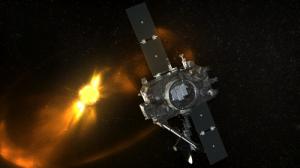
Artist's concept showing a coronal mass ejection (CME) sweeping past STEREO. (Image credit: NASA)

_______________________________________________________

Coronal mass ejections, - giant clouds of plasma shot out into space by the sun and X-ray emitting solar flares are the largest explosions in the solar system and can pack the force of a billion megaton nuclear bombs. They are caused by the buildup and sudden release of magnetic stress in the solar atmosphere above the turbulent active regions we see as sunspots.

When directed at Earth, CMEs can produce spectacular aurora and disrupt satellites, radio communications and power systems. Energetic particles associated with these solar eruptions permeate the entire solar system and may be hazardous to spacecraft and astronauts.

“An integral part of exploration, heliophysics is the system science that unites all of the linked phenomena in the region of the cosmos influenced by a magnetically variable star like our sun,” said Madhulika Guhathakurta, NASA STEREO program scientist at NASA Headquarters, Washington. The STEREO mission represents the most significant upgrade and expansion to this system science as it will not only provide a rich package of upgraded sensors, but it will travel to new vantage points.”


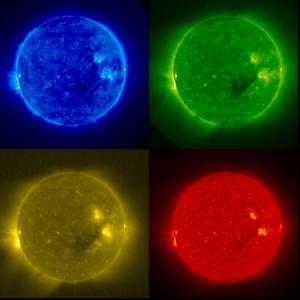
A mosaic of the extreme ultraviolet images from STEREO's SECCHI/Extreme Ultraviolet Imaging Telescope aboard the "A" observatory taken on Dec. 4, 2006.
These false color images show the sun's atmospheres at a range of different temperatures. Clockwise from top left: 1 million degrees C (171 Å), 1.5 million C (195 Å), 60,000-80,000 C (304 Å), and 2.5 million C (286 Å). (Credit: NASA/NRL)

Twin Spacecraft Swing Past Moon, Preparing For 3-D Solar Studies from Science Daily
_______________________________________________________
_______________________________________________________
The Voyager's and the Heliosphere by Astroprof
Holding the Sun up & Stereo on the Sun by Astroprof
Solar & Lunar Atmospheres from Astroprof's Page
_______________________________________________________
_______________________________________________________

Labels: ,

Friday, November 10, 2006

Giant Stellar Flares


_______________________________________________________
Image above: This movie shows a massive solar flare from October 2003, captured by the SOHO satellite. Note the burst of high-speed particles after the flare creating a snowstorm effect. The stellar flare that Swift detected from a star system called II Pegasi was millions of times more powerful. Credit: NASA-ESA/SOHO/EIT

The flaring star in II Pegasi is 0.8 times the mass of the sun; its companion is 0.4 solar masses.
The stars are close, only a few stellar radii apart. As a result, tidal forces cause both stars to spin quickly, rotating in step once in 7 days compared to the sun's 28-day rotation period. Fast rotation is conducive to strong stellar flares.

Young stars spin fast and flare more actively, and the early sun likely generated solar flares on par with II Pegasi. Yet II Pegasi could be at least a billion years older than our middle-aged 5-billion-year-old sun. "The tight binary orbit in II Pegasi acts as a fountain of youth, enabling older stars to spin and flare as strongly as young stars," said Steve Drake of NASA Goddard, a co-author with Osten on an upcoming Astrophysical Journal paper.

The key finding in the II Pegasi flare was the detection of higher-energy X-rays. Swift's Burst Alert Telescope usually detects gamma-ray bursts, the most powerful explosions known, which arise from star explosions and star mergers. The II Pegasi flare was energetic enough create a false alarm for a burst detection. Scientists quickly knew this was a different kind of event, however, when the flare overwhelmed Swift's X-ray Telescope, a second instrument.

Higher-energy "hard" X-ray detection in this case is the telltale signal of electron particle acceleration, creating what is called non-thermal X-rays. NASA's RHESSI mission sees this in the sun's solar flares. While lower-energy "soft" X-rays from thermal emission have been seen on other stars, scientists have never seen hard X-rays on any flaring star other than the sun. Because the hard X-rays occur earlier in the flare and are responsible for heating the coronal gas, they reveal unique information about the flare's initial stages.

Had the sun flared like II Pegasi, these hard X-rays would have overwhelmed the Earth's protective atmosphere, leading to significant climate change and mass extinction. Ironically, one theory posits that stellar particle outbursts are needed to condition dust to form into planets and perhaps life.

The Swift observation demonstrates that such outbursts do occur."Swift was built to catch gamma-ray bursts, but we can use its speed to catch supernovae and now stellar flares," said Swift Project Scientist Neil Gehrels of NASA Goddard. "We can't predict when a flare will happen, but Swift can react quickly once it senses an event.

Swift catches Stellar bursts & giant flares from NASA 06 Nov 2006
_______________________________________________________

Science Daily release:
A Leading Edge
Camera For Molecules

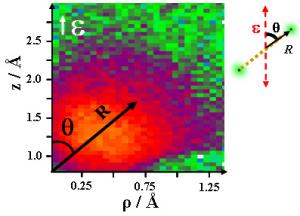
Researchers at the Max Planck Institute for Nuclear Physics in Heidelberg have visualised vibration and rotation in the nuclei of a hydrogen molecule as a quantum mechanical wave packet.

What is more, this has been achieved on an extremely short spatio-temporal scale. They "photographed" the molecule using intensive, ultrashort laser pulses at different points in time and compiled a film from the separate images. This allowed them to visualise the quantum mechanical wave pattern of the vibrating and rotating molecule (Physical Review Letters, Online-Edition, November 6, 2006).

Cameras and light microscopes are not viable options when photographing molecules: a hydrogen molecule is around 5,000 times smaller than the wavelength of visible light and it is therefore not possible to create an optical image of these molecules. Instead, for some time Max Planck researchers have been using pump-probe technology to make high-resolution and ultrahigh-speed images. The molecules are first "bumped" with a "pump" laser pulse and then after a specific time measured with a "probe" laser pulse.
_______________________________________________________
Molecular Photography by JoAnne Hewett @ Cosmic Variance
Double-eyed vortex at Venus' South Pole from ESA 09 Nov 2006
Lisa Randall on Xtra dimensions by Sabine Hossenfelder 09 Nov 2006
_______________________________________________________
_______________________________________________________

Labels: ,