Monday, February 19, 2007

Coronal Mass Ejection


_______________________________________________________
Credits: SOHO/LASCO/EIT (ESA & NASA)

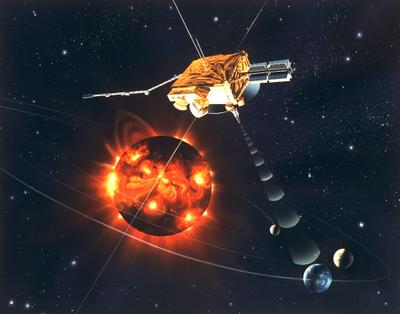
A Coronal Mass Ejection (CME) blasting off the Sun’s surface in the direction of Earth. In this image, the left portion is composed of an EIT 304 image superimposed on a LASCO C2 coronagraph. Two to four days later, the CME cloud is shown striking and beginning to be mostly deflected around the Earth’s magnetosphere. The blue paths emanating from the Earth’s poles represent some of its magnetic field lines. The magnetic cloud of plasma can extend to 30 million miles wide by the time it reaches earth. These storms, which occur frequently, can disrupt communications and navigational equipment, damage satellites, and even cause blackouts.

The Sun connects with all the planets via the solar wind, a flow of electrically charged particles that constantly 'blows' off the Sun and creates 'space weather'. Space weather interactions can affect and erode the atmospheres of Earth and other planets, and, when channelled through a planetary magnetic field, create beautiful aurorae. Until now, physicists have been principally concerned with the way the solar wind interacts with Earth, the so-called Sun-Earth connection. Now it is time to think bigger.


_______________________________________________________
Credits: ESA/David Hardy

Ulysses has made fundamental contributions to our understanding of the Sun, the heliosphere, and our local interstellar neighbourhood. Charged particles are in fact ‘tied’ by electromagnetic forces and follow the magnetic field lines in space. In the case of the Sun, which is a rotating object, so the field lines are actually twisted into spirals like water from a garden sprinkler.

In mid-December 2006, although very close to the minimum of its 11-year sunspot cycle, the Sun showed that it is still capable of producing a series of remarkably energetic outbursts.

The solar storms, which were confined to the equatorial regions, produced quite intense bursts of particle radiation that were clearly observed by near-Earth satellites. Surprisingly, similar increases in radiation were detected by the instruments on board Ulysses, even though it was three times as far away and almost over the south solar pole. Particle events of this kind were seen during the second polar passes in 2000 and 2001, at solar maximum.

Scientists are busy trying to understand how the charged particles made it all the way to the poles. "Charged particles have to follow magnetic field lines, and the magnetic field pattern of the Sun near solar minimum ought to make it much more difficult for the particles to move in latitude.

Surprises from the Sun’s South Pole from ESA Int 19/02/07
International Heliophysical Year begins from ESA Int 19/02/07
_______________________________________________________
A Year of observing the Sun-Earth relationship Starts PPARC.
The New Solar System from Ryan Wyatt @ Visualising Science.
_______________________________________________________
_______________________________________________________

Labels: , , ,

Monday, February 12, 2007

The travels of Ulysses


______________________________________________________


Less than one hundred years ago, the south pole of Earth was a land of utter mystery. It was terra incognita until intrepid Explorers Roald Amundsen and Robert F. Scott, fighting wind, disorientation and a fantastic almost-martian cold reached the Pole in 1911 and 1912

The situation is much the same today on the sun. "The sun's south pole is uncharted territory," says solar physicist Arik Posner of NASA headquarters. "We can barely see it from Earth, and most of our sun-studying spacecraft are stationed over the sun's equator with a poor view of higher latitudes."

There is, however, one spacecraft that can travel over the sun's poles. "On February 7th, Ulysses reached a maximum heliographic latitude of 80 degrees South - almost directly above the South Pole," says Posner who is the Ulysses Program Scientist for NASA.

Ulysses has flown over the sun's poles only twice before--in 1994-95 and 2000-01. The flybys were brief, but enough to prove that the poles are strange and interesting places.

Consider the following:

1. The sun's north magnetic north pole sticks out the south end of the sun. Magnetically, the sun is upside down!

"Most people don't know it, but we have the same situation here on Earth," notes Posner. "Our magnetic north pole sticks out of the geographic south pole."

"Both the sun's and Earth's magnetic poles are constantly on the move, and they occasionally do a complete flip, with N and S changing places."

This flipping happens every 11 years on the sun in synch with the sunspot cycle. It happens every 300,000 years or so on Earth in synch with--what? No one knows. "Studying the polar magnetic field of the sun might give us some clues about the magnetic field of our own planet."

2. There are coronal holes over the sun's pole. These are places where the sun's magnetic field opens up and allows solar wind to escape. "Flying over the sun's poles, you get slapped in the face by a hot, million mph stream of protons and electrons," Ulysses is experiencing and studying this polar wind right now.

3. Something keeps cosmic rays out of the sun's polar regions. The current flyby gives us a chance to investigate this phenomenon.

4. Another mystery: There is evidence from earlier flybys that the north pole and the south pole of the sun have different temperatures. "We're not sure why this should be," says Posner, "and we're anxious to learn if it is still the case." Today's south polar flyby will be followed by a north polar flyby in early 2008, allowing a direct north vs. south comparison.


Today the spacecraft Ulysses is gliding 300 million km (2 AU) above the sun's 'Antarctic.'

That's a safe distance and a good place to sample the sun's polar winds and magnetic fields.
______________________________________________________
Ulysses - Exploring Space over the Sun's Poles from ESA
Deep Space Voyage to High Latitudes over the Solar Poles. from NASA
______________________________________________________
______________________________________________________
On matters closer to Earth. I shall soon (next month) be starting a closer scrutiny of medical advances, standards in health care and nhs practices in Cambridge on the other site Torchwood
______________________________________________________
______________________________________________________

Labels: , , ,

Thursday, November 23, 2006

The Sun's Poles


_________________________________________________
Credits: JPL-ESA, 1994 ESA Space


Ulysses starts third passage over the Sun's south pole.

Launched in 1990, the European-built spacecraft is engaged in the exploration of the heliosphere, the bubble in space blown out by the solar wind. Given the capricious nature of the Sun, this third visit will undoubtedly reveal new and unexpected features of our star's environment.

The first polar passes in 1994 (south) and 1995 (north) took place near solar minimum, whereas the second set occurred at the height of solar activity in 2000 and 2001.

As Ulysses approaches the polar regions for the third time, the Sun has settled down once again and will be close to its minimum. Ulysses orbits the Sun once every 6.2 years, making it perfect for studying the 11-year solar activity cycle. One can really say that Ulysses is exploring the heliosphere in four dimensions - covering all three spatial dimensions as well as time.

Even though the Sun will be close to its activity minimum just as it was in 1994-95, there is one fundamental difference: the Sun's magnetic field has reversed its polarity. In addition to the 11-year activity cycle, the Sun has a magnetic cycle of 22 years, known as the Hale Cycle. Ulysses, now in its 17th year in orbit, is giving scientists the chance to observe the heliosphere from a unique, out-of-ecliptic vantage point and with the same set of instruments over almost a complete Hale Cycle.

The Ulysses science team is expecting to find that the change in polarity of the Sun's magnetic field will have a clear effect on the way cosmic ray particles reach our location in the inner heliosphere. During the last solar minimum, positively charged particles had a slightly easier time reaching the polar regions; this time, the negatively charged electrons should have the advantage.

But there could be surprises. In 1994, the pole-to-equator difference in the number of particles observed, although present, was much smaller than expected. This lead to several new models for the way charged particles move in the complex environment of interplanetary space. The new observations will test if these new theories are correct.

Another surprise from the first polar passes was the fact that the heliosphere is not as symmetric as previously believed. The Sun's magnetic field was found to be slightly stronger in the south than in the north. Scientists be watching out for this effect as Ulysses swings from the south pole to the north in 2007.

Ulysses returns to the Sun's polar cap NASA release 20th Nov 2006
Ulysses embarks on third set of polar passes 17th November 2006
Ulysses Starts New Journey Around The Sun's Poles 21st Nov 2006
_______________________________________________________
_______________________________________________________
The Weblog Awards 2006 - A chance for you to nominate
the best Educational Blogs >>> Nominations Best Science Blogs
_______________________________________________________
Famous Quotes
Action is the foundational key to all success. Pablo Picasso
_______________________________________________________
_______________________________________________________

Labels: ,