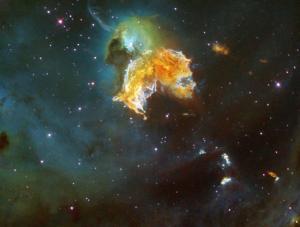
 Hubble Space Telescope image of a nearby supernova remnant. Denoted N 63A, the object is the remains of a massive star that exploded, spewing its gaseous layers out into an already turbulent region. (Image Credit: NASA, ESA, HEIC, and The Hubble Heritage Team (STScI/AURA); Acknowledgment: Y.-H. Chu and R. M. Williams (UIUC)ENLARGE Image
 and
more imagesSupernova Remnant MenagerieA new view of violent and chaotic-looking mass of gas has been captured by the Hubble Space Telescope in an image of a nearby supernova remnant. Denoted N 63A, the object is the remains of a massive star that exploded, spewing its gaseous layers out into an already turbulent region.
The supernova remnant N 63A is a member of N 63, a star-forming region in the Large Magellanic Cloud (LMC). Visible from the southern hemisphere, the LMC is an irregular galaxy lying 160,000 light-years from our own Milky Way galaxy. The LMC provides excellent examples of active star formation and supernova remnants, many of which have been studied with Hubble.
Numerous of the stars in the immediate vicinity of N 63A are extremely massive. It is estimated that the 'mother-star', or progenitor, of the supernova that produced the remnant seen here was about 50 times more massive than our own Sun. Such a massive star has strong stellar winds that can clear away the gas around it and form a wind-blown bubble. The supernova that formed N 63A is thought to have exploded inside the central cavity of such a wind-blown bubble, which was itself embedded in a clumpy portion of the LMC's interstellar medium.
Images in the infrared, X-ray, and radio emission of this supernova remnant show the much more expanded bubble that totally encompasses the optical emission seen by Hubble. Odd-shaped mini-clouds or cloudlets that were too dense for the stellar wind to clear away are now engulfed in the bubble interior. The supernova generated a propagating shock wave, that continues to move rapidly through the low-density bubble interior, and shocks these cloudlets, shredding them fiercely.
Supernova remnants have long been thought to set off episodes of star formation when their expanding shock encounters nearby gas. As the Hubble images have illustrated, N 63A is still young and its ruthless shocks destroy the ambient gas clouds, rather than coercing them to collapse and form stars. Data obtained at various wavelengths from other detectors reveal on-going formation of stars at 10-15 light-years from N 63A. In a few million years, the supernova ejecta from N 63A would reach this star-formation site and may be incorporated into the formation of planets around solar-type stars there, much like the early history of the solar system.
The Hubble image of N 63A is a colour representation of data taken in 1997 and 2000 with Hubble's Wide Field Planetary Camera 2. Colour filters were used to sample light emitted by oxygen (shown in blue), hydrogen (shown in green) and sulphur (shown in red).Source:esa/nasa space telescope
Original text: Science Daily 8th June 2005_______________________________________________________
The Case Of The Neutron Star With A Wayward Wake_______________________________________________________
 This composite image was made with wide-field X-ray (blue/Rosat), radio (green/Very Large Array), and optical (red/Digitized Sky Survey) observations of the supernova remnant, IC443. The pullout, also a composite with a Chandra X-ray close-up, shows a neutron star that is spewing out a comet-like wake of high-energy particles as it races through space. Based on an analysis of the swept-back shape of the wake, astronomers deduced that the neutron star known as CXOU J061705.3 222127, or J0617 for short, is moving through the multimillion degree Celsius gas in the remnant. (Chandra X-ray: NASA/CXC/B.Gaensler et al; ROSAT X-ray: NASA/ROSAT/Asaoka & Aschenbach Radio Wide: NRC/DRAO/D.Leahy; Radio Detail: NRAO/VLA Optical: DSS The Case Of The Neutron Star With A Wayward Wake
A long observation with NASA's Chandra X-ray Observatory revealed important new details of a neutron star that is spewing out a wake of high-energy particles as it races through space. The deduced location of the neutron star on the edge of a supernova remnant, and the peculiar orientation of the neutron star wake, pose mysteries that remain unresolved.
"Like a kite flying in the wind, the behavior of this neutron star and its wake tell us what sort of gas it must be plowing through," said Bryan Gaensler of the Harvard-Smithsonian Center for Astrophysics in Cambridge, Mass., and lead author of a paper submitted to The Astrophysical Journal. "Yet we're still not sure how the neutron star got to its present location."
The neutron star, known as CXOU J061705.3+222127, or J0617 for short, appears to lie near the outer edge of an expanding bubble of hot gas associated with the supernova remnant IC 443. Presumably, J0617 was created at the time of the supernova -- approximately 30,000 years ago -- and propelled away from the site of the explosion at about 500,000 miles per hour.
However, the neutron star's wake is oriented almost perpendicularly to the direction expected if the neutron star were moving away from the center of the supernova remnant. This apparent misalignment had previously raised doubts about the association of the speeding neutron star with the supernova remnant.
Gaensler and his colleagues provide strong evidence that J0617 was indeed born in the same explosion that created the supernova remnant. First, the shape of the neutron star's wake indicates it is moving at the predicted pace, which is a little faster than the speed of sound in the remnant's multimillion-degree gas. In contrast, if the neutron star were outside the confines of the remnant, its inferred speed would be a sluggish 20,000 miles per hour. Also, the measured temperature of the neutron star matches that of one born at the same time of the supernova remnant.
What then, could cause the misaligned, or wayward, neutron star wake? The authors speculate that perhaps the doomed progenitor star was moving at a high speed before it exploded, so that the explosion site was not at the observed center of the supernova remnant. Fast moving gusts of gas inside the supernova remnant have further pushed the neutron star's wake out of alignment.
Observations of J0617 in the next 10 years should put this idea to the test. "If the neutron star was born off-center and if the wake is being pushed around by cross-winds, the neutron star should be moving close to vertically, away from the center of the supernova remnant. Now we wait and see," said Gaensler.
Another group, led by Margarita Karovska, also of the Harvard-Smithsonian Center, has concentrated on other, previously unnoticed intriguing features of J0617. At a recent conference on neutron stars in London, England, they announced their findings, which include a thin filament of cooler gas that appears to extend from the neutron star along the long axis of its wake, and a second point-like feature embedded in the X-ray nebula around the neutron star
"There are a number of puzzling observational features associated with this system crying out for longer observations" said Karovska.
Other members of the Gaensler team were S. Chatterjee and P. O. Slane (CfA), E. van der Swaluw (Royal Netherlands Meteorological Institute), F. Camilo (Columbia University), and J. P. Hughes (Rutgers University). Karovska's team included T. Clarke (Naval Research Laboratory), G. Pavlov (Penn State University), and M.C. Weisskopf and V. Zavlin of the Marshall Space Flight Center, Huntsville, Ala. which also manages the Chandra program for NASA's Science Mission Directorate. The Smithsonian Astrophysical Observatory provides science support and controls flight operations from the Chandra X-Ray Centre in Cambridge, Mass.
Original text Science Daily 1st June 2006_______________________________________________________
Deepest Image Of Exploded Star Uncovers Bipolar Jets_______________________________________________________
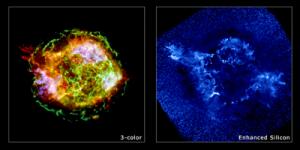
 This spectacular image of the supernova remnant Cassiopeia A is the most detailed image ever made of the remains of an exploded star. The one-million-second image shows a bright outer ring (green) ten light years in diameter that marks the location of a shock wave generated by the supernova explosion. A large jet-like structure that protrudes beyond the shock wave can be seen in the upper left. In the accompanying image, specially processed to highlight silicon ions, a counter-jet can be seen on the lower right. (Credit: NASA/CXC/GSFC/U.Hwang et al.)Deepest Image Of Exploded Star Uncovers Bipolar Jets
The spectacular image of Cassiopeia A released from NASA's Chandra X-ray Observatory has nearly 200 times more data than the "First Light" Chandra image of this object made five years ago. The new image reveals clues that the initial explosion, caused by the collapse of a massive star, was far more complicated than suspected
"Although this young supernova remnant has been intensely studied for years, this deep observation is the most detailed ever made of the remains of an exploded star," said Martin Laming of the Naval Research Laboratory, Washington. Laming is part of a team of scientists led by Una Hwang of NASA's Goddard Space Flight Center, Greenbelt, Md. "It is a gold mine of data that astronomers will be panning through for years to come," he added.
The 1 million-second (about 11.5-day) observation of Cassiopeia A uncovered two large, opposed jet-like structures that extend to about 10 light-years from the center of the remnant. Clouds of iron that have remained nearly pure for the approximately 340 years since the explosion also were detected.
"The presence of the bipolar jets suggests that jets could be more common in relatively normal supernova explosions than supposed by astronomers," said Hwang. A paper by Hwang, Laming and others on the Cassiopeia A observation will appear in an upcoming issue of The Astrophysical Journal Letters.
X-ray spectra show that the jets are rich in silicon atoms and relatively poor in iron atoms. In contrast, fingers of almost-pure iron gas extend in a direction nearly perpendicular to the jets. This iron was produced in the central, hottest regions of the star.
The high silicon and low iron abundances in the jets indicate that massive, matter-dominated jets were not the immediate cause of the explosion, as these should have carried out large quantities of iron from the central regions of the star.
A working hypothesis is that the explosion produced high-speed jets similar to those in hypernovae that produce gamma-ray bursts, but in this case, with much lower energies.The explosion also left a faint neutron star at the center of the remnant.
Unlike the rapidly rotating neutron stars in the Crab Nebula and Vela supernova remnants that are surrounded by dynamic magnetized clouds of electrons, this neutron star is quiet and faint.
Nor has pulsed radiation been detected from it. It may have a very strong magnetic field generated during the explosion that helped to accelerate the jets, and today resembles other strong-field neutron stars (a.k.a. "magnetars") in lacking a wind nebula.
The data for this new Cassiopeia A image were obtained by Chandra's Advanced Charged Coupled Device Imaging Spectrometer (ACIS) instrument during the first half of 2004. Due to its value to the astronomical community, this rich dataset was made available immediately to the public.
NASA's Marshall Space Flight Center, Huntsville, Ala., manages the Chandra program for the NASA Science Mission Directorate, Washington. Northrop Grumman of Redondo Beach, Calif., formerly TRW, Inc., was the prime development contractor for the observatory. The Smithsonian Astrophysical Observatory controls science and flight operations from the Chandra X-ray Center in Cambridge, Mass.
Source NASA/Marshall space Flight Centre
Original test: Science Daily 24 August 2004
For additional information and images http://chandra.nasa.gov _______________________________________________________
Neutron Star Discovered Where A Black Hole Was Expected_______________________________________________________
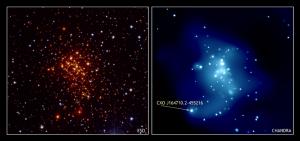 The optical image (left) of Westerlund 1 shows a dense cluster of young stars, several with masses of about 40 suns. Some astronomers speculated that repeated collisions between such massive stars in the cluster might have led to formation of an intermediate-mass black hole, more massive than 100 suns. A search of the cluster with Chandra (right) found no evidence for this type of black hole. Instead they found a neutron star (CXO J164710.2-455216), a discovery which may severely limit the range of stellar masses that lead to the formation of stellar black holes. (Credit: NASA/CXC/UCLA/M.Muno et al.) Neutron Star Discovered Where A Black Hole Was Expected
A very massive star collapsed to form a neutron star and not a black hole as expected, according to new results from NASA's Chandra X-ray Observatory. This discovery shows that nature has a harder time making black holes than previously thought
Scientists found this neutron star, a dense whirling ball of neutrons about 12 miles in diameter, in an extremely young star cluster. Astronomers were able to use well-determined properties of other stars in the cluster to deduce that the progenitor of this neutron star was at least 40 times the mass of the Sun.
"Our discovery shows that some of the most massive stars do not collapse to form black holes as predicted, but instead form neutron stars," said Michael Muno, a UCLA postdoctoral Hubble Fellow and lead author of a paper to be published in The Astrophysical Journal Letters.
When very massive stars make neutron stars and not black holes, they will have a greater influence on the composition of future generations of stars. When the star collapses to form the neutron star, more than 95% of its mass, much of which is metal-rich material from its core, is returned to the space around it.
"This means that enormous amounts of heavy elements are put back into circulation and can form other stars and planets," said J. Simon Clark of the Open University in the United Kingdom.
Astronomers do not completely understand how massive a star must be to form a black hole rather than a neutron star. The most reliable method for estimating the mass of the progenitor star is to show that the neutron star or black hole is a member of a cluster of stars, all of which are close to the same age.
Because more massive stars evolve faster than less massive ones, the mass of a star can be estimated from if its evolutionary stage is known. Neutron stars and black holes are the end stages in the evolution of a star, so their progenitors must have been among the most massive stars in the cluster.
Muno and colleagues discovered a pulsing neutron star in a cluster of stars known as Westerlund 1. This cluster contains a hundred thousand or more stars in a region only 30 light years across, which suggests that all the stars were born in a single episode of star formation. Based on optical properties such as brightness and color some of the normal stars in the cluster are known to have masses of about 40 suns. Since the progenitor of the neutron star has already exploded as a supernova, its mass must have been more than 40 solar masses.
Introductory astronomy courses sometimes teach that stars with more than 25 solar masses become black holes -- a concept that until recently had no observational evidence to test it. However, some theories allow such massive stars to avoid becoming black holes. For example, theoretical calculations by Alexander Heger of the University of Chicago and colleagues indicate that extremely massive stars blow off mass so effectively during their lives that they leave neutron stars when they go supernovae. Assuming that the neutron star in Westerlund 1 is one of these, it raises the question of where the black holes observed in the Milky Way and other galaxies come from.
Other factors, such as the chemical composition of the star, how rapidly it is rotating, or the strength of its magnetic field might dictate whether a massive star leaves behind a neutron star or a black hole. The theory for stars of normal chemical composition leaves a small window of initial masses - between about 25 and somewhat less than 40 solar masses - for the formation of black holes from the evolution of single massive stars. The identification of additional neutron stars or the discovery of black holes in young star clusters should further constrain the masses and properties of neutron star and black hole progenitors.
The work described by Muno was based on two Chandra observations on May 22 and June 18, 2005. NASA's Marshall Space Flight Center, Huntsville, Ala., manages the Chandra program for the agency's Science Mission Directorate. The Smithsonian Astrophysical Observatory controls science and flight operations from the Chandra X-ray Center in Cambridge, Mass.
Source Chandra X-Ray Observatory
Original text: Science Daily 3 November 2005
Additional information and images http://chandra.nasa.gov_______________________________________________________
Swarm Of Black Holes Near The Galactic Center_______________________________________________________
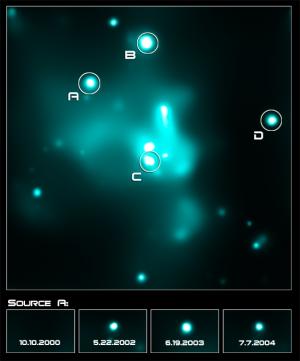
 These images are part of an ongoing Chandra program that monitors a region around the Milky Way's supermassive black hole, Sagittarius A* (Sgr A*). Four bright, variable X-ray sources (circles) were discovered within 3 light years of Sgr A* (the bright source just above Source C). The lower panel illustrates the strong variability of one of these sources. This variability, which is present in all the sources, is indicative of an X-ray binary system where a black hole or neutron star is pulling matter from a nearby companion star. (Credit: NASA/CXC/UCLA/M.Muno et al.) Chandra Finds Evidence For Swarm Of Black Holes Near The Galactic Center
A swarm of 10,000 or more black holes may be orbiting the Milky Way's supermassive black hole, according to new results from NASA's Chandra X-ray Observatory. This would represent the highest concentration of black holes anywhere in the Galaxy.
These relatively small, stellar-mass black holes, along with neutron stars, appear to have migrated into the Galactic Center over the course of several billion years. Such a dense stellar graveyard has been predicted for years, and this represents the best evidence to date of its existence. The Chandra data may also help astronomers better understand how the supermassive black hole at the center of the Milky Way grows.
The discovery was made as part of Chandra's ongoing program of monitoring the region around Sagittarius A* (Sgr A*), the supermassive black hole at the center of the Milky Way. It was announced today by Michael Muno of the University of California, Los Angeles (UCLA) at a meeting of the American Astronomical Society in San Diego, CA.
Among the thousands of X-ray sources detected within 70 light years of Sgr A*, Muno and his colleagues searched for those most likely to be active black holes and neutron stars by selecting only the brightest sources that also exhibited large variations in their X-ray output. These characteristics identify black holes and neutron stars that are in binary star systems and are pulling matter from nearby companion stars. Of the seven sources that met these criteria, four are within three light years of Sgr A*.
"Although the region around Sgr A* is crowded with stars, we expected that there was only a 20 percent chance that we would find even one X-ray binary within a three-light-year radius," said Muno. "The observed high concentration of these sources implies that a huge number of black holes and neutron stars have gathered in the center of the Galaxy."
Mark Morris, also of UCLA and a coauthor on the present work, had predicted a decade ago that a process called dynamical friction would cause stellar black holes to sink toward the center of the Galaxy. Black holes are formed as remnants of the explosions of massive stars and have masses of about 10 suns. As black holes orbit the center of the Galaxy at a distance of several light years, they pull on surrounding stars, which pull back on the black holes.
The net effect is that black holes spiral inward, and the low-mass stars move out. From the estimated number of stars and black holes in the Galactic Center region, dynamical friction is expected to produce a dense swarm of 20,000 black holes within three light years of Sgr A*. A similar effect is at work for neutron stars, but to a lesser extent because they have a lower mass.
Once black holes are concentrated near Sgr A*, they will have numerous close encounters with normal stars there, some of which are in binary star systems. The intense gravity of a black hole can induce an ordinary star to "change partners" and pair up with the black hole while ejecting its companion. This process and a similar one for neutron stars are expected to produce several hundreds of black hole and neutron star binary systems.
"If only one percent of these binary systems are X-ray active each year, they can account for the sources we see," said Eric Pfahl of the University of Virginia in Charlottesville and a coauthor of a paper describing these results that has been submitted to the Astrophysical Journal Letters. "Although the evidence is mostly circumstantial, it makes a strong case for the existence of a large population of neutron stars and stellar-mass black holes within three light-years of the center of our Galaxy."
The black holes and neutron stars in the cluster are expected to gradually be swallowed by the supermassive black hole, Sgr A*, at a rate of about one every million years. At this rate, about 10,000 black holes and neutron stars would have been captured in a few billion years, adding about 3 percent to the mass of the central supermassive black hole, which is currently estimated to contain the mass of 3.7 million suns.
In the meantime, the acceleration of low-mass stars by black holes will eject low-mass stars from the central region. This expulsion will reduce the likelihood that normal stars will be captured by the central supermassive black hole. This may explain why the central regions of some galaxies, including the Milky Way, are fairly quiet even though they contain a supermassive black hole.
The region analyzed in this research near Sgr A* has been observed 16 times between 1999 and 2004 using Chandra's Advanced CCD Imaging Spectrometer (ACIS) instrument. Other members of the research team include Frederick K. Baganoff (Massachusetts Institute of Technology), Niel Brandt (Penn State), Andrea Ghez and Jessica Lu (UCLA).
NASA's Marshall Space Flight Center, Huntsville, Ala., manages the Chandra program for NASA's Science Mission Directorate, Washington. The Smithsonian Astrophysical Observatory controls science and flight operations from the Chandra X-ray Center in Cambridge, Mass.
Original text: Science Daily 12th January 2005______________________________________________________
______________________________________________________
Famous QuotesAll truth, in the long run, is only common sense clarified.Thomas Huxley______________________________________________________
Labels: ESA, NASA, Neutron Stars, Supernovae


.jpg)





There were other possible explanations of these outbursts, such as sudden changes to the magnetosphere (cloud of charged particles) that surrounds the stars.
By analysing the spectrum of X-rays coming from XTE J1810-197 since its 2003 outburst, the research team determined the existence of a hot spot about 7 kilometres wide at the neutron star's surface. The spot was heated to about 5 million degrees by the outburst, and has been cooling since then. This is consistent with the starquake theory, in which the part of the neutron star's crust that buckles releases tremendous energy and heats up its surroundings.
Jules Halpern of Columbia University in New York City, US, says further studies of such outbursts may reveal why magnetars have such short lives. The known magnetars all appear to be very young – most are less than 10,000 years old.
It may be the case that hundreds of outbursts over the lifetime of the star are responsible for dissipating most of the magnetic field. After that . . . they may turn into ordinary radio pulsars or some other type of neutron star.
Reference: The Astrophysical Journal Letters (vol 667, p 73)
_________________________________________________________
_________________________________________________________
Explosion Reveals Tiny Magnetic Island from Space Daily
EINSTEIN - AN EDGE SYMPOSIUM Super Strings & The Multiverse
Missing Link In The Evolution Of Magnetic Cataclysmic Stars? from Science Daily